


.jpg)



Have you ever come across the name TransUnion when checking your credit score or applying for a loan? While the name may sound familiar, many borrowers don't know what the organization is or what it does. So what is TransUnion, and why does it matter?
TransUnion is a credit bureau that collects and shares information about how you use credit. They are known as one of the big three alongside Equifax and Experian. Let's unpack the question, "What is TransUnion?" so that you can better understand how your financial behavior impacts your score and your ability to borrow.
What is TransUnion?
TransUnion is one of the three major credit bureaus in the United States. It collects information about your credit activity and organizes it into credit reports. Some of the information on your report may include:
- Payment history
- Credit utilization
- Available credit
- Age of accounts
- Types of accounts (also known as credit mix)
TransUnion gathers this data from lenders, credit card issuers, landlords, and other companies that report payment activity. TransUnion compiles this information into your credit report and inputs it into a credit scoring model, such as FICO and VantageScore.
What TransUnion does not do is lend money or approve credit. It doesn't decide whether you qualify for a credit card, apartment, or loan. Instead, lenders use your credit report and the scores based on it to help make those decisions.
Each credit bureau may receive slightly different information from creditors. Therefore, your TransUnion report may look different from reports at other bureaus. That's normal, and it's one reason why scores vary depending on which bureau's data is used.
How TransUnion handles your credit score
TransUnion does not create your score. Instead, it gathers financial information and compiles it into your report, which is used to calculate your score. The two main scoring models are FICO and VantageScore.
Here's how the process works:
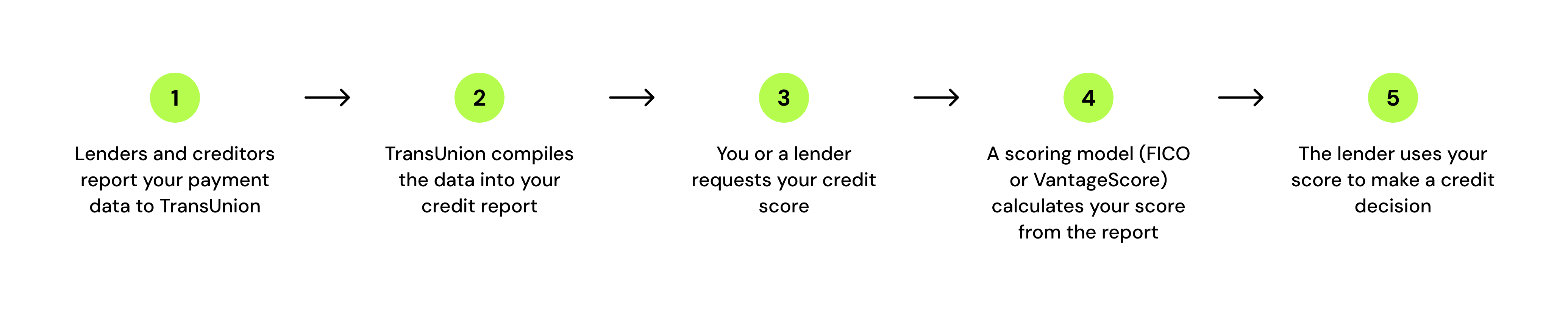
- Lenders and reporting partners send financial information to TransUnion on a regular basis
- These updates include whether you paid on time and how much your credit card balance increased
- When you apply for credit, the lender will request your score from TransUnion and the other bureaus
- Your payment history and mix of accounts influence your score
When you are consistent with your payment activity, you can establish or strengthen your credit profile over time. Some credit-building tools, such as Kikoff's products, are designed to report monthly payment activity to one or more major credit bureaus. For example, you can use Kikoff to report your on-time rent payments to TransUnion, which may not get reported otherwise.
You also have the right to review your TransUnion credit report and dispute errors. If you find any inaccurate or incomplete information, you can file a dispute.
The backstory of TransUnion
TransUnion is the youngest of the big three credit bureaus. It was founded in 1968 as a holding company for Union Tank Car Company. The following year, it acquired the Credit Bureau of Cook County. This move provided the company with access to 3.6 million credit accounts. TransUnion was an early adopter of tape-to-disc transfer technology, which helped modernize credit reporting.

In the 1970s and 1980s, the company expanded throughout the United States by acquiring several other entities. By 1988, TransUnion achieved national coverage.
In the 2010s and 2020s, TransUnion has continued to maintain its edge by investing in cutting-edge technologies and processes. It has also acquired several information groups and credit reporting firms. For example, it acquired Neustar for $3.1 billion in 2021.
TransUnion made another big move in 2023. The company rebranded thousands of business-to-business offerings into seven distinct business lines, including TruValidate and TruAudience.
How TransUnion fits into your financial strategy
TransUnion plays a central role in the U.S. credit system and in your individual financial journey. While it doesn't make lending decisions or create your score, it does gather information used to calculate your score.
If you want to shape your credit report, you'll need to engage in consistent, positive behavior, such as making payments on time. You can also get credit for positive behavior that you are already exhibiting, such as paying your rent and utility bills on time.
Kikoff is a user-friendly, free service for reporting positive financial behavior.
Frequently Asked Questions
About the editor

Disclaimer: The information provided in this blog post is meant for informational purposes only and does not constitute financial advice.