.jpg)



If you’ve been working hard to pay down debt and strengthen your credit, you’ve probably been watching your score like a hawk. However, your score won’t budge until the credit bureaus update your report. So how often do credit reports update? That depends on the bureau and the type of activity.
Unfortunately, negative activity, such as having a delinquent account sent to a collection agency or a new hard inquiry, tends to get reported more quickly. The good news is you can influence your score by taking control of your financial behavior.
Our guide unpacks the question, “How often do credit reports update?” so you have a better idea of when your hard work will show up in your score.
How often credit reports update
The answer to the question, “How often do credit reports update?” varies depending on the bureau, the lender, and the type of activity. Here’s what you need to know.
General timing
Most creditors report to the credit bureaus once a month. They will send updates shortly after your billing cycle closes. That means your balance, payment status, and account activity typically refresh every 30 to 45 days.
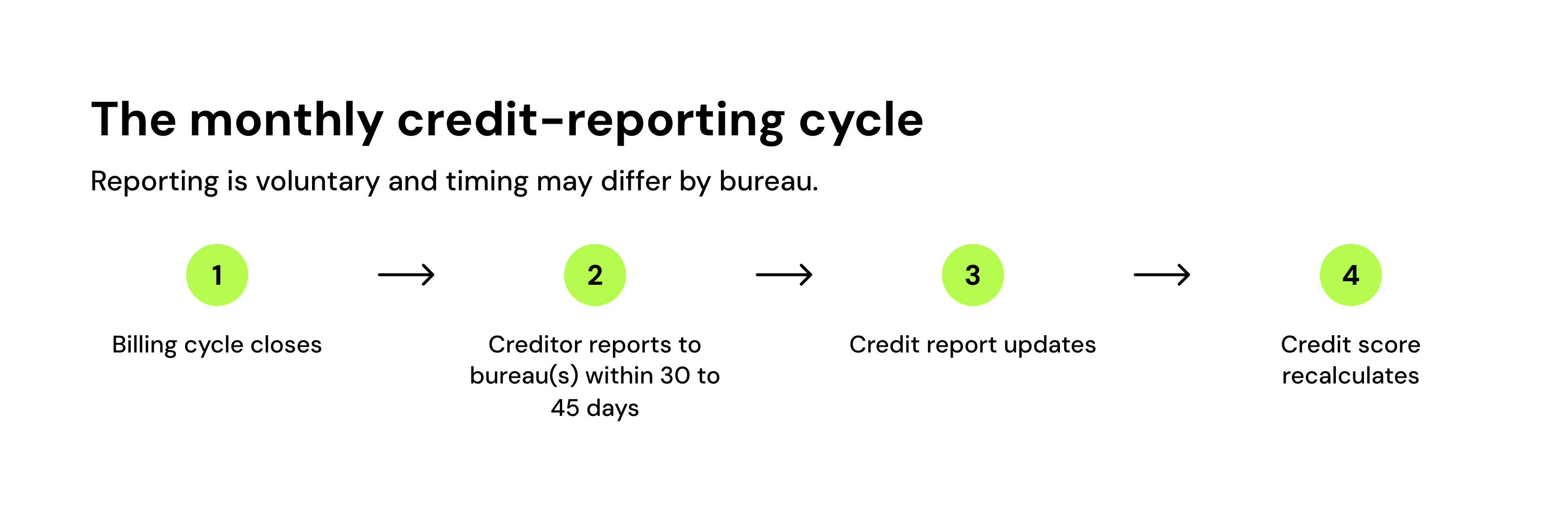
However, reporting is voluntary. Creditors are not legally required to report to all three bureaus. Some only report to one or two. Others report at different times each month. That’s why your reports and your scores may look slightly different depending on which bureau you check.
Experian
Experian typically receives updates from creditors once per billing cycle. Let’s say your credit card statement closes on the 20th. The updated balance may appear within a few days to a week after that date.
Experian will update your report as it processes new information from lenders and creditors. If a creditor reports your payment mid-cycle, your report may be updated sooner. However, most of these changes occur in accordance with your account billing cycles.
Equifax
Equifax also updates your report once per billing cycle. When lenders submit new data, the bureau will add the information to your report. Since reporting cycles differ by creditor, your Equifax report may update a few days earlier or later than your other reports.
TransUnion
Like the other bureaus, TransUnion processes information as it arrives. Some lenders may report to TransUnion, but not both of the other two bureaus. In those cases, you may see new activity appear on your TransUnion report first.
How long it takes for new activity to show up on your credit report
Most new activity appears on your report within 30 to 45 days, depending on the type of activity and when in the billing cycle it occurred. Here’s how it usually works:
- You make a payment or change your balance
- Your billing cycle closes
- The lender prepares its monthly report
- The bureau receives and processes the data
If you pay off your credit card balance on the first day of the new cycle, it may take the full 45 days to show up on your report. However, if you made the payment right before the end of a billing cycle, you may see it in a week or two after the close of that cycle.
Factors that delay credit report updates
Your report may take longer to update based on one or more of the following:
- Lender reporting schedules
- Processing times at bureaus
- Weekends and holidays
- Disputes
If your billing cycle hasn’t ended yet, be patient, as it could take some time to update your reports.
Conclusion
Most credit reports update once per billing cycle, which generally puts new activity on your report within 30 to 45 days.
The exact timing depends on your lender rather than the bureau, since reporting is voluntary and creditors submit on their own schedules. That's also why your Experian, Equifax, and TransUnion reports can look slightly different at any given moment.
You can't speed up the reporting cycle, but you can control what gets reported into it.
Kikoff gives eligible users access to a Kikoff Credit Account with no interest and no hard credit check to sign up, and reports monthly payments to all three credit bureaus.
Build credit with Kikoff and start building a positive credit history.
Frequently Asked Questions
About the editor

Disclaimer: The information provided in this blog post is meant for informational purposes only and does not constitute financial advice.