


.jpg)


If you've ever applied for a loan or checked your credit score, you've likely come across the names of the big-three credit bureaus, which include Experian. But what is Experian? For many people, it's just a name that pops up on a credit report. Most consumers don't fully understand what the company does or why it matters.
Experian is one of the major companies that power the U.S. credit system, alongside TransUnion and Equifax. Learning how it works can help you make sense of your credit report and understand why your score changes. Here's what you need to know so that you can take control of your financial future.
What is Experian?
Experian is a credit bureau. Like other credit bureaus, it collects and stores information about how you use your credit. Then, it compiles this information into a credit report.
The company can share your credit report with lenders and other authorized third parties. However, lenders typically need your express consent to obtain this report.
Experian's data can also be input into scoring models in order to calculate your credit score. The two main credit scoring models are FICO and VantageScore.
Some consumers mistakenly believe that Experian can decide whether they will be approved for a loan or line of credit. It doesn't. Instead, credit bureaus like Experian organize credit-related data, such as your payment history. They make that information available when legally permitted.
An Experian credit report can include details such as:
- Open and closed accounts
- Balances
- Credit limits
- Late payments
- Accounts in collections
- Hard inquiries
Think of Experian as a record-keeping organization. It turns all of this data into a usable record of your financial behavior.
How Experian handles your credit score
Experian supplies your credit report to scoring models, which use it to calculate your credit score. Both FICO and VantageScore use a scale that ranges from 300 to 850. The higher the score, the less risky you are viewed by lenders.
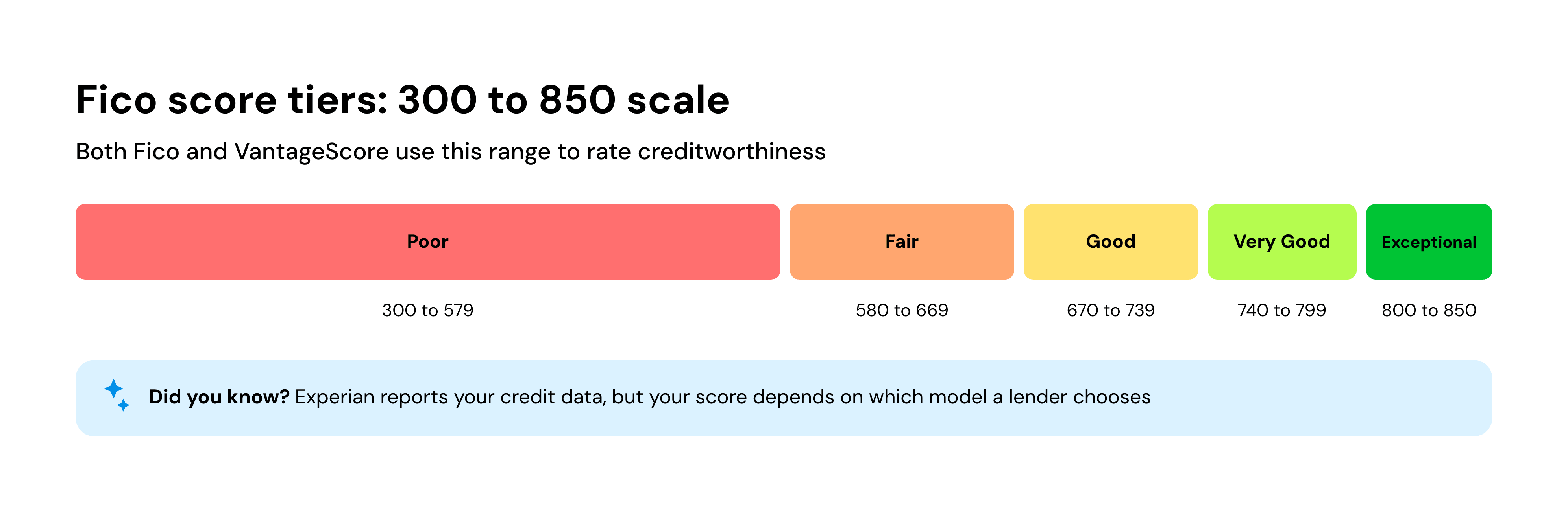
For FICO and VantageScore, your credit report is the source material. Your score is the result of analyzing that information using a specific formula.
However, some lenders don't report to all three credit bureaus. Their reporting cycles are not the same, either. As a result, your Experian report may be different from your Equifax or TransUnion report.
Lenders are aware of this discrepancy, which is why they will typically look at least two of the three reports when making lending decisions.
Experian updates your report regularly as lenders send it new information. On-time payments and new accounts typically appear within a few weeks. If you have a thin credit history or are rebuilding your credit after a setback, consistency matters. Positive activity that gets reported over time will gradually strengthen your credit file.
Unfortunately, many landlords don't report things like on-time rent payments. However, you can use a third-party reporting solution like Kikoff to get credit for paying your rent on time. Kikoff helps you establish a payment history without relying on traditional loans.
Experian: The backstory
What is Experian's backstory? The company traces its roots to 1826, when London merchants started exchanging information about customers who failed to pay their debts. One of these associations became known as the Manchester Guardian Society, which would later become part of Experian.
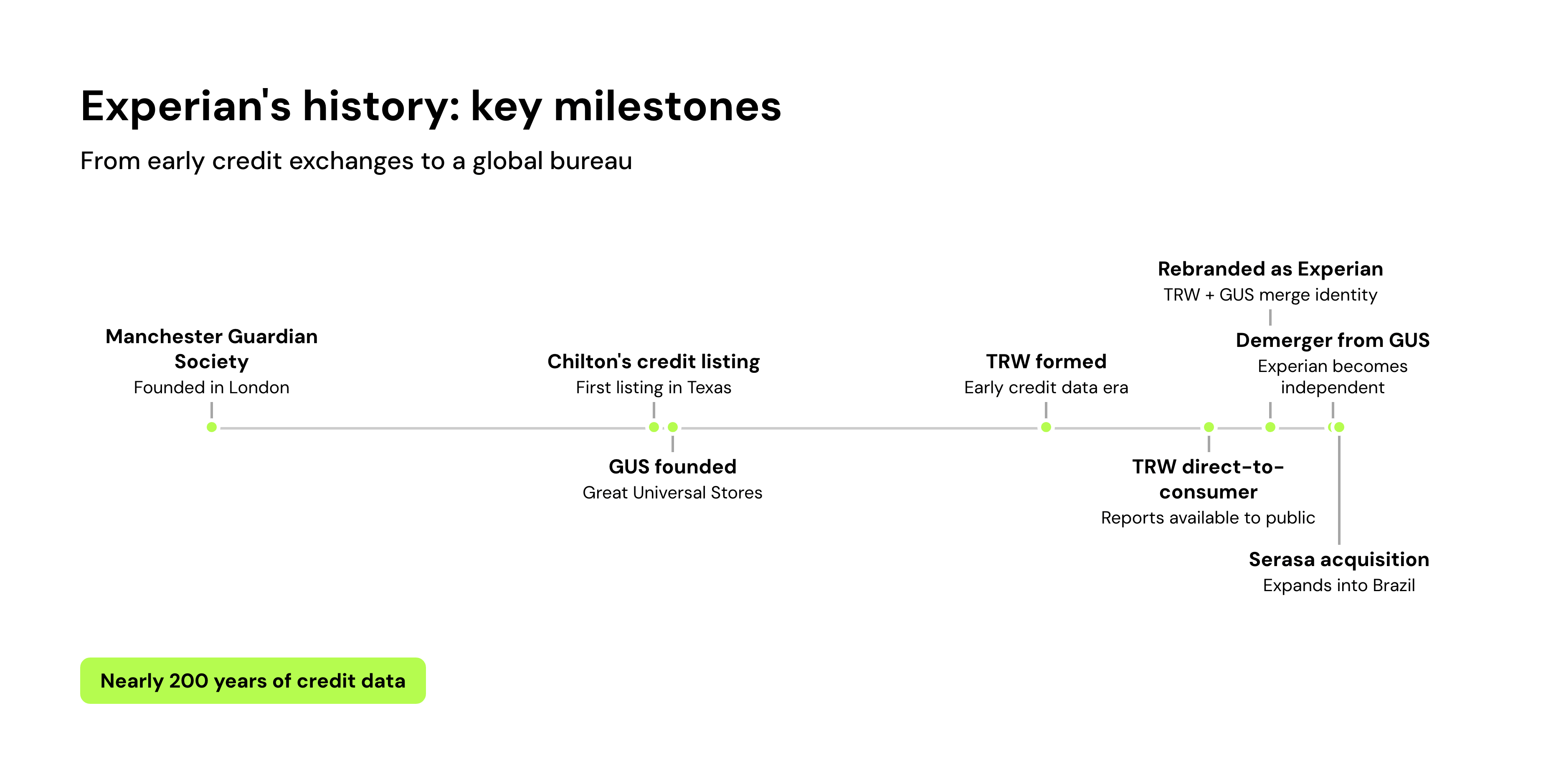
In 1897 in the United States, Jim Chilton joined a relative's law firm in Texas and began listing good and bad credit risks. He persuaded merchants to pool credit data. Chilton's business ultimately became part of Experian's U.S. wing.
In 1900, Great Universal Stores (GUS) was founded. It became one of the biggest mail-order businesses in the United Kingdom and accumulated vast amounts of data, which would serve as the starting point for Experian's U.K. operations.
In the early 1960s, Dean Wooldridge and Simon Ramo formed TRW, a partnership with Thompson Products. In 1986, TRW started exploring the direct-to-consumer market, but this model did not gain a foothold until the internet was further developed. In 1996, TRW and GUS combined and were rebranded as Experian.
In 2006, Experian demerged from GUS to become independent. In 2007, Experian took a controlling interest in Serasa, which had been the biggest credit bureau in Brazil and the fourth largest in the world.
Over the last few years, Experian has expanded its offerings to include employer services and verification. Most notably, Experian now offers a digital checking account to help consumers build credit, as well as a free auto insurance comparison tool.
How to use Experian to your advantage
Experian is a data company that plays a major role in how your credit information flows through the financial system. Now that you know what the company does, you can take a more proactive approach in managing your credit behavior to improve your score.
Ready to get started? Start building a positive credit history with Kikoff.
Frequently Asked Questions
About the editor

Disclaimer: The information provided in this blog post is meant for informational purposes only and does not constitute financial advice.