

.jpg)




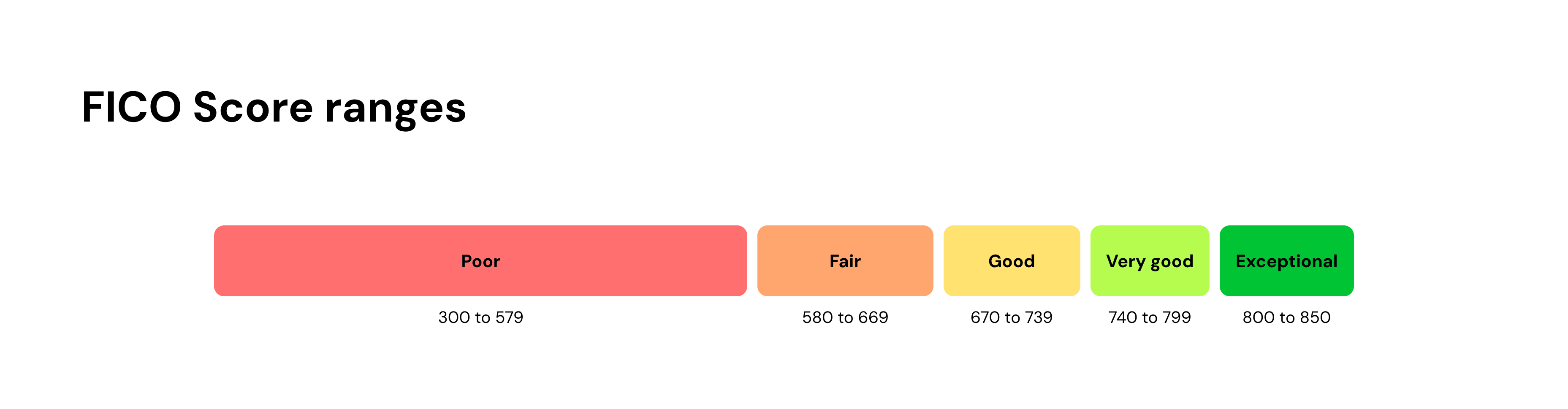
With a 651 credit score, you can likely get approved for an unsecured credit card, a personal loan, an auto loan, or a mortgage. That includes an FHA loan with 3.5% down. You'll pay more than borrowers with good credit, because your score sets your rate. At 651, you're 10 points from prime auto rates and 19 points from good credit.
Is 651 a poor credit score?
No. FICO's fair range runs from 580 to 669, so 651 sits in the upper half of it. At 670, you'd move into good credit.
A score in this part of the range usually means one or two of these factors are holding it back:
- An older late payment. A payment 30 days or more late stays on your report for seven years. Its effect on your score shrinks as it ages, especially when newer on-time payments build behind it.
- High card balances. Using a large share of your available credit lowers your score. Unlike a late payment, this changes as soon as your balances come down.
- A short or thin credit history. A thin credit file, meaning a report with only a few accounts or accounts that haven't been open long, gives scoring models less to go on.
Many lenders will work with a 651 score. What changes is the terms, including higher rates, lower limits, and, in some states, higher car insurance premiums than borrowers with good credit get.
Read more >> What Can You Get Approved For With a 665 Credit Score?
What can you get approved for with a 651 credit score?
At 651, most lenders will approve you for a range of financial products, though the price depends on the tier you land in.
Credit cards
Unsecured cards designed for fair credit are realistic with a 651 credit score, and some rewards cards may approve you. Expect a modest limit and a higher APR than cards for good credit. Before applying, check whether the issuer offers prequalification, which uses a soft credit check that doesn't affect your score.
If you're turned down, a secured credit card is a reliable option. With these cards, you put down a refundable deposit that usually becomes your credit limit. You generally get it back if you close the account in good standing or are graduated to an unsecured card with steady on-time payments.
Personal loans
A personal loan is realistic at 651, though the rate can be higher than a borrower with good credit would get. Your rate also depends on your income, your debt-to-income ratio (DTI), and the loan term. Include credit unions when comparing lenders: Federal credit unions can't charge more than 18% on most loans.
Online lenders and banks that work with fair credit are another option. Compare offers using prequalification, so only the lender you choose runs a hard credit check.
Auto loans
Approval for a car loan at 651 is usually straightforward, because the loan is secured by the vehicle you're buying. If you stop paying, the lender can take it back and sell it. That lowers the lender's risk, but it also means falling behind puts your car at risk.
A 651 score falls in Experian's near prime tier (601 to 660). Your credit score plays a major role in the interest rate you're offered on a car loan. On a $20,000, 60-month new car loan at average rates, a near prime borrower would pay about $3,000 more in interest than a super prime borrower, and about $2,000 more than a prime borrower. Experian sorts these tiers by VantageScore 4.0, so your FICO score may place you a little differently.
At 651, the prime tier starts 10 points away, at 661. If you can wait to buy, that gap may be worth closing first.
Use an auto loan calculator to check payment amounts before you sign.
Mortgages
With a 651 credit score, mortgages are within reach, with costs depending on the type:
- FHA loans. Borrowers with scores of 580 or higher can qualify with 3.5% down. On a $250,000 home, that's $8,750 up front. Each lender can set higher minimums.
- Conventional loans. Fannie Mae no longer sets a minimum score for loans run through its automated system, but lenders still set their own minimums. Fannie Mae does charge lenders an upfront fee on the loans it buys, based on your score and down payment. At 20% down, the fee for scores of 640 to 659 is 2.25% of the loan amount, compared with 0.375% at 780 or higher. On a $200,000 loan, that's $4,500 versus $750, and you'd pay it through a higher rate or more cash at closing. At 660, 9 points away, the fee drops to 1.875%, or $3,750.
- USDA loans. These are for homes in eligible rural and suburban areas with income limits. USDA doesn't set a minimum score, but lenders typically look for 620 to 640. At 651, you're above that range, though each lender sets its own.
A lender can show you an FHA and a conventional quote side by side. Our mortgage calculator can help you compare the monthly payments.
What interest rates can you expect with a 651 credit score?
Expect rates above what borrowers with good credit get. The Federal Reserve's averages across all borrowers were 22.15% for card accounts charging interest and 11.86% for 24-month bank personal loans. Those averages cover borrowers at every credit level. With a 651 score, your offers may come in at or above them.
The rate applies to the whole balance, so a few points add up. If you can wait to borrow, 10 points would move you into Experian's prime tier for auto loans, and 19 would get you to good credit.
5 ways to raise a 651 credit score
- Check your credit reports for errors. You can get all three for free every week at AnnualCreditReport.com. If something is wrong, like an account that isn't yours or a late payment you made on time, dispute it with the bureau. Disputing is free.
- Pay every bill on time. Payment history is the biggest factor in your score, making up 35% of a FICO Score.
- Bring down card balances before your statement closes. Your issuer usually reports the statement balance, so using less of your available credit on that date can raise your score as soon as the lower balance is reported.
- Apply only when you need to. Each application can add a hard inquiry, which takes a few points off for about a year. Prequalify first where you can.
- Shop for rates within a tight window. FICO counts multiple auto, mortgage, or student loan inquiries made within a period of 14 to 45 days as one, depending on the FICO version. Credit card and personal loan applications each count separately.
If your report is thin on accounts, adding one helps. A Kikoff Credit Account reports your payments to all three bureaus.
Read more >> How to Build Credit
Bottom line
At 651, most lenders will approve you for a range of products. What your score decides now is the price. You're 10 points from prime auto rates and 19 points from good credit in FICO's ranges, so small gains can lower what you pay.
Kikoff brings credit building, bill and rent reporting, AI-powered disputes, credit monitoring, and debt negotiation into one place. Sign up with no credit check. Plans start at $5 a month.
Frequently Asked Questions
Article Sources
Disclaimer: The information provided in this blog post is meant for informational purposes only and does not constitute financial advice.