.jpg)
.jpg)



Missing a credit card payment can lead to a late fee and additional interest. If the account becomes 30 days past due and the issuer reports it, the late payment may also hurt your credit.
If you have missed a due date, check your account and pay the amount needed to bring it current as soon as you can. You can also call the card issuer to ask about a fee waiver, hardship assistance, or a payment plan.
What happens when you miss a credit card payment?
The exact consequences depend on your card agreement and how long the account remains past due. Here is a general timeline:
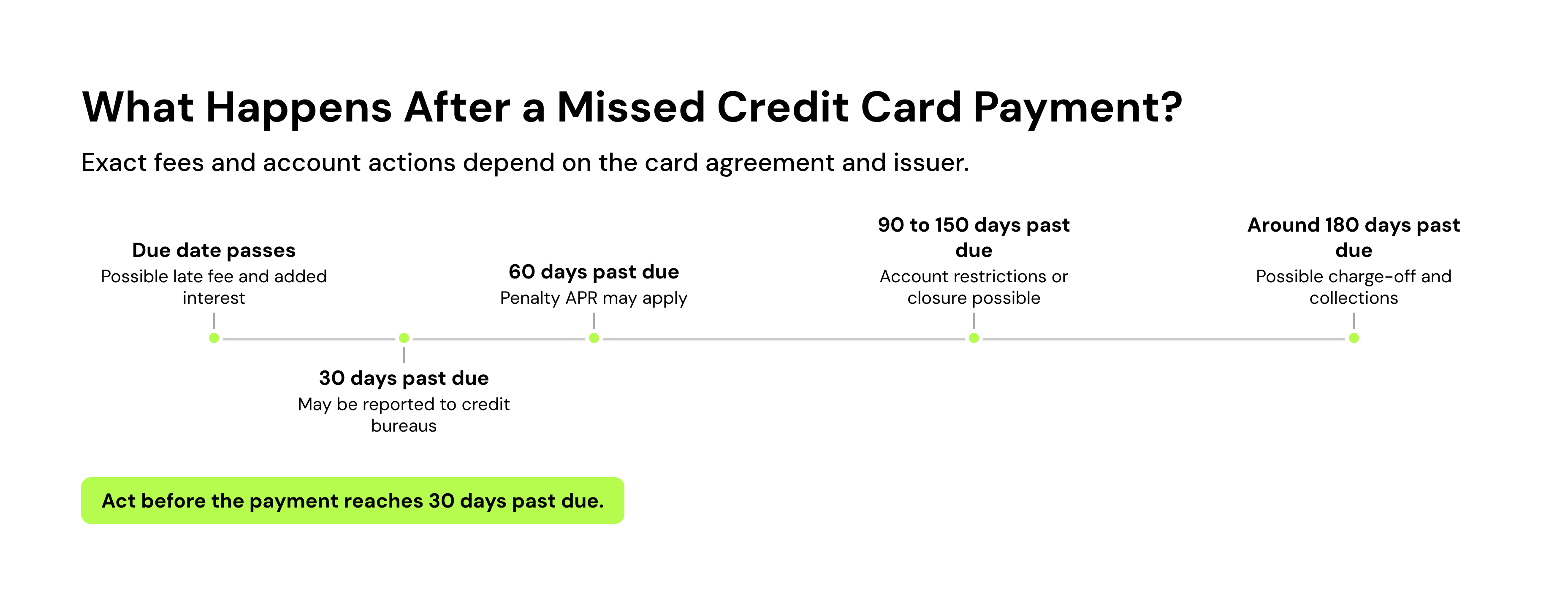
- After the due date: Your issuer may charge a late fee. You may also continue to accrue interest and, depending on your card terms, lose the grace period on new purchases. A credit card payment generally must be received by the issuer’s cutoff time on the due date to be considered on time. The Consumer Financial Protection Bureau (CFPB) says that cutoff generally cannot be earlier than 5 p.m.
- 30 days past due: The issuer may report the late payment to the credit bureaus. Card issuers typically do not report a payment as late before it is 30 days past due, according to Experian’s guidance on account status, although you may still owe a late fee before then.
- 60 days past due: The issuer may apply a penalty annual percentage rate (APR) to your existing balance if your agreement allows it. Federal rules permit this increase when the minimum payment is not received within 60 days after its due date.
- 90 to 150 days past due: The issuer may restrict or close the account, continue collection efforts, and keep reporting the worsening delinquency.
- Around 180 days past due: Credit card accounts are generally charged off. A charge-off is an accounting action, not debt forgiveness. You still owe the balance, and the creditor may collect it or transfer or sell it to a collection agency. Federal banking guidance generally calls for open-end credit to be charged off at 180 days past due.
Important: A late fee and a reported late payment are separate consequences. You could owe a late fee soon after the due date even if the payment has not been reported to the credit bureaus.
Read more >> What Happens If You Don’t Pay Your Credit Card?
How a missed credit card payment can affect your credit
Payment history is an important credit-scoring factor, but a payment that is only a few days late generally will not appear as a late payment on your credit reports. If the account becomes at least 30 days past due and the issuer reports it, your credit scores may decline.
There is no universal point loss. The effect depends on the scoring model and the rest of your credit profile. A 60-day or 90-day delinquency is generally more serious than a single 30-day delinquency, and repeated late payments can cause additional harm.
An accurate late payment may generally remain on your credit reports for up to seven years, according to the CFPB’s guidance on negative credit-report information. Paying the account current does not erase an accurate late-payment record, but it can stop the account from becoming more delinquent.
Credit reporting is voluntary, so creditors are not required to report every account or every payment to the nationwide credit bureaus. Check your credit reports rather than assuming that every payment action appears immediately.
Late fees, interest, and penalty APRs
A card issuer may charge a late fee even if this is your first late payment. The amount depends on your card agreement and applicable law, so review your statement or card terms instead of relying on a standard dollar estimate. You can also call the issuer and ask whether it will waive the fee, especially if you normally pay on time.
Interest can continue to accrue while a balance is unpaid. If your payment becomes more than 60 days late, the issuer may apply a penalty APR to the existing balance. After the penalty rate takes effect, the issuer generally must restore the prior rate on that balance after you make six consecutive minimum payments on time. Other balances or new transactions may be treated differently under your agreement.
Read more >> What Is the Credit CARD Act of 2009?
What to do after missing a payment
Check the amount needed to bring the account current
Log in to your account or contact the issuer to confirm what you need to pay. The amount may include the missed minimum payment, a new minimum payment, and fees. Pay as soon as you can because waiting may increase interest charges and move the account into a more serious delinquency category.
If you cannot pay the full amount shown, contact the issuer before sending a partial payment. Ask what amount is required to prevent the account from becoming further past due and whether assistance is available.
Call your card issuer
Explain your situation and ask about available options. Depending on the issuer and your account history, you may be able to request:
- A one-time late-fee waiver
- A due-date change
- A short-term payment arrangement
- A hardship program with modified payments or interest
Get the terms in writing when possible, and ask how the arrangement may affect your account status and credit reporting.
Review your credit reports
If the account reached 30 days past due, review your credit reports at AnnualCreditReport.com. If the issuer reported inaccurate information, dispute the error with the credit bureau and the company that furnished the information. Do not dispute an accurate late payment simply because it is harmful to your credit.
Set up reminders or autopay
Autopay can help prevent future missed payments. Consider setting it for at least the minimum amount due, then make additional payments manually if you can. Keep enough money in the linked account and confirm that each payment was processed. Calendar or account alerts can provide an extra safeguard.
How to rebuild positive payment history
One late payment does not prevent you from making progress. Focus on actions you can sustain:
- Bring past-due accounts current and keep them current
- Pay every bill by its due date
- Keep credit card balances low relative to their limits
- Avoid taking on payments you cannot comfortably manage
- Check your credit reports for errors
There is no standard recovery timeline because credit-scoring models and credit profiles vary. As the late payment ages and you add more positive information, its effect may lessen.
Kikoff’s Credit Account reports your on-time payments to all three major credit bureaus, with no hard credit check to join. Each on-time payment can add positive payment history to your credit profile, but individual credit outcomes vary.
Bottom line
A missed due date can trigger a fee, but credit-reporting consequences may begin if the account reaches 30 days past due and the issuer reports it. Pay the amount needed to bring the account current as soon as possible, contact the issuer if you need help, and verify any reported information on your credit reports. Acting early can help keep one missed payment from turning into a longer delinquency.
Frequently Asked Questions
Article Sources
Disclaimer: The information provided in this blog post is meant for informational purposes only and does not constitute financial advice.