


.jpg)




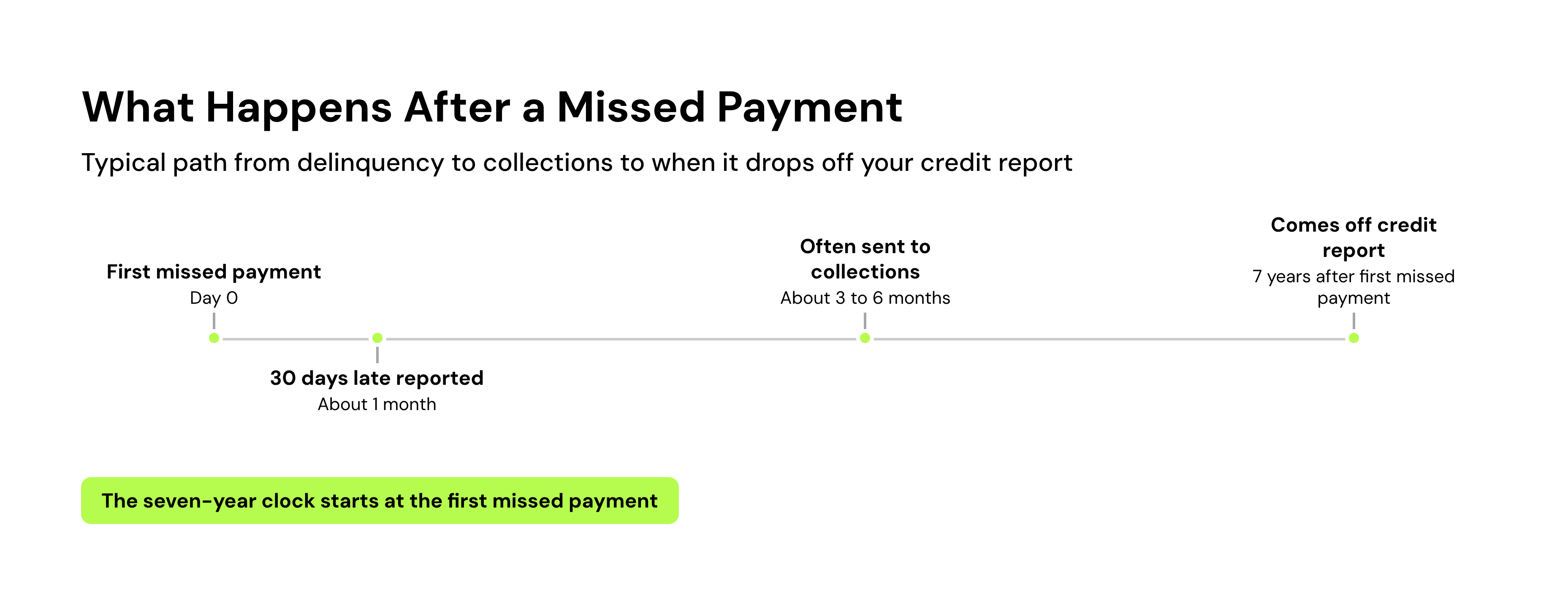
A collection account generally stays on your credit report for seven years. Paying it usually doesn’t shorten that. When it comes off depends on one date: the day you first fell behind on the original debt. The date a collector took over doesn’t change it.
When the seven-year clock starts
A collection comes off your report up to seven years after the original delinquency date, according to Experian. That’s the date you first missed a payment on the original account and never caught up.
Here’s how that works: Say you miss your credit card payments in June and July, then catch up in August. You miss again in September and never catch up. If the card issuer sells the debt to a collector, the seven years start from the September missed payment. When they’re up, both the original credit card account and the collection account come off your report.
That seven-year limit comes from the Fair Credit Reporting Act (FCRA). Most other negative items, including late or missed payments, follow the same rule. Bankruptcies can stay on your report for up to 10 years.
Read more >> How to Remove Derogatory Marks on Your Credit Report
Do paid collections fall off sooner?
Usually not. Paying a collection changes its status to “paid,” but the account stays on your report for the full seven years.
Medical debt is the exception. Equifax, Experian, and TransUnion announced in 2022 that paid medical debts, medical debts less than a year old, and medical debt under $500 would no longer appear on credit reports, according to the Congressional Research Service. That’s the bureaus’ own policy, not a federal law. A 2025 federal rule that would have removed all medical debt from credit reports was vacated by a court in July 2025.
A medical debt that doesn’t appear on your report may still be a debt you owe, and a collector can still try to collect it.
Paying can still help your score
Even when a paid collection stays on your report, some scoring models stop counting it.
FICO Scores 9 and 10 and VantageScore 3.0 and 4.0 ignore paid collections, according to Experian. FICO Score 8, the most widely used scoring model, counts collections whether they’re paid or not.
How collections affect your credit score over time
A collection usually hurts your score most when it first appears. As it gets older, it counts for less, especially if the rest of your report shows on-time payments.
Waiting doesn’t add anything positive, though. What offsets an older collection is newer history: accounts in good standing and payments made on time.
How to remove collections from your credit report
You generally can’t remove a collection that’s accurate. If one is wrong, you can dispute it. For example, it might not be your debt, the amount might be off, or the delinquency date might be later than when you actually fell behind (a later date keeps it on your report longer). File with each credit bureau that lists it, and with the collector. Disputing with the bureaus is free. If you’d rather not file each dispute yourself, Kikoff AI Credit Disputes can help with the process.
You may have heard of “pay-for-delete” agreements, where you pay the debt and the collector asks the bureaus to remove the account. Collectors aren’t required to agree. If one does, get the agreement in writing before you pay.
Check the statute of limitations before paying an old debt
Each state sets a deadline, called the statute of limitations, for how long a collector can sue you over a debt. In some states, making a partial payment or acknowledging you owe an old debt may restart the time period, according to the CFPB. It doesn’t restart the seven-year credit reporting clock, but it can give the collector more time to sue.
Because these rules vary by state, your state attorney general’s office can help you determine legal rights where you live. For advice on whether to pay a specific debt, talk with a licensed attorney, a local legal aid office, or a nonprofit credit counselor. The National Foundation for Credit Counseling (NFCC) offers free or low-cost counseling at 800-388-2227.
Read more >> How to Remove Collections From Your Credit Report
Bottom line
A collection generally stays on your report for seven years from the date you first fell behind, whether or not you pay it.
Its impact fades over those years, but waiting doesn’t add anything to your report. On-time payments do. A Kikoff Credit Account reports your payments to Equifax, Experian, and TransUnion, so you’re building a positive record while the collection ages. There’s no credit check to sign up, and plans start at $5 a month.
Frequently Asked Questions
Article Sources
Disclaimer: The information provided in this blog post is meant for informational purposes only and does not constitute financial advice.