


.jpg)



If you've applied for credit recently, your lender probably checked your credit report. But did you know that this can affect your credit score?
Many lenders will do what's called a "soft inquiry" or "soft pull" when pre-approving you for credit cards or other credit products. However, when you formally apply, they perform a "hard inquiry" or "hard pull." Hard inquiries are unavoidable when you apply for new credit, but it's important to understand the impact they have on your credit score.
So what are hard inquiries, and why do they matter? Here's a closer look.
What are hard inquiries on a credit report?
What are hard inquiries used for? Before a lender extends credit to you, they want to see how much of a risk you'll be. A hard inquiry lets them access your credit file so they can see your payment history, how much of your available credit you're using, and other key information.
If someone asked you to lend them money, you'd probably want to make sure they were going to pay you back. You might ask your mutual friends to see if this person has ever promised to repay money and then failed to do so. For lenders, hard inquiries work similarly.
What is a hard credit check vs. a soft credit check?
A "soft inquiry" is a credit check that doesn't impact your credit score. Soft inquiries are usually conducted for reasons other than lending you money. Someone may run a soft inquiry in these situations:
- When you apply for housing
- When you set up utilities at a new address
- When you purchase insurance
- When you check your own credit
Many financial companies will also do a soft inquiry as part of the pre-approval process for loans and credit cards. If you don't qualify, your credit score won't be impacted. If you do pre-qualify, the lender will usually run a hard inquiry as part of the application process.
Why hard inquiries impact your credit score
Hard inquiries will generally cause a temporary drop in your credit report. A single hard inquiry will usually lower your score by five points or less.
You might be surprised to hear that a hard inquiry would lower your score. After all, you're not making a late payment or running up a credit card. A hard inquiry lowers your score because it signals to lenders that you're trying to take on new credit (and possibly new debt). When you take on more debt, you might be riskier to lend to.
A single hard inquiry doesn't do much damage to your credit score, but multiple hard inquiries in a short amount of time can. If you're applying for multiple accounts at almost the same time, lenders may think you're desperate for credit.
Applying for one credit card will only have a slight impact on your credit score, but if you apply for five different cards in a month, the impact on your credit will likely be much greater.
There is one notable exception: rate shopping. If you're applying for a mortgage, car loan, or student loan and put in applications with multiple lenders, the multiple hard inquiries will usually be counted as one inquiry.
However, you'll need to make sure that you complete all applications within a set timeframe. Newer FICO scoring models consolidate hard inquiries within 45 days of each other, and older models consolidate hard inquiries within 14 days of each other.
It's important to note that only hard inquiries of the same type will be consolidated. For example, if you apply for five car loans in a week, your credit report will show one hard inquiry. If you apply for five car loans and a personal loan in a week, your report will show two hard inquiries.
How often to run hard inquiries
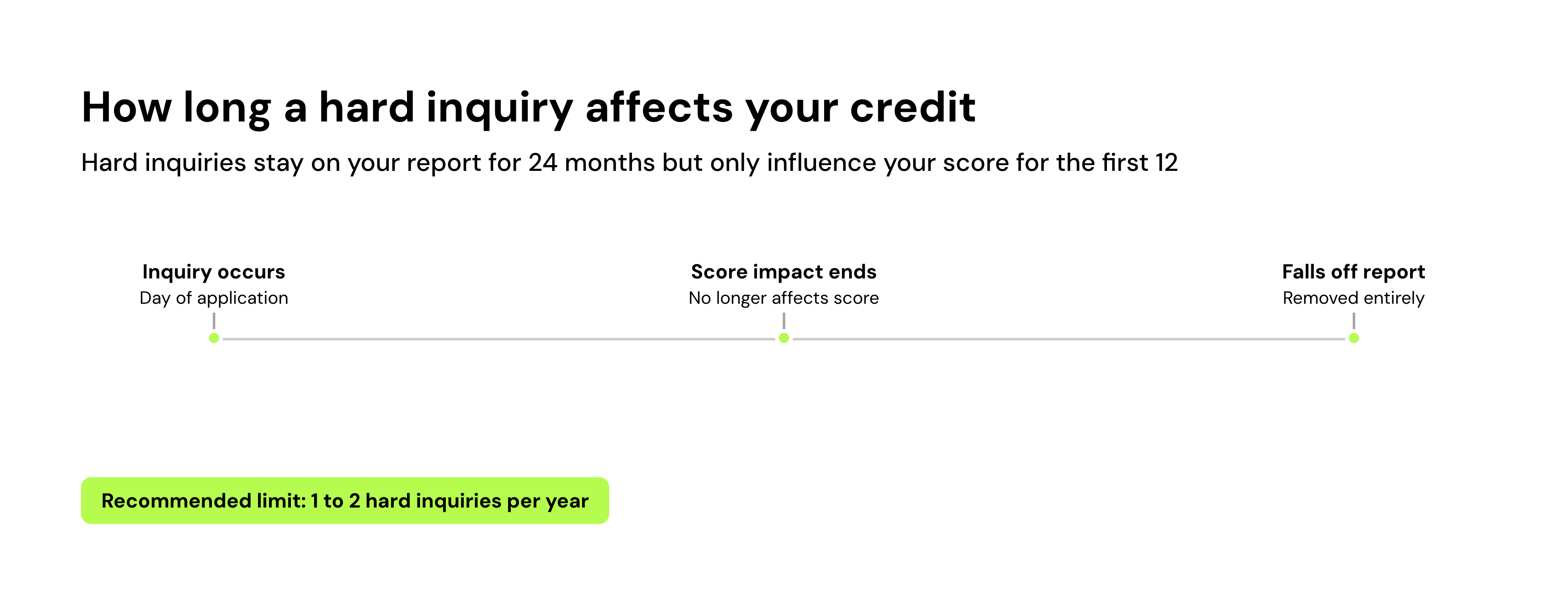
Hard inquiries will stay on your credit report for two years. However, they usually will only impact your credit score for a year. As a general rule of thumb, you should limit hard inquiries to one to two per year to minimize damage to your credit score.
Examples of hard inquiries
What are hard inquiries used for? These are some situations that almost always trigger a hard credit check:
Applying for a credit card
The right credit card can help you build credit, but the initial hard inquiry might temporarily lower your score.
Want to build credit without a hard inquiry? Kikoff is a credit-builder app that doesn't check your credit to start. If you have bad credit or no credit at all, we're here to help.
Applying for a mortgage
For many people, buying a house is the most significant purchase they'll ever make. Before committing to a mortgage, lenders want to verify that a homebuyer will be able to pay off the loan.
Applying for a car loan or personal loan
When you're approved for a loan, the lender pays out immediately. A hard credit check helps them determine how risky you are to lend to and set an appropriate rate. Your credit score plays a major role in the rate you'll receive on a car loan.
Conclusion
The world of credit can be confusing and difficult to navigate, especially if you're new to it. That's why we're here. Kikoff is a credit-builder app that could help you rebuild your credit or establish it for the first time.
Once you're approved (with no credit check!), you get a small credit line. You make purchases in the Kikoff store and pay them off, and we report your payments to credit bureaus. If you're ready to start building, open an account with Kikoff today!
Frequently Asked Questions
About the editor

Disclaimer: The information provided in this blog post is meant for informational purposes only and does not constitute financial advice.