.jpg)
.jpg)


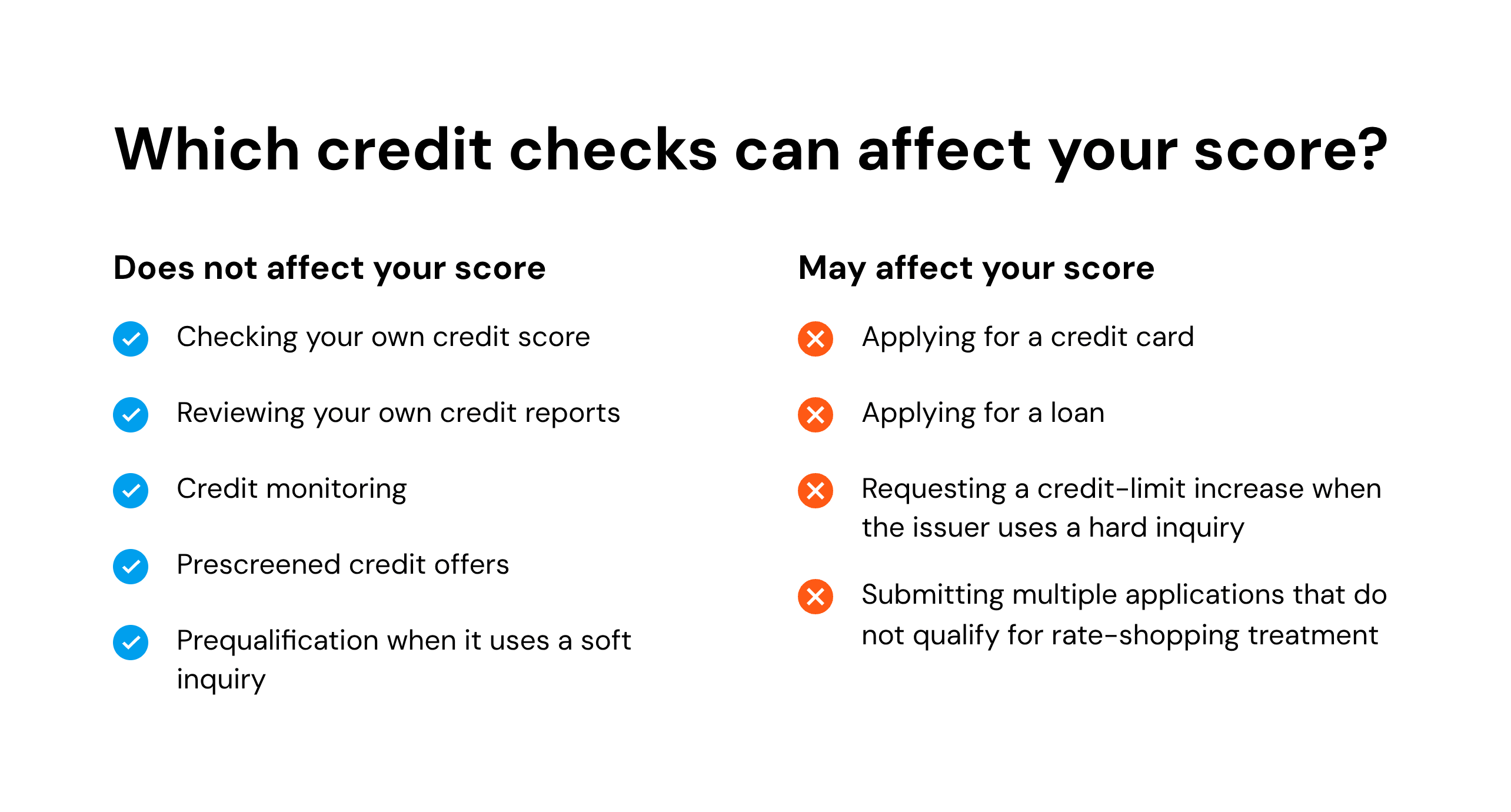
Checking your own credit score does not lower it. When you review your score or credit reports through a bank, credit bureau, or monitoring service, the request is generally recorded as a soft inquiry, which does not affect your scores.
A lender may perform a hard inquiry when you apply for credit. That type of check can affect a score, although the impact varies by scoring model and credit profile.
Does checking your credit score lower it?
No. Checking your own credit score is not an application for new credit, so it does not lower your score.
The same is true when you request your own credit reports. The Consumer Financial Protection Bureau confirms that reviewing your own reports has no effect on your scores.
If your score changes shortly after you check it, the timing is usually coincidental. A recently reported balance, payment, account, inquiry, or other update may have reached your credit file around the same time.
The score itself can also vary because:
- The provider uses a different scoring model
- The score is based on data from a different credit bureau
- One bureau received updated account information before another
- The score was calculated on a different date
A credit score is a snapshot based on a particular model and the credit-report information available at that moment. Seeing different numbers does not necessarily mean that one is wrong.
Credit score and credit report are not the same: Your credit reports contain account and payment information. A scoring model uses information from one of those reports to calculate a score.
What is the difference between hard and soft inquiries?
A credit inquiry occurs when someone accesses your credit report. Whether it affects your score depends on why the report was accessed.
| What to compare | Soft inquiry | Hard inquiry |
|---|---|---|
| Why it happens | The report is reviewed without a full application for new credit. | A lender reviews your credit after you apply. |
| Common examples | Checking your own credit, account reviews, prescreened offers, and some prequalification tools | Applications for credit cards, mortgages, auto loans, student loans, or other credit |
| Effect on your score | Does not affect your score | May affect your score |
| Who can see it | Generally visible only to you on your report | May be visible to lenders reviewing your report |
Prequalification often uses a soft inquiry, but do not assume that every eligibility tool works the same way. Check the disclosure or ask the company whether it will perform a hard inquiry before submitting your information.
Read more >> What Is the Fair Credit Reporting Act?
How lenders’ credit checks affect your score
When you formally apply for a credit card or loan, the lender will generally perform a hard inquiry. Hard inquiries may affect your score because scoring models consider how recently and frequently you have applied for credit.
The effect of one inquiry is usually limited, but there is no universal point change. Its impact depends on the scoring model and the rest of your credit profile.
If you open the account, other changes may also affect your score. The new account can change the average age of your accounts, credit mix, total debt, and available revolving credit.
Rate shopping does not work the same way for every score
Credit-scoring models may group certain inquiries when you shop for one loan over a short period. The rules depend on the model and type of credit:
- Newer FICO models generally treat eligible mortgage, auto loan, and student loan inquiries made within a 45-day window as one inquiry for scoring. Older versions may use a 14-day window.
- FICO’s special treatment does not apply to personal-loan or credit-card applications.
- VantageScore 4.0 generally counts multiple major credit inquiries within a 14-day window as one inquiry.
- Each lender inquiry may still appear separately on your credit reports even when a scoring model groups them for calculation purposes.
Because you may not know which scoring model a future lender will use, keeping eligible rate shopping within 14 days is the more cautious approach.
Shopping for a credit card or personal loan? Do not assume that several applications will be grouped. Look for prequalification tools that clearly state they use a soft inquiry, then submit a full application only when you are ready.
Why did your score change after you checked it?
Your score can change when new information reaches the credit bureau, even if you have not applied for another account.
Common reasons include:
- A credit card issuer reported a new balance
- A payment changed the balance on a loan or card
- A new account or hard inquiry appeared
- An account became older
- A lender changed a credit limit
- A missed payment or collection was reported
- An error was corrected or added to the report
The creditor’s reporting schedule may not match the date you made a payment. For example, paying a card today does not guarantee that your credit reports or scores will reflect the new balance tomorrow.
You may also see a different number because you are comparing two scoring models or scores based on different bureau data. Compare the model, bureau, and calculation date before treating a change as a problem.
If the underlying report contains information you do not recognize, review all three reports and dispute inaccurate information with the bureau displaying it and the company that supplied it.
How often should you check your credit score?
You can check your score as often as you like without lowering it when the service uses a soft inquiry. For many people, checking about once a month is enough to follow meaningful changes without reacting to every small movement.
You may want to check more closely:
- Before applying for a major loan
- After paying down a large credit card balance
- After opening or closing an account
- After receiving a fraud or credit-monitoring alert
- While building credit or correcting an error
Checking a score does not replace reviewing your credit reports. You can currently request a free report from Equifax, Experian, and TransUnion every week through AnnualCreditReport.com.
Read more >> How Often Should You Check Your Credit Score?
Bottom line
Checking your own credit score or reports does not lower your score. Those reviews are soft inquiries.
A hard inquiry generally occurs after you formally apply for credit and may affect your score. Before authorizing a credit check, ask whether it will be hard or soft, especially when using a prequalification tool.
If you want help tracking changes, Kikoff Credit Monitoring can provide score monitoring and alerts, with coverage that varies by plan. Signing up does not require a hard credit inquiry, and plans currently start at $5 per month. Review the available features and terms before choosing a plan.
Frequently Asked Questions
Article Sources
Disclaimer: The information provided in this blog post is meant for informational purposes only and does not constitute financial advice.