






With a 588 credit score, you can likely get approved for a secured credit card, an auto loan, a personal loan from a credit union, or an FHA mortgage with 3.5% down. Some unsecured cards for fair credit may approve you too. You'll pay more than borrowers with stronger credit, because your score sets your rate. At 588, you're 13 points from near prime auto rates and 82 points from good credit.
Is 588 a poor credit score?
No, but only by 8 points. FICO's fair range runs from 580 to 669, so 588 sits near the bottom of it. Good credit starts at 670.
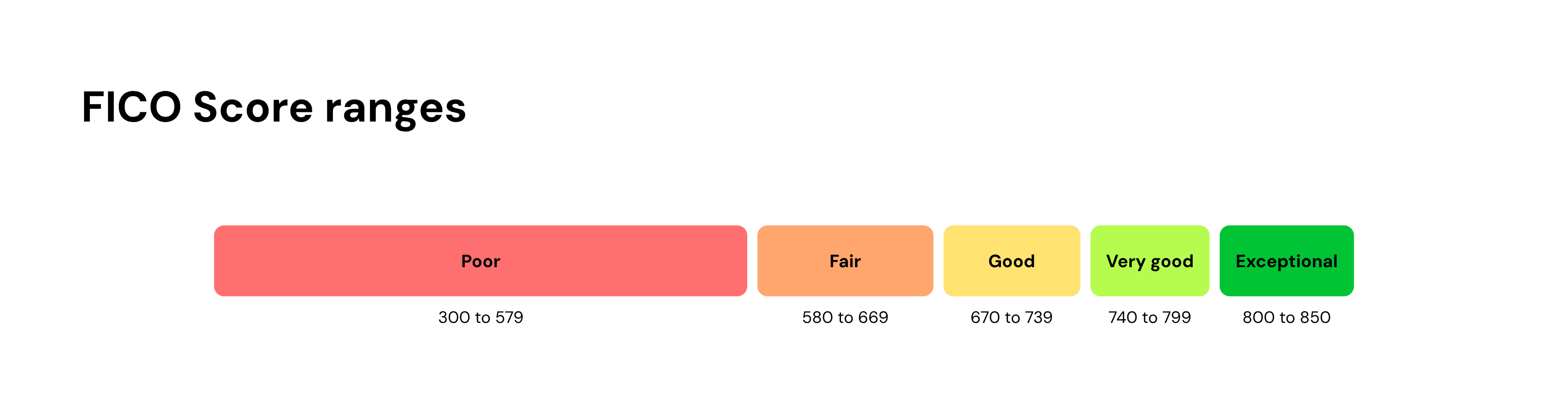
A score this close to poor usually means your credit report shows one or more of these issues:
- Late payments. A payment 30 days late gets reported and stays on your report for seven years. Its effect on your score shrinks as it ages, especially when newer on-time payments build behind it.
- Accounts in collections. This is a debt handed off to a collection agency, often a medical bill or an old card balance. A collection also stays for seven years, counted from the original delinquency.
- High card balances. Using a large share of your available credit lowers your score. Unlike a late payment, this changes as soon as your balances come down.
Many lenders will work with a 588 score, though some will treat it much like poor credit. What changes is the terms: higher rates, lower limits, bigger deposits, and, in some states, higher car insurance premiums than borrowers with good credit get.
Read more >> What Can You Get Approved For With a 620 Credit Score?
What can you get approved for with a 588 credit score?
At 588, more products are open to you than below 580, but prices run high.
Credit cards
Some unsecured cards designed for fair credit will consider a 588 score, but near the bottom of the range, approval isn't guaranteed. If you're approved, expect a modest limit and a higher APR than cards for good credit. Before applying, check whether the issuer offers prequalification. It uses a soft credit check, so it won't add a hard inquiry to your report.
A secured credit card is your most likely approval. You put down a refundable deposit that usually becomes your credit limit. A $500 deposit, for example, gets you a $500 limit. You generally get it back if you close the account in good standing or are graduated to an unsecured card after steady on-time payments.
Personal loans
A personal loan is a realistic option at 588, but it's harder to get than at a higher fair score. Expect a smaller amount and a higher rate than a borrower with good credit would get.
Start with a credit union if you belong to one or can join. Federal credit unions can't charge more than 18% on most loans. Some also offer payday alternative loans (PALs) of up to $2,000, repaid over one to 12 months. Application fees are capped at $20, and rates are capped at 28%.
Online lenders that work with fair credit are another option, though their rates can run higher. Compare offers through prequalification. It's a soft check, so only the lender you choose runs a hard credit check. Any of these is cheaper than a payday loan, where a typical $15 fee per $100 borrowed works out to an APR of nearly 400%.
Auto loans
Approval for a car loan with a 588 credit score is often easier than approval for a personal loan with the same score. That's because your car is the collateral: If you stop paying, the lender can take it back and sell it to cover the loan. That lowers the lender's risk, but it also means falling behind puts your car at risk.
A 588 score falls in Experian's subprime tier (501 to 600). Your credit score plays a major role in the interest rate you're offered on a car loan. On a $20,000, 60-month new car loan at average rates, a subprime borrower would pay about $5,300 more in interest than a super prime borrower, and about $4,300 more than a prime borrower. Experian's near prime tier starts at 601, 13 points above 588. Experian sorts these tiers by VantageScore 4.0, so your FICO score may place you a little differently.
If banks and credit unions turn you down, buy here, pay here dealers finance cars themselves. They often require weekly or biweekly payments and charge much higher rates than traditional loans.
Use an auto loan calculator to check payment amounts before you sign.
Mortgages
With a 588 credit score, a mortgage is within reach, but the type matters:
- FHA loans. Borrowers with scores of 580 or higher can qualify with 3.5% down. On a $250,000 home, that's $8,750 up front. At 588, you're 8 points above that line. Below 580, the minimum rises to 10% down. Each lender can set higher minimums.
- Conventional loans. Fannie Mae no longer sets a minimum score for loans run through its automated system, but lenders still set their own minimums, so a conventional loan is less likely at 588. Fannie Mae also charges lenders an upfront fee on the loans it buys, based on your score and down payment. At 20% down, the fee for scores of 639 and below is 2.75% of the loan amount, compared with 0.375% at 780 or higher. On a $200,000 loan, that's $5,500 versus $750, paid through a higher rate or more cash at closing. The next fee band starts at 640, at 2.25%, which would save $1,000 on a $200,000 loan.
- USDA loans. These are for homes in eligible rural and suburban areas with income limits. USDA doesn't set a minimum score, but lenders typically look for 620 to 640. At 588, you're below that range.
A lender can show you an FHA and a conventional quote side by side. Our mortgage calculator can help you compare the monthly payments.
What interest rates can you expect with a 588 credit score?
Expect rates toward the high end of the range a lender offers. According to the Federal Reserve's G.19 release, the average rate on credit card accounts charging interest is 22.15%, and the average 24-month bank personal loan is 11.86%. Those averages cover borrowers at every credit level. With a 588 score, your offers are likely to come in above them.
The rate applies to the whole balance, so a few points add up. If you can wait to borrow, 13 more points would put you in Experian's near prime auto tier, which starts at 601.
5 ways to raise a 588 credit score
- Check your credit reports for errors. You can get all three for free every week at AnnualCreditReport.com. If something is wrong, like an account that isn't yours or a late payment you made on time, dispute it with the bureau. Disputing is free.
- Bring past-due accounts current, if you can. For accounts already in collections, it can be hard to know which to pay first. The National Foundation for Credit Counseling (NFCC) can connect you to free or low-cost counseling at 800-388-2227.
- Pay every bill on time. Payment history is the biggest factor in your score, making up 35% of a FICO Score.
- Pay down card balances. Using less of your available credit can raise your score as soon as your issuer reports the lower balance, which makes it a fast way to close a small gap.
- Apply only when you need to. Each application can add a hard inquiry, which takes a few points off for about a year. Prequalify first where you can, since prequalification uses a soft check.
If your report is thin on accounts, adding one helps. A Kikoff Credit Account reports your payments to all three bureaus.
Read more >> How to Build Credit
Bottom line
At 588, you've cleared the 580 line that opens FHA loans with 3.5% down, and many lenders will approve you for secured cards, auto loans, and credit union loans. What your score mostly decides now is the price. Another 13 points would put you in Experian's near prime auto tier, and 82 would get you to good credit in FICO's ranges.
Kikoff brings credit building, bill and rent reporting, AI-powered disputes, credit monitoring, and debt negotiation into one place. Sign up with no credit check. Plans start at $5 a month.
Frequently Asked Questions
Article Sources
Disclaimer: The information provided in this blog post is meant for informational purposes only and does not constitute financial advice.