



You can get a debt consolidation loan with poor credit, especially from a credit union or an online lender that works with lower scores. The real question is whether the loan you qualify for costs less than the debt you already have. With a lower score, the rate and fees can be high enough to erode any savings.
Can you get a debt consolidation loan with bad credit?
Often, yes, but requirements vary by lender and loan type. Here are the typical minimums and what lenders weigh along with your score.
Your credit score isn’t looked at in isolation. Instead, you can expect lenders to consider your overall credit profile. You may have a harder time qualifying if you have:
- Negative marks on your credit report, such as late payments or accounts in collections.
- A high debt-to-income ratio
- High credit card balances compared with your limits
- Income that’s irregular or hard to document
Read more >> What Is Debt Consolidation? How It Works and When It Pays
Where to get a debt consolidation loan with bad credit
Traditional banks may be harder to qualify with, but you might find approval for a debt consolidation loan from an online lender or credit union. No matter where you apply, be sure to shop around. Each lender is unique when it comes to interest rates, fees, and borrowing limits.
- Online lenders: Some online lenders are willing to work with borrowers with bad credit. It might also be possible to get prequalified with no hard credit check. If you’re approved, you could get your money relatively quickly.
- Credit unions: Credit unions are not-for-profit and owned by their members. Federal credit unions can’t charge more than 18% APR on most loans through at least September 10, 2027, and payday alternative loans are capped at 28%. You’ll need to become a member first. Search for one near you through the NCUA.
If you can’t qualify on your credit, a secured loan may be easier to get. That could be a personal loan backed by your car or savings, or a home equity loan or HELOC backed by your home. Collateral lowers the lender’s risk, but it shifts that risk onto you. If you fall behind, the lender can repossess your car or foreclose on your home.
Turning credit card debt into debt secured by your house is hard to undo. A licensed attorney or nonprofit credit counselor can help you weigh what you’d save against the risk.
Read more >> Should You Consolidate Credit Card Debt?
Shop around without lowering your score
Prequalifying usually uses a soft inquiry, which doesn’t affect your credit score. That makes it the safe way to compare offers, so prequalify with several lenders. When you find the best offer, submit a full application to just that one. Each full application can count as its own hard inquiry.
What to watch out for with bad credit debt consolidation loans
The goal of debt consolidation is to save money and potentially get debt-free faster. Be on the lookout for these possible downsides:
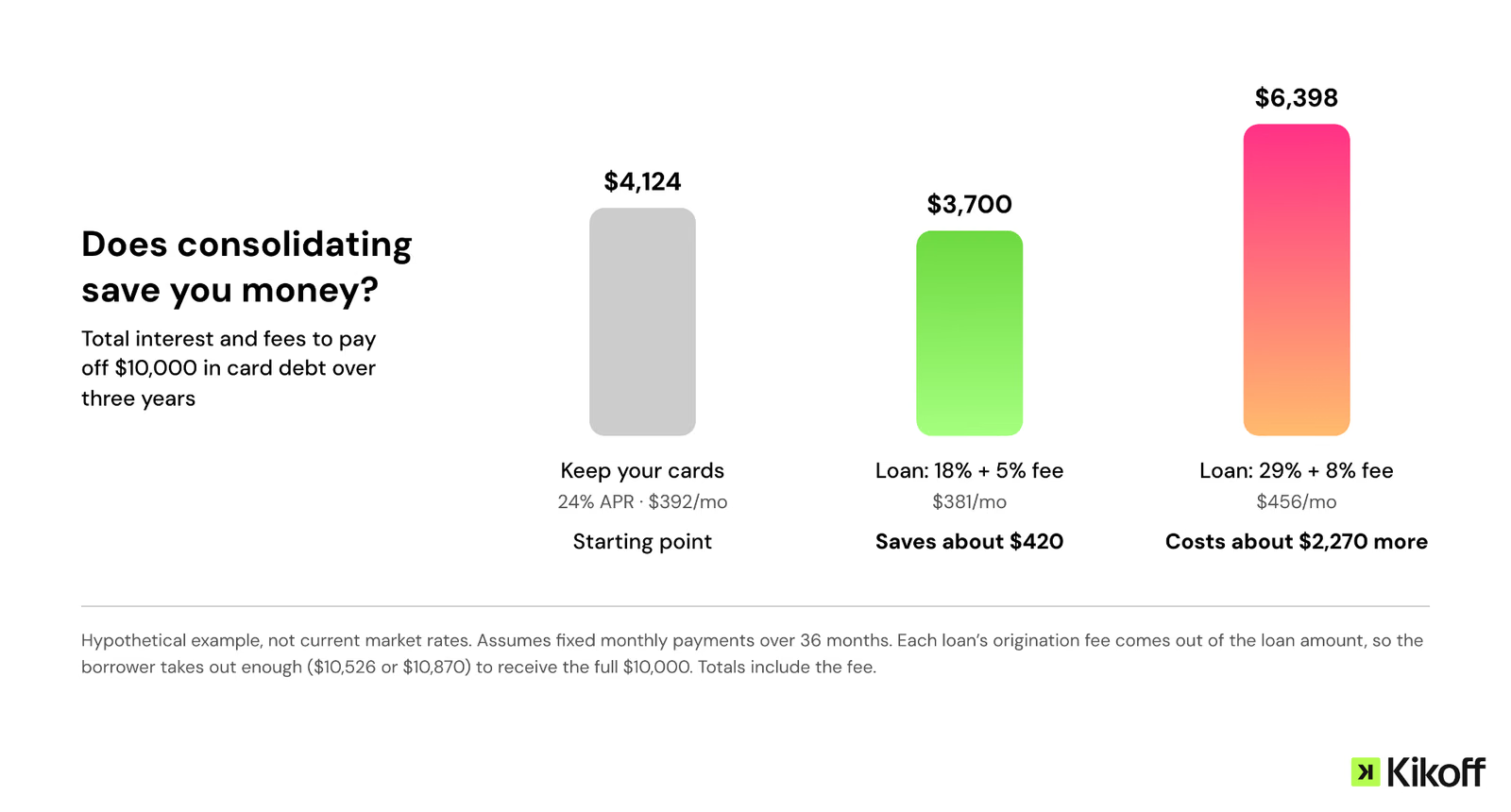
- High interest rates. It’s often difficult to qualify for a low interest rate with bad credit because lenders price lower scores as higher risk. In some cases, rates can be as high as 35.99%. That could defeat the purpose of debt consolidation.
- Origination fees. A loan origination fee covers the administrative costs of creating a new loan. It varies based on lender but could range from 1% to 10% of the amount borrowed or more. If the fee comes out of the loan, you’ll receive less than you borrowed, so you may need to borrow more to pay off every balance. Do the math to see if a lender’s interest rate and origination fee are worth the potential savings of debt consolidation.
- Predatory lenders. Some lenders target people who are struggling, with terms that are hard to understand. A typical two-week payday loan has an APR of almost 400%, according to the CFPB. Walk away from any lender that wants a fee before it sends your money, and check that the lender is licensed with your state’s financial regulator.
Alternatives to debt consolidation loans
Debt consolidation may not be your only option. Here are three other pathways to consider.
If none of these looks like a clear fit, start with a nonprofit credit counselor. A counselor can review your debts and budget for free or at low cost. The National Foundation for Credit Counseling can connect you with one at 800-388-2227.
Read more >> Debt Consolidation Loan vs. Personal Loan
How to improve your credit before applying
Taking steps to improve your credit before applying for a debt consolidation loan may be your best option.
- Make on-time payments. Your payment history accounts for 35% of your FICO Score. One missed payment can stay on your credit report for up to seven years.
- Pay down your debt. This can reduce your credit utilization ratio, or the percentage of available credit you’re using. That’s important since how much you owe makes up 30% of your FICO Score. Start by choosing a debt repayment strategy that works for you.
- Dispute any errors in your report. Check your reports for free every week at AnnualCreditReport.com. If you find something that’s wrong, dispute it for free with each bureau that shows it. If you’d rather not write the letters yourself, Kikoff’s AI Credit Disputes can help you spot errors and draft them.
- Space out applications for new credit. Each full credit application can mean a hard inquiry, which can lower your score by a few points for about a year. Prequalify where you can, and apply only when you’re ready to accept an offer.
Read more >> What Is Credit Counseling? How It Works and What It Costs
Bottom line
A debt consolidation loan is worth it with bad credit only if the APR, fees included, beats what you pay now. If it doesn’t, a nonprofit credit counselor can tell you whether a debt management plan fits instead.
Your score decides more than whether you’re approved. It sets the rate, and that rate applies to every dollar you consolidate. That’s not a reflection of you. It’s how risk-based pricing works. A Kikoff Credit Account reports your on-time payments to Equifax, Experian, and TransUnion, so each month adds to the record lenders price from. There’s no credit check to sign up, and plans start at $5 a month.
Frequently Asked Questions
Article Sources
Disclaimer: The information provided in this blog post is meant for informational purposes only and does not constitute financial advice.