



A major purchase on your credit card, like a car repair, a new appliance, or a medical bill, can lower your credit score if it pushes your balance high enough. How much it matters depends on your credit limit, when you pay off the charge, and your overall credit profile.
Can a large purchase on a credit card hurt your credit score?
Credit card issuers don’t report individual purchases to the credit bureaus, but it’s still possible for a large expense to hurt your credit score if it pushes your balance high enough.
That said, the impact ultimately depends on how much of your available credit you’re using and the balance your card issuer reports to the credit bureaus.
How credit utilization works
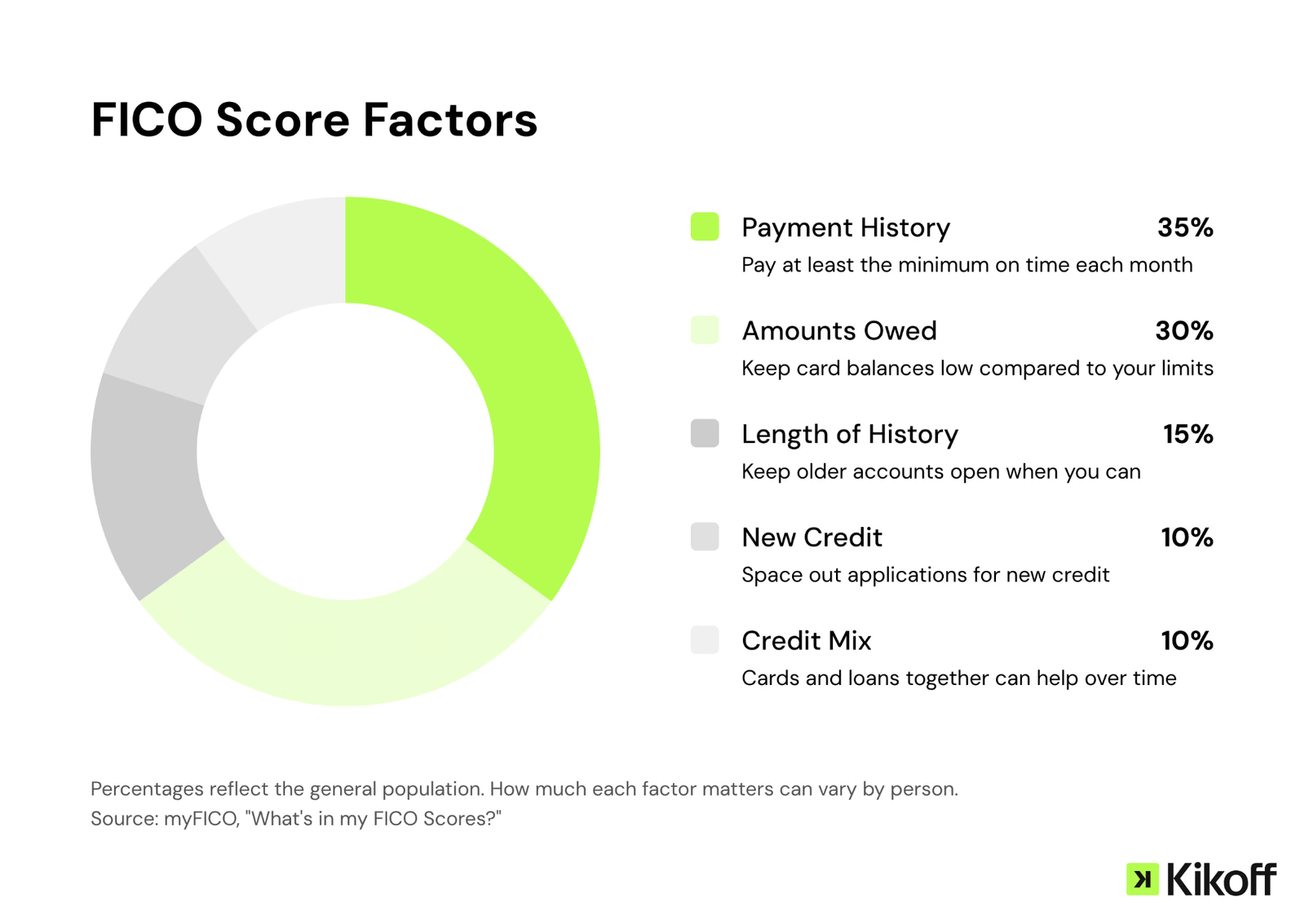
Your credit utilization ratio is the percentage of available credit you’re using on certain revolving credit accounts, primarily credit cards. This metric falls under the amounts owed category, which contributes to 30% of your FICO credit score.
The balance used to calculate your utilization rate is the balance your card issuers report to the credit bureaus, which typically happens on your monthly statement date.
How utilization is calculated
To calculate your utilization rate for a particular card, you’ll simply divide its balance by its credit limit. For example, if you have a $2,000 balance and a $4,000 limit, you have a 50% utilization rate.
Credit models will calculate your utilization rate for each card you have, as well as across all of your cards. To get your overall ratio, add up all of your card balances, then divide that number by the sum of your total credit limits.
What counts as high utilization?
There’s no hard-and-fast rule for what your credit utilization should be, but credit experts suggest that the negative impact tends to increase around the 30% mark. The higher it goes, the more it can hurt your score.
For context, borrowers with excellent credit tend to keep their utilization below 10%.
When a large purchase will hurt your score
A large purchase can negatively impact your credit score if it pushes your reported credit utilization rate much higher than it is now. It can be particularly damaging if you have a low credit limit or you already have a high balance on the card.
Applying for a loan soon? When you apply for a mortgage, auto loan, or new card, the lender pulls your credit reports that day. A high balance on them can mean a lower score, and that can mean a higher rate, which you pay on the whole loan. If you can, put off the big purchase until after you apply, or pay it down and wait for your issuer to report the lower balance first.
When a large purchase won’t hurt your score
A large expense may have little or no impact on your credit score if you have plenty of available credit on the card. For example, a $2,000 purchase may be significant for your budget, but if you have a $20,000 credit limit, it won’t register as high utilization.
You can also avoid a negative impact on your credit by paying down your balance before your statement closes.
Read more >> Why Only Paying the Minimum Hurts Your Credit
How to minimize the credit score impact of a large purchase
If you’re worried about the possibility of a big purchase hurting your credit, here are steps to minimize or even eliminate the potential impact.
Pay it off before the statement closes
Credit card issuers typically report your statement balance each month. So, even if you pay off your balance in full by your due date, the high balance may already be on your credit reports for that month.
If your budget allows, pay down the bill before your monthly statement closes. You’ll find that date on your statement or in your card’s app. The issuer will then report the lower balance.
Request a credit limit increase beforehand
Your credit utilization ratio is determined by your balance and your credit limit, so getting a higher limit can help keep your utilization down (as long as your balance doesn’t grow along with it).
Depending on your card issuer, you may be able to request a credit limit increase through your online account or by calling the number on the back of your credit card. Keep in mind that a limit increase request often triggers a hard inquiry, which can lower your score by a few points temporarily. Ask your issuer before your request whether it runs a hard or soft check.
Split the purchase across multiple cards
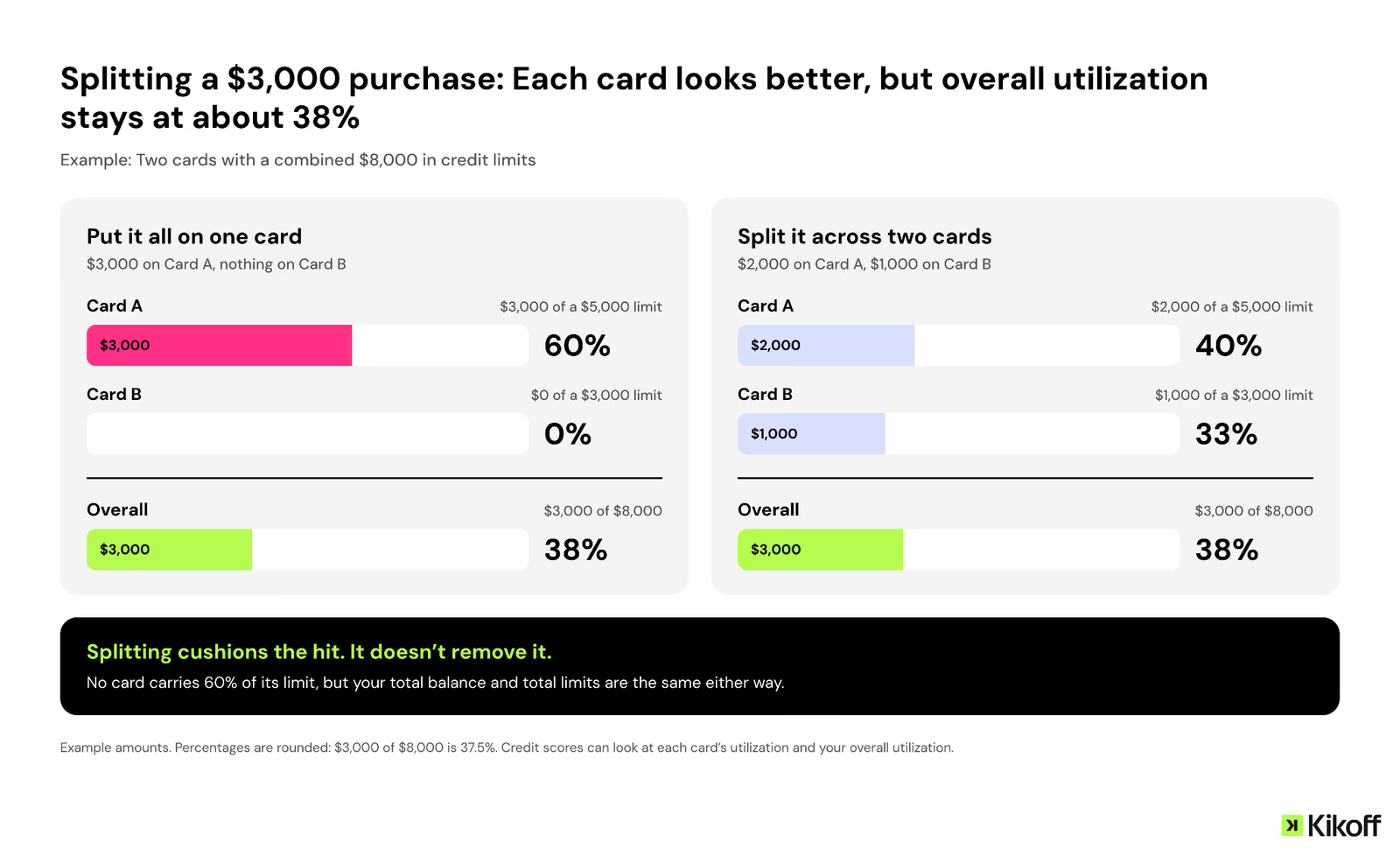
If the merchant allows it, splitting a large purchase across multiple cards can help keep your utilization rate down on each one. For example, let’s say you have two cards with a zero balance; one has a $5,000 credit limit, and the other has a $3,000 limit.
If you put the full $3,000 on the first card, its utilization would be 60%. If you put $2,000 on the first card and $1,000 on the second, they’d be at 40% and 33%. Your overall utilization stays the same either way: $3,000 of $8,000, or about 38%. Splitting helps each card look better, but it doesn’t change the total, so it cushions the hit instead of removing it.
Pay down existing balances first
If you carry a balance on your credit card every month, it could make sense to pay down what you already owe to make room for the new charge. This may take some time, though, so consider it only if you have flexibility with when you make the purchase.
Read more >> How to Lower Your Credit Utilization
How long does the impact last?
Unlike other negative marks on your credit reports, which often stay on your credit reports for a fixed period of time, your credit utilization ratio is fluid.
Say you rack up an 80% utilization ratio on a single card one month to cover an emergency expense, and your credit score drops as a result. If you manage to pay off the balance in full the very next month, your score may rebound as soon as the card issuer reports the new balance.
Some newer credit scoring models, such as FICO 10T and VantageScore 4.0, also look at trended data, meaning how your balances have changed over the past two years. If you have a history of carrying high balances and paying them off all at once, your score may not bounce back as fully under those models.
After you pay down the balance, check that your issuer reported the lower number. You can see your reports from all three bureaus for free every week at AnnualCreditReport.com. If you’d rather keep an eye on it without checking manually, Kikoff’s Credit Monitoring tracks exactly how much of your available credit you’re using, with month-over-month and day-over-day trends that show every balance change and payment as it happens.
Bottom line
A large purchase hurts your credit only as long as it keeps your reported balance high. Pay it down and your utilization, and usually your score, can recover within a statement cycle or two.
Utilization works like a snapshot. Your payment history is the part of your credit that keeps a record. Kikoff’s Credit Account reports your on-time payments to Equifax, Experian, and TransUnion every month, with no credit check to sign up. Plans start at $5 a month.
Frequently Asked Questions
Disclaimer: The information provided in this blog post is meant for informational purposes only and does not constitute financial advice.