






Credit card debt is effectively one of the most expensive forms of debt a person can carry.
The average credit card APR in 2026 sits well above 20%, which means every month you carry a balance, a significant portion of your payment is going straight to interest rather than reducing what you actually owe. The longer the balance sits, the more it grows, and the harder it becomes to make meaningful progress.
The good news is that getting out of credit card debt is a solvable problem. It mainly requires a clear picture of where you stand, a strategy that matches your situation, and a set of habits that keep you on track while you work through it.
Let's jump in.
How to manage and pay off credit card debt
Managing credit card debt starts before you make a single extra payment.
Every individual who carries a balance across multiple cards needs to know the full scope of what they're dealing with before choosing a payoff approach. Jumping into a repayment strategy without that picture is basically trying to navigate without a map.
Take a full inventory of what you owe
The first step is knowing exactly where you stand across every account.
For each credit card you carry a balance on, write down the card name, the current balance, the interest rate (APR), and the minimum monthly payment. This gives you a complete picture of your total debt load and the cost of each individual balance.
Lots of people avoid this step because seeing the full number feels uncomfortable. But the total doesn't change whether you look at it or not, and having it in front of you is what makes it possible to build a real plan. Once you have your inventory, you'll be able to see which balances are costing you the most in interest and where paying extra will have the biggest impact.
A simple spreadsheet works well for this, or even a piece of paper. The format doesn't matter as much as the act of getting everything visible in one place.
Understand how interest is working against you
Before choosing a payoff strategy, it's worth understanding exactly how credit card interest compounds.
Credit card interest is generally calculated as a daily periodic rate, which is your APR divided by 365. That daily rate is applied to your average daily balance each day of the billing cycle, then added to your balance at the end of the month.
The formula looks like this: Daily periodic rate = APR / 365. Monthly interest charge = average daily balance x daily periodic rate x number of days in the billing cycle.
This means carrying a $3,000 balance at 24% APR costs roughly $60 in interest every single month, and that interest gets added to the balance you owe, which then accrues more interest the following month. The longer a balance sits, the more of your minimum payment goes toward interest rather than the principal, which is why minimum-only payments can keep you in debt for years.
Understanding this is what makes the urgency of paying above the minimum so clear.
Choose a payoff strategy
There are two main approaches to paying off credit card debt, and the best one depends on what motivates you.
The avalanche method
The avalanche method is mathematically the most efficient payoff strategy.
With this approach, you make minimum payments on all of your cards, then put every extra dollar toward the card with the highest interest rate first. Once that card is paid off, you redirect that payment toward the next highest rate, and so on.
This method minimizes the total amount of interest you pay over time, which means you'll get out of debt faster and pay less overall compared to any other approach. It's the single most cost-effective strategy if you can stay motivated even when progress on individual cards feels slow.
The snowball method
The snowball method focuses on paying off the smallest balance first, regardless of interest rate.
You make minimum payments on everything, then direct extra payments toward the card with the lowest balance. Once that's paid off, you roll that payment into the next smallest balance, building momentum as you go.
The snowball method generally costs more in interest over time than the avalanche, but it produces faster visible wins, which can be super important for staying motivated. Research consistently shows that people who see early progress are more likely to stick with a payoff plan long enough to finish it.
Neither method is wrong. The best one is basically whichever one you'll actually follow through on.
Pay more than the minimum
This is the single most important behavioral change for getting out of credit card debt.
Minimum payments are designed to keep you in debt as long as possible while maximizing the interest you pay. On a $5,000 balance at 22% APR, paying only the minimum each month can take over a decade to pay off and cost thousands of dollars in interest alone.
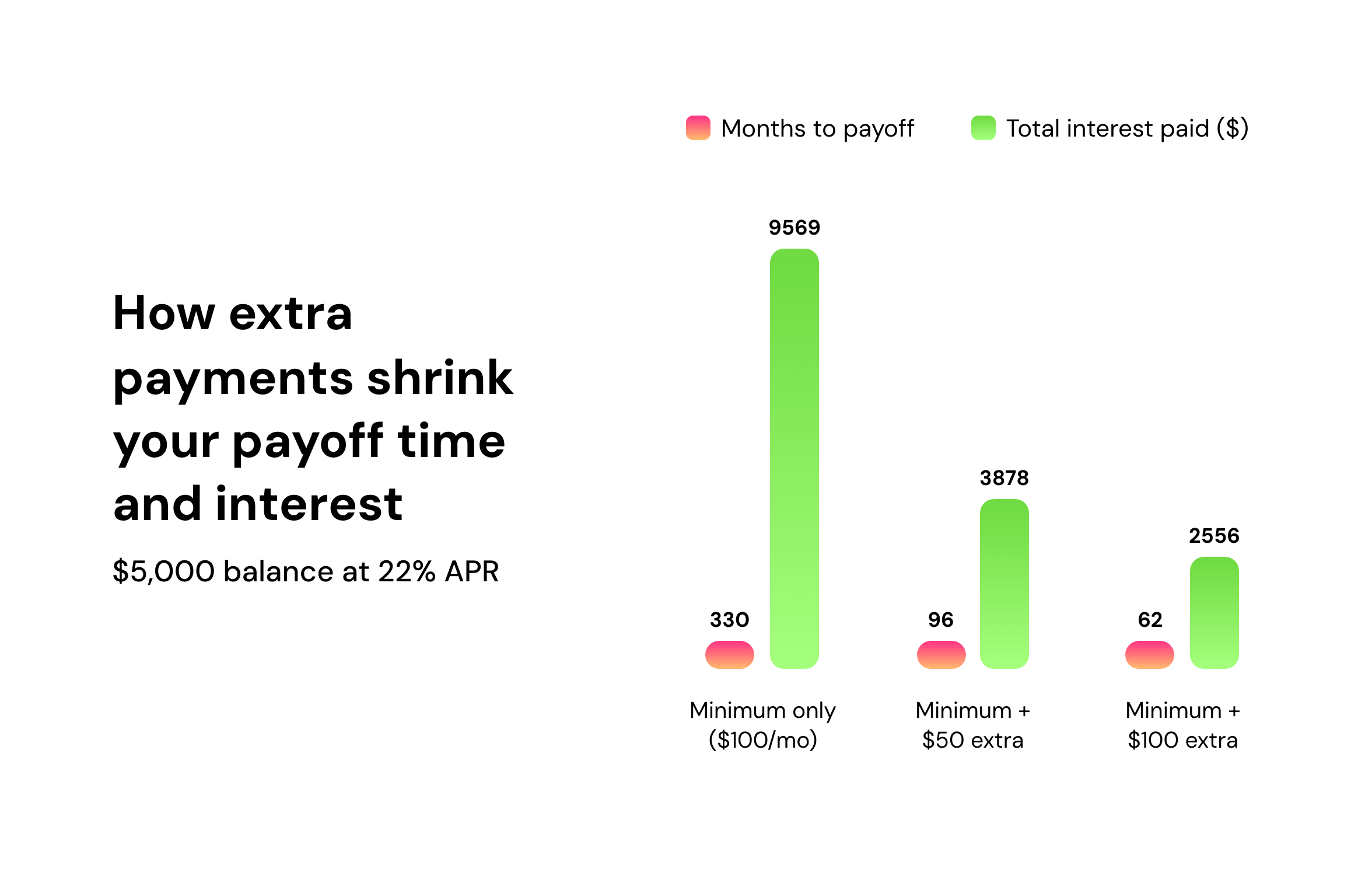
Even a modest increase above the minimum, say an extra $50 or $100 per month, dramatically shortens the payoff timeline and reduces total interest paid. The more you can consistently put toward your highest-priority balance, the faster the debt shrinks.
If cash is tight, look for small budget adjustments that free up even a little extra each month. Lots of people find that cutting one or two recurring expenses they barely use generates enough to meaningfully accelerate their payoff.
Consider a balance transfer
A balance transfer moves your existing credit card debt onto a new card with a lower, often 0%, introductory APR.
This can be a super effective tool for paying down debt faster because every dollar you pay goes directly toward the principal rather than being split between principal and interest. Many balance transfer cards offer 0% APR for 12 to 21 months, giving you a meaningful window to make real progress.
There are a few things to keep in mind before using this strategy. Balance transfer cards usually charge a fee of 3% to 5% of the amount transferred, so it's worth calculating whether the interest savings outweigh that upfront cost. You'll also generally need a decent credit score to qualify for a competitive balance transfer offer.
Just make sure you have a plan to pay off as much of the balance as possible before the introductory period ends, because the rate that kicks in after the promotional window closes is usually high.
Look into debt consolidation
Debt consolidation is another option for simplifying and reducing the cost of multiple credit card balances.
A debt consolidation loan replaces several high-interest credit card balances with a single personal loan, usually at a lower fixed interest rate. This means one monthly payment instead of several, and a clear payoff timeline with an end date, unlike revolving credit card debt that can drag on indefinitely.
The trade-off is that consolidation loans require a credit check, and the rate you qualify for depends on your credit profile. Someone with a strong credit history will likely get a much lower rate than someone who is still rebuilding.
If consolidation is on your radar, shop around and compare APRs carefully before applying. Even a few percentage points difference in rate can mean hundreds of dollars over the life of the loan.
Stop adding to the balance
Paying down debt while continuing to add to it is basically running on a treadmill.
This doesn't necessarily mean cutting up your cards entirely, but it does mean being intentional about any new charges you put on the cards you're trying to pay down. Every new purchase on a card with a balance you're working to eliminate pushes the finish line further out and adds more interest to the pile.
If you're using credit cards for regular spending, try shifting those purchases to a card that's already paid off, or use a debit card or cash for day-to-day expenses while you're in payoff mode. The goal is to make sure your balance is moving in one direction: down.
Protect your credit while paying off debt
Carrying and paying down credit card debt affects your credit score in a few important ways.
Credit utilization, which is one of the two biggest factors in your credit score at 30%, is directly tied to your credit card balances. High balances relative to your credit limit push utilization up and can meaningfully drag your score down. As you pay off balances, your utilization drops and your score will generally improve alongside it.

Payment history, the single most important scoring factor at 35%, is protected as long as you're making at least the minimum payment on every account on time, every month. Even while in debt, consistent on-time payments keep this factor healthy and prevent further damage to your score.
Apps like Kikoff make it easy to build positive payment history alongside your debt payoff journey, with a credit account that reports to all three bureaus and no hard credit check to sign up. Building credit while paying off debt isn't a contradiction. It's a strategy.
Conclusion
Getting out of credit card debt is mainly a matter of having the right strategy, the right habits, and a clear picture of what you're working with.
Start with a full inventory of every balance, choose a payoff method that fits how you're wired, and prioritize paying above the minimum every single month. Every dollar you put toward the principal today is interest you won't have to pay tomorrow.
If you're looking to rebuild or strengthen your credit while you work through debt, Kikoff offers a low-cost credit account that builds positive payment history while you focus on paying balances down. Take a step toward stronger credit habits with Kikoff.
Frequently Asked Questions
About the editor

Disclaimer: The information provided in this blog post is meant for informational purposes only and does not constitute financial advice.