
New vehicles lose an average of $4,422 in value a year over their first five years, according to AAA’s 2026 Your Driving Costs study. That’s the single largest cost of owning a new car, ahead of fuel, insurance, and loan interest.
Depreciation never shows up as a bill, so it’s easy to forget. You feel it when you sell or trade in the car, or if it’s totaled while you still owe more on the loan than the car is worth. Your down payment and loan length decide how long that gap lasts.
How much value cars lose each year
AAA’s figure is a weighted average across new vehicles, measured over five years and 75,000 miles, or about 15,000 miles a year. At that pace, a new car loses about $22,100 in value over five years.
That loss isn’t spread evenly. Cars lose value fastest in their first year or two, then the yearly drop slows as the car ages. So the early years usually take a bigger bite than $4,422, and the later years a smaller one.
With a used car, the first owner already took the steepest part of the drop, so it usually loses fewer dollars a year.
What makes a car lose value faster
A few things speed up depreciation, and some of them are in your hands:
- Miles. The more you drive, the less the car is worth at resale.
- Condition and history. Accidents, missed maintenance, and visible damage all lower what buyers will pay. Keep your service records. They’re proof the car was cared for.
- Demand for the model. Cars that lots of buyers want hold their value better than ones that sit on lots.
- Electric or gas. In AAA’s 2026 study, electric medium sedans had about twice the depreciation of gas-powered medium sedans.
How to check what your car is worth now
Checking takes a few minutes, and it’s free.
- Look up your car’s value. Use a free pricing guide such as Kelley Blue Book, Edmunds, or J.D. Power. Enter the exact trim, mileage, and an honest condition rating. Note both the trade-in value and the private-sale value, since a dealer will usually offer less.
- Get your payoff amount. Call your lender or log in to your account and ask for the payoff amount. It’s usually a little higher than the balance on your statement because interest builds daily.
- Subtract. If the car’s value is higher than your payoff, the difference is your equity. If the payoff is higher, you owe more than the car is worth.
For example, if your car is worth $17,000 and your payoff is $19,000, you’re $2,000 short. You’d have to cover that $2,000 to sell the car and walk away with no loan.
Why loan length changes the picture
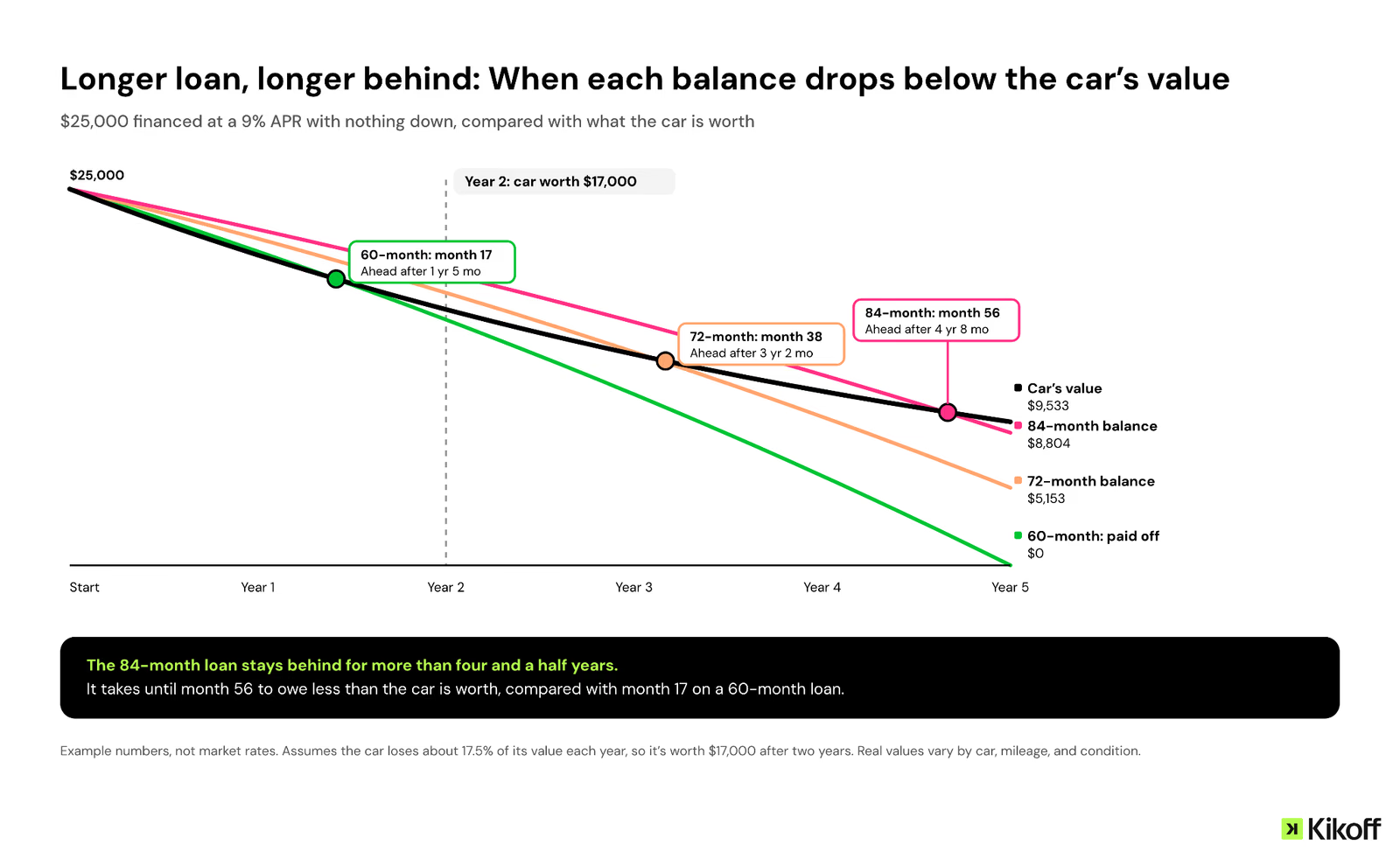
The longer your loan term, the slower you pay down what you owe, while the car keeps losing value at the same pace. The example below shows $25,000 financed at a 9% APR with nothing down, and a car worth $17,000 after two years. These are example numbers, not market rates.
A lower monthly payment can be the right call for your budget. The trade-off is more interest and more time owing more than the car is worth. A down payment, even $1,000 or $2,000, narrows that gap from day one.
If you owe more than the car is worth
Owing more than the car is worth doesn’t cause problems by itself. If you keep the car and make your payments, the gap usually closes as the loan shrinks. It matters at three points.
- When you sell or trade in. While you have a loan, your lender is listed on the title. You’ll need to pay off the loan, including any shortfall, before the title can go to the buyer. A dealer may offer to roll what you still owe into your next loan, which means you start that loan behind, too. The steps to release a lien and transfer a title vary by state, so check with your state’s motor vehicle agency before you sell.
- If the car is totaled or stolen. Collision and comprehensive coverage usually pay what the car is worth, not what you owe.. Guaranteed asset protection (GAP) coverage pays the difference if you have it. Check your loan paperwork, since GAP is often sold at the dealership, and ask your insurer whether your policy includes it.
- If you fall behind on payments. Call your lender as soon as you know a payment will be late and ask about a deferral or a changed due date. Paying before you’re 30 days late helps keep the missed payment off your credit reports. Repossession rules depend on your state. According to the CFPB, many states let a lender repossess after a missed payment with no warning or court order, while others require notice first. If the car is sold for less than you owe, you may still owe the difference, called a deficiency balance. To learn your state’s rules, contact your state attorney general or consumer protection office. The FTC’s repossession basics explain what lenders can and can’t do.
If you’re facing repossession or a deficiency balance, a local legal aid office may help for free. Consider talking with a financial advisor, licensed attorney, or nonprofit credit counselor for personalized guidance. The National Foundation for Credit Counseling (NFCC) can connect you with free or low-cost debt counseling at 800-388-2227.
Bottom line
New cars lose value fastest early, and AAA’s estimate averages about $4,422 a year over five years. You can’t stop depreciation, but you can keep your loan from falling far behind it with a down payment, a shorter term, and a lower rate. Your credit shapes that rate. Kikoff’s Credit Account reports your on-time payments to Equifax, Experian, and TransUnion, which helps build the credit history lenders weigh when they price your next car loan. There’s no credit check to sign up. Plans start at $5 a month.
Frequently Asked Questions
Article Sources
Disclaimer: The information provided in this blog post is meant for informational purposes only and does not constitute financial advice.