
Opening a savings account takes five steps, and you can usually do it online in minutes. The bigger decision is which kind of savings account to open. A regular, high-yield, or money market account keeps your money within reach, and a CD pays a locked rate if you can leave the money alone for a set time.
Types of savings accounts
Before you apply, pick a type that fits what you’re saving for.
Traditional savings accounts
A basic savings account is simple to open, often at the same bank as your checking, so moving money between them is fast. The downside is that it usually pays little interest.
High-yield savings accounts
A high-yield savings account works like a regular one, but it can pay much more interest. They're often offered by online banks and credit unions, and many have no minimum balance.
Money market accounts (MMAs)
A money market account is a savings account with a few checking features, like a debit card or limited check-writing. It can pay more than regular savings, but many MMAs require a minimum balance to avoid fees or earn the advertised rate.
Certificates of deposit (CDs)
A certificate of deposit pays a fixed rate in exchange for leaving your money untouched for a set term, commonly three months to five years. If you take the money out early, you'll usually pay a penalty.
Read more >> What Are the 6 Types of Bank Accounts?
How to open a savings account, step by step
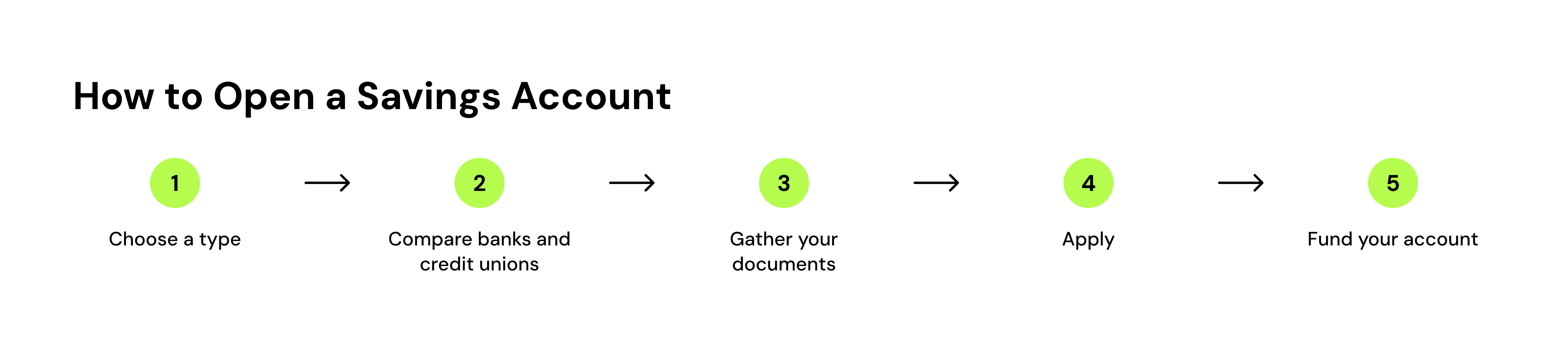
If you’re ready to open a savings account, all you need to do is follow these five simple steps.
1. Choose the type of account
Start with what the money is for. For an emergency fund or money you might need soon, a regular or high-yield savings account keeps it within reach. For money you won't need for a while, a CD can lock in a rate. If you want to pay from your savings with a check or debit card, look at money market accounts.
2. Compare banks and credit unions
Look at your own bank, at least one credit union, and at least one online bank. Compare three things:
- The annual percentage yield (APY)
- Monthly fees
- Any minimum balance
Credit unions may charge lower fees, but you have to become a member first. Membership is often based on where you live, work, or go to school.
3. Gather your information
Most applications ask for:
- Your name, date of birth, and address
- Your Social Security number (some banks accept an ITIN instead)
- Your phone number and email
- A government-issued photo ID
- Proof of address, if the bank can't verify it electronically
- A way to make your first deposit
You’ll also choose who owns the account. You can open it in your name alone or jointly with someone else, who will be able to deposit and withdraw just like you. You can also name a beneficiary for the account.
4. Apply in person or online
You can usually apply online or at a branch. Before you submit an application, read the fee schedule for limits, fees, or rate requirements so there are no surprises.
5. Fund your account
Make your first deposit by transferring money from another bank account, using a debit card, or depositing cash at a branch. Many online banks can't take cash, so if you plan to deposit cash, choose a bank or credit union with branches. If the account has a minimum opening deposit, make sure your first deposit meets it.
Read more >> Are Online Savings Accounts Safe?
What to look for when choosing a savings account
- APY. This is how much you’ll earn in a year, including compounding. On $1,000, a 3% APY earns about $30 a year, while a 0.5% APY earns about $5. Check whether the rate is promotional or tiered. Savings rates are variable, so the bank can change yours after you open the account.
- Fees. Look for no monthly maintenance fee, or an easy way to waive it.
- Minimums. Check both the amount you need to open the account and the balance you need to keep to avoid a fee or earn the full rate.
- Withdrawal limits. The Federal Reserve dropped its cap on some savings withdrawals in 2020, but it doesn't require banks to drop their own limits. The account agreement lists any limit and fee.
- Insurance. Confirm the institution is insured by the FDIC or NCUA.
- Ease of access. A good app and responsive customer support can make it easier to reach your money when you need it.
FDIC and NCUA insurance
Deposits at FDIC-insured banks are covered up to $250,000 per depositor, per insured bank, for each account ownership category. The NCUA applies the same limits to federally insured credit unions. If you open an account through an app that isn't a bank, insurance covers the partner bank holding your money, not the app company.
Read more >> NCUA vs. FDIC: What's the Difference?
Check your bank's insurance in a minute. For a bank, search its name in the FDIC's BankFind Suite. For a credit union, look it up in the NCUA's Credit Union Locator.
For an app, look up the partner bank that holds your money, not the app's name.
Do you need good credit to open a savings account?
No. Opening a savings account doesn't involve a hard credit check or a credit score requirement. Many banks check your ChexSystems report instead, which tracks your banking history, like unpaid overdraft fees or accounts closed with a negative balance. A negative record there can make it harder to open an account.
You can check your own record first. ChexSystems provides a free copy of your report once every 12 months, and you can dispute anything that's wrong directly with ChexSystems.
Your credit reports are a separate record. Check them free weekly at AnnualCreditReport.com, and use Kikoff Credit Monitoring to track changes between checks.
Read more >> Do You Need a Credit Score to Open a Bank Account?
Bottom line
Opening a savings account takes five steps, and the most important one is first: choose the type that fits what you're saving for. Then compare APYs, fees, and minimums at a bank, a credit union, and an online bank, and confirm the institution is insured before you deposit.
Savings does more than earn interest. When a surprise bill shows up, it's what lets you keep paying everything else on time, and on-time payments are what lenders see on your credit report. A Kikoff Credit Account reports yours to all three credit bureaus. There's no credit check to sign up, and plans start at $5 a month.
Frequently Asked Questions
Article Sources
Disclaimer: The information provided in this blog post is meant for informational purposes only and does not constitute financial advice.