
A certificate of deposit (CD) pays you a fixed interest rate in exchange for leaving your money untouched for a set term, and that rate’s usually higher than a regular savings account’s. Opening one takes five steps. The two that matter most are choosing the term and checking what it costs to get your money out early, because breaking a CD can cost you some or all of the interest you’ve earned.
5 steps to opening a CD
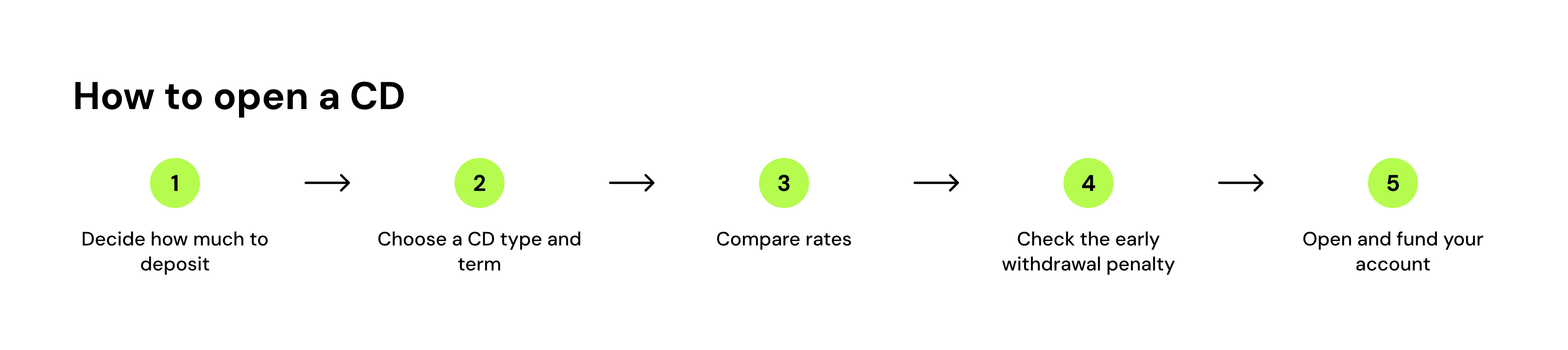
1. Decide how much you want to deposit
A CD isn’t a savings account you dip into. You put the money in once and leave it there for the whole term. If you need it early, you’ll usually pay a penalty.
You may not need much to start: most CDs require $500 to $2,500 to open, and some digital banks have no minimum deposit.
Only deposit money you’re sure you won’t need before the term ends. Keep an emergency cushion in a regular savings account, so a car repair or surprise bill doesn’t force you to break the CD.
2. Choose a CD type and term length
Traditional CDs are the most common, but a few other types give you more flexibility. Terms commonly run from three months to five years, so match the term to when you’ll actually need the money.
Don’t assume a longer term pays more. Depending on where rates are headed, a one-year CD can pay as much as a five-year CD. Check the rate at each term you’re considering. And only go longer if the rate makes the extra wait worth it.
Can’t pick a term? Build a CD ladder
A CD ladder splits your money across several terms, so part of it comes free regularly. For example, split $5,000 into three CDs: one for one year, one for two years, and one for three years. A CD matures every year, so you’re never locked out of all your money at once.
Each time a CD matures, you can take the cash if you need it, or roll it into a new three-year CD to keep the ladder going. After the first two years, every CD in the ladder earns a three-year rate, but one still matures every year.
3. Compare CD rates across banks and credit unions
Where you open the CD can matter more than the term, and shopping around takes only a few minutes. Look at your own bank, at least one credit union, and at least one online or digital bank. Online banks can sometimes pay more because they don’t have brick-and-mortar branches to run.
Compare offers by annual percentage yield (APY), not the interest rate alone. APY includes compounding, so it lets you compare offers side by side. Banks and credit unions are required to show the APY in their account disclosures.
If a bank is new to you, look it up before you deposit. Use the FDIC’s BankFind Suite for banks, or the NCUA’s Credit Union Locator for credit unions. Insured CDs are covered up to $250,000 if the institution fails.
4. Check the early withdrawal penalty
Most CDs charge a penalty if you take money out before the term ends, often a set number of months’ interest.
You don’t have to dig for it. Banks are required to tell you the penalty and how it’s calculated. If you can’t find it online, ask for the account disclosures before you deposit anything.
What a penalty looks like
Say you put $5,000 in a one-year CD at a 2.51% APY, and the penalty is three months’ interest. Breaking the CD early would cost you about $31.38.
When you break it matters. After 10 months you’d have earned roughly $105, so the penalty takes a bite and you keep the rest. After one month you’d have earned only about $10, so the $31.38 penalty is more than you’ve earned, and the difference comes out of your original deposit.
5. Open the account and fund it
You can typically apply online, at a branch, or by phone with:
- Your name, date of birth, and address
- Your Social Security number (some banks accept an ITIN instead)
- Your phone number and email
- A government-issued photo ID
- A bank account to transfer the deposit from
Once you’re approved and the money moves over, your CD starts earning interest. Put the maturity date, or the day the term ends, on your calendar now with a reminder far enough ahead to decide what to do next.
Run the numbers >> Use Kikoff’s CD calculator to compare what you’d earn across a 6-month, 1-year, and 5-year term.
How much interest will your CD earn?
With a traditional CD, your rate is locked the day you open the account and stays put for the entire term. That’s the difference from a savings account, where the bank can change your rate with the market.
To estimate your earnings, multiply your deposit by the APY. For example, $5,000 in a one-year CD at 2.51% APY earns $125.50. Over a two-year term at the same APY, it earns $254.15, because in the second year you also earn interest on the first year's $125.50.
What you’re offered depends on:
- General market rates. Rates on new CDs tend to rise and fall with the Federal Reserve’s rate decisions, which are scheduled eight times a year.
- Where you’re buying it from. Banks, credit unions, and online banks set their own rates, so compare all three.
- The term. Longer terms don’t always pay more, so check every term you’d consider.
How term length and compounding affect what you earn
To see how term length and compounding work together, here’s what $5,000 would earn at five different terms. These are sample rates, not current ones, so use them to compare, not to plan.
Types of CD accounts
Most CDs work the same basic way, but a few variations change the trade-off between earning more and keeping your options open.
Read more >> What Are the 6 Types of Bank Accounts?
Bottom line
Opening a CD comes down to two choices: how long you can leave the money alone, and what it costs if you can’t. Compare APYs at a bank, a credit union, and an online bank, pick a term you’re confident you can wait out, and read the penalty disclosure before you fund it.
A CD earns interest by keeping your money locked away. A lot of credit-building products work the same way: secured cards and credit builder loans hold your deposit or loan funds until you’re done. A Kikoff Credit Account doesn’t take a deposit, so your savings can stay in your CD, and it reports your on-time payments to all three credit bureaus. There’s no credit check to sign up, and plans start at $5 a month.
Frequently Asked Questions
Article Sources
Disclaimer: The information provided in this blog post is meant for informational purposes only and does not constitute financial advice.