.jpg)




If your bank or credit union fails, federal insurance replaces your deposits up to $250,000. The FDIC covers banks, the NCUA covers federally insured credit unions, and the dollar limit is the same at both.
This insurance counts per ownership category, not per account. Accounts you hold alone at one institution are added together against a single $250,000 limit.
What's the difference between NCUA and FDIC?
The National Credit Union Administration (NCUA) and the Federal Deposit Insurance Corporation (FDIC) are government agencies that insure customers’ funds at financial institutions. The NCUA covers funds at credit unions specifically.
Both insure the same amount: $250,000 per depositor, per institution, for each account ownership category. But they diverge in two key ways:
- Who's covered. Anyone can open an insured deposit account at a bank. Credit union coverage runs through membership, and on a joint account the primary owner has to be a member.
- Covered accounts. Covered accounts at a bank include checking, savings, money market accounts, CDs, cashier's checks, and money orders, while covered accounts at a credit union include regular shares, share drafts, money market shares, and share certificates.
What is the FDIC?
During the Great Depression in the 1930s, thousands of banks failed and ran out of physical currency. Customers could no longer access their savings, so they (understandably) lost faith in the banking system.
The U.S. government established the Federal Deposit Insurance Corporation in 1933 to stabilize the banking system, restore consumer trust in banks, and make sure a similar disaster didn’t happen again.
At FDIC-insured banks, deposit accounts like the following are covered:
- Checking and savings accounts
- Money market deposit accounts
- Certificates of deposit (CDs)
- Cashier's checks, money orders, and other official items issued by banks
Coverage is $250,000 per depositor, per bank, for each account ownership category.
Say you have $200,000 in checking and $100,000 in savings at the same bank, both in your name only. Neither account is over $250,000, so it looks covered. But accounts in a single ownership category at one bank are added together, so your $300,000 counts against one $250,000 limit. That leaves $50,000 of your savings uninsured.
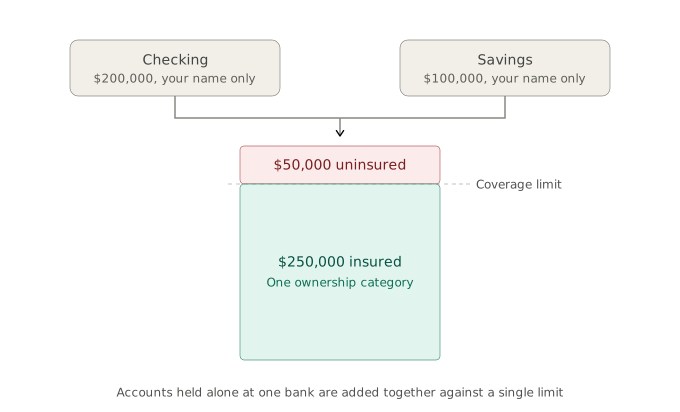
FDIC coverage depends on how the account is owned. Move the $100,000 into a joint account, an IRA, or a second insured bank, and the whole balance is covered. The FDIC's Electronic Deposit Insurance Estimator (EDIE) will run your actual accounts for free.
What is the NCUA?
The National Credit Union Administration came along much later than the FDIC. As credit unions grew more popular, it became clear that members' deposits needed to be insured just as they were at most banks.
Created in 1970, the NCUA supervises federal and state credit unions that are federally insured. It also manages the National Credit Union Share Insurance Fund (NCUSIF).
Covered accounts include regular shares, share drafts, money market shares, and share certificates. And like the FDIC, coverage is $250,000 per member, per credit union, for each account ownership category.
What isn't covered?
The NCUA and FDIC were created to protect the deposit accounts of customers and members from bank failures, not shield them from investment losses.
The following types of accounts aren’t insured, even if they’re purchased through an FDIC- or NCUA-insured bank or credit union:
- Stocks and bonds
- Mutual funds
- Annuities
- Life insurance policies
- Municipal securities
- Cryptocurrency
- U.S. Treasury bills, bonds, and notes
Treasury securities aren't deposits, so they aren't FDIC- or NCUA-insured. Instead, they're backed by the full faith and credit of the U.S. government. Notably, neither the NCUA nor the FDIC insures safe deposit boxes or their contents.
How to check if your money is insured
If you have an account at a bank, use the FDIC BankFind Suite to confirm your banking institution's insurance status. If your account is with a credit union, use the NCUA Credit Union Locator.
Those tools tell you whether the institution is insured. To find out how much of your balance is covered, use the FDIC's Electronic Deposit Insurance Estimator, which handles single, joint, and trust accounts, as well as IRAs, or the NCUA's Share Insurance Estimator. Both are free and neither asks for your account numbers.
Starting April 1, 2027, all insured banks must also display the FDIC's official digital sign on their websites, in their apps, and at certain ATMs.
Fintech companies and online institutions are a different case. FDIC insurance generally covers eligible deposits held at an FDIC-insured bank — not the fintech company itself — though some fintech apps structure accounts for “pass through” FDIC coverage when funds are held at an insured bank and program requirements are met.
Before you open one, find the bank in the app's disclosures (it usually reads "deposits held at [Bank], Member FDIC") and look that bank up in BankFind. If the app claims to be FDIC-insured itself rather than naming a bank partner, treat that as a reason to stop.
Bottom line
Coverage is $250,000 per person, per institution, per ownership category, and you don't have to apply for it. The only work is confirming your institution is insured and making sure no single category holds more than the limit.
One thing deposit insurance doesn't touch is your credit. Checking and savings accounts aren't reported to the credit bureaus, so an insured account can hold money safely for years without building any credit history. That takes an account that reports.
Kikoff's Credit Account reports to Equifax, Experian and TransUnion, and there's no credit check to sign up. Plans start at $5 a month.
Frequently Asked Questions
Article Sources
Disclaimer: The information provided in this blog post is meant for informational purposes only and does not constitute financial advice.