
If you've encountered both the terms "ITIN" and "SSN" and aren't entirely sure what separates them, you're not alone.
Both are nine-digit identification numbers used by the U.S. government, but they're issued to different people, for different reasons, and come with different financial implications.
In this post, we'll break down exactly what each number is, who qualifies for each, and what the difference means for things like taxes, banking, and building credit.
What's the difference between ITIN and SSN?
The core difference is who each number is issued to and what it's used for.
A Social Security number is issued to U.S. citizens and eligible residents for the purpose of tracking earnings and administering Social Security benefits, while an Individual Taxpayer Identification Number is issued by the IRS specifically to people who have U.S. tax obligations but don't qualify for an SSN.
Let's jump in.
What is a Social Security number?
A Social Security number, or SSN, is effectively a nine-digit identifier issued by the Social Security Administration to U.S. citizens, permanent residents, and certain work-authorized immigrants.
It was originally created to track individuals' earnings and manage Social Security retirement and disability benefits, but it has since become the primary identification number used across nearly every aspect of American financial life.
Every individual born in the United States is generally assigned an SSN at birth, and work-authorized immigrants can apply for one after receiving the appropriate visa status.
SSNs are used for employment verification, tax filing, credit applications, banking, government benefits, and a wide range of other financial and legal purposes.
Lenders, credit bureaus, and financial institutions use your SSN as the primary key to locate your credit file, which is why it sits at the center of the U.S. credit system.
What is an ITIN?
An ITIN, or Individual Taxpayer Identification Number, is a nine-digit tax processing number issued by the IRS to individuals who are required to file U.S. taxes but are not eligible for a Social Security number.
It always begins with the number 9 and follows the same formatting as an SSN, but it is not interchangeable with one.
ITINs are mainly issued to non-resident aliens, undocumented immigrants, resident aliens who don't meet SSN eligibility requirements, and their dependents or spouses who have U.S. tax filing obligations.
The ITIN exists solely for federal tax purposes. It does not authorize someone to work in the United States, does not make someone eligible for Social Security benefits, and does not establish immigration status.
That said, many financial institutions and credit-building platforms accept ITINs in place of SSNs, which means ITIN holders can still access banking products, credit accounts, and other financial tools in the U.S.
Key differences between ITIN and SSN
Here's a breakdown of how ITIN and SSN compare across the areas that matter most:
- Issuing authority: SSNs are issued by the Social Security Administration. ITINs are issued by the IRS.
- Who qualifies: SSNs go to U.S. citizens, permanent residents, and work-authorized immigrants. ITINs go to individuals with U.S. tax obligations who don't qualify for an SSN.
- Primary purpose: SSNs are used for employment, benefits, taxes, and financial identity. ITINs are used exclusively for federal tax filing purposes.
- Work authorization: Having an SSN generally indicates work authorization. An ITIN does not confer any work authorization.
- Social Security benefits: SSN holders who contribute to Social Security through payroll taxes are eligible for benefits. ITIN holders are not.
- Credit history: Both can be used to establish a U.S. credit file, though SSNs are more universally accepted across lenders and financial platforms.
- Format: Both are nine digits. ITINs always begin with the number 9 and have specific middle digits (70 through 88, 90 through 92, or 94 through 99).
Can you build credit with an ITIN?
Yes, absolutely.
The credit bureaus, Equifax, Experian, and TransUnion, track credit activity based on identity, and an ITIN is a recognized form of identification within the system.
This means that if you open a credit account that accepts ITINs and the lender reports your payment activity to the bureaus, that activity goes on your credit file and contributes to your credit score the same way it would for an SSN holder.
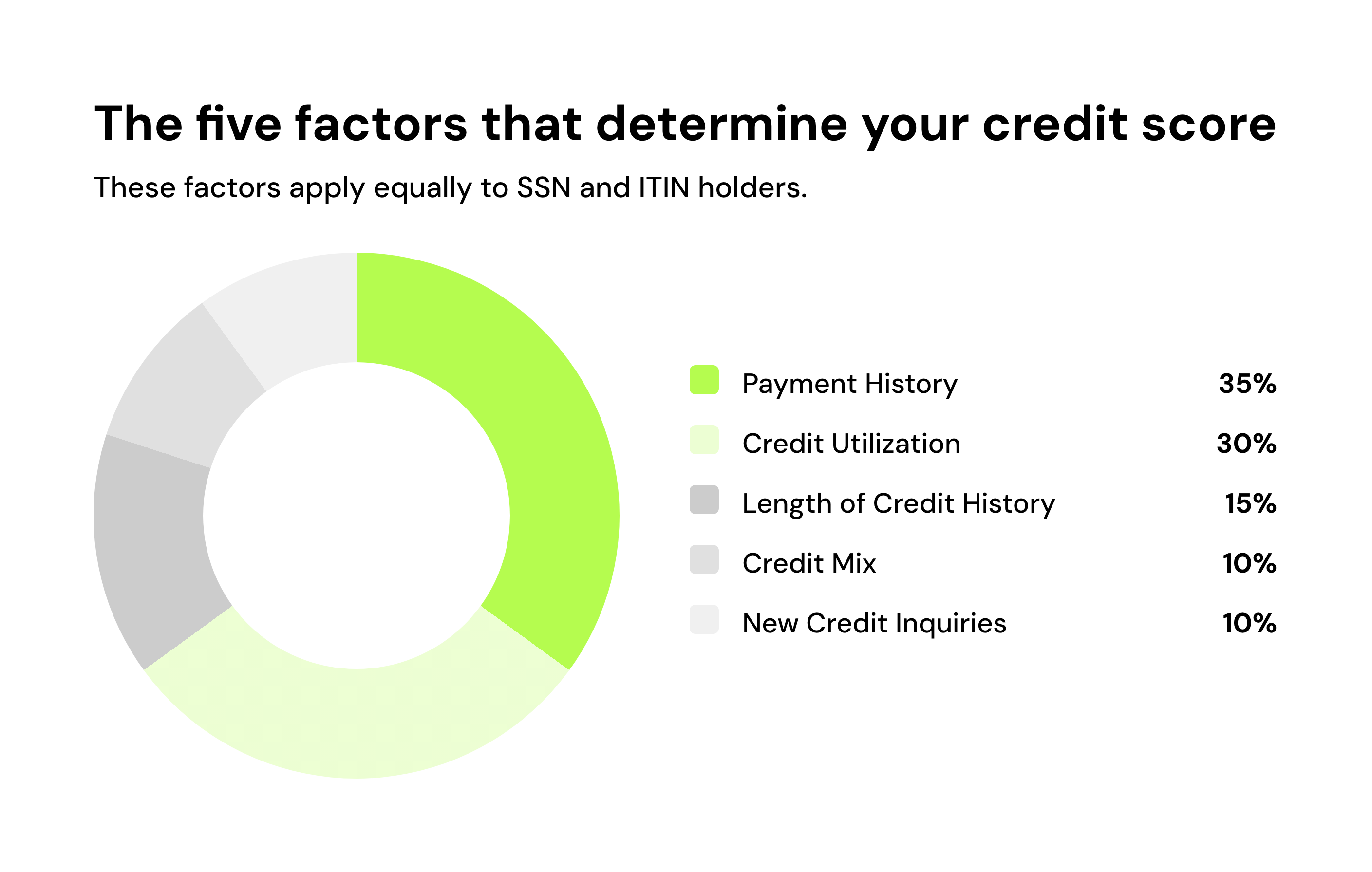
The five factors that determine your credit score, payment history (35%), credit utilization (30%), length of credit history (15%), credit mix (10%), and new credit inquiries (10%), apply equally regardless of whether your identity is tied to an SSN or an ITIN.
The main challenge for ITIN holders is finding institutions that accept ITINs during the application process, since many mainstream lenders and credit-building platforms default to SSN-only verification.
Kikoff is one platform that accepts ITINs at sign-up, making it one of the most accessible ways for ITIN holders to start building U.S. credit history with no hard credit check required.
Can you open a bank account with an ITIN?
Yes, many banks and credit unions accept ITINs for account opening.
Major banks including Bank of America, Wells Fargo, and Chase, as well as many community banks and credit unions, offer accounts to individuals without an SSN as long as they can provide an ITIN and valid identification, usually a passport or consular ID.
Having a bank account is a super important foundation for managing your finances and eventually qualifying for credit products, so this is generally one of the first steps ITIN holders should take.
Some institutions may have additional documentation requirements, be it proof of address, a secondary ID, or an in-person visit to a branch, so it's worth calling ahead to confirm what's needed before you go.
Can you get a mortgage with an ITIN?
Yes, though the process is different from a conventional mortgage.
Some lenders offer what are commonly called "ITIN loans" or "non-QM loans," which are specifically designed for borrowers without an SSN.
These loans typically require a larger down payment, generally 10% to 20%, and may carry slightly higher interest rates than conventional mortgages, but they are a real and accessible path to homeownership for ITIN holders.
Building a strong U.S. credit history before applying is super important, since lenders offering ITIN mortgages still evaluate your creditworthiness using your credit file.
The earlier you start building credit with an ITIN, the more options you'll have when it comes time to apply for a home loan.
Can an ITIN be converted to an SSN?
An ITIN cannot be directly converted to an SSN, but if you become eligible for an SSN later, such as through a change in immigration status, you should apply for an SSN and notify the IRS.
Once you receive an SSN, your existing credit history that was built under your ITIN can generally be linked to your new SSN, so your credit progress doesn't disappear.
The IRS will deactivate your ITIN once they're notified that you've received an SSN, since both numbers would then represent the same individual in the tax system.
This said, the process of merging credit files can sometimes require manual outreach to the credit bureaus to ensure your history is properly consolidated.
Building your financial foundation with an ITIN
Having an ITIN rather than an SSN doesn't close the door on building a strong financial life in the United States.
Lots of ITIN holders have built excellent credit scores, opened bank accounts, purchased homes, and accessed financial products that put them on solid footing over time.
The key is starting early, finding institutions that accept ITINs, and building positive credit habits consistently.
Kikoff accepts ITINs at sign-up and begins reporting your payment activity to the major credit bureaus immediately, making it one of the fastest ways to establish a U.S. credit profile if you're starting from scratch.
Conclusion
The difference between an ITIN and an SSN comes down to who each number is for and what it authorizes.
An SSN is issued to eligible U.S. residents and sits at the center of employment, benefits, and financial identity. An ITIN is issued by the IRS for tax purposes to individuals who don't qualify for an SSN, and while it's more limited in scope, it's far from a dead end financially.
ITIN holders can open bank accounts, build credit, and even qualify for mortgages with the right institutions.
If building U.S. credit is part of your financial goals, Kikoff makes it easy to get started with no hard credit check required.
Frequently Asked Questions
Yes, some credit card issuers accept ITINs in place of SSNs. Not all issuers do, so it's worth checking the specific requirements before applying. Secured credit cards and credit-building platforms that explicitly support ITIN sign-ups, like Kikoff, are generally the most accessible starting points.
No. Having an ITIN versus an SSN does not directly affect how your credit score is calculated. Your score is based entirely on the activity in your credit file, and that activity is tracked the same way regardless of which identification number is associated with your account.
Generally, no. Your credit history built under an ITIN can typically be linked to your new SSN, though you may need to contact the credit bureaus directly to ensure the files are properly merged. It's a good idea to notify the bureaus proactively once you receive your SSN rather than waiting for the link to happen automatically.
No. An ITIN is a tax identification number only and does not authorize work in the United States. Work authorization is a separate matter governed by immigration status and is not connected to whether someone has an ITIN.
Sources
Disclaimer: The information provided in this blog post is meant for informational purposes only and does not constitute financial advice.