
A high-yield savings account (HYSA) is a savings account that pays more interest than a traditional one, usually at an online bank or credit union. Opening one takes five steps and includes comparing APYs and checking the fees, minimums, and withdrawal limits that can eat into what you earn.
How to open a high-yield savings account in 5 steps
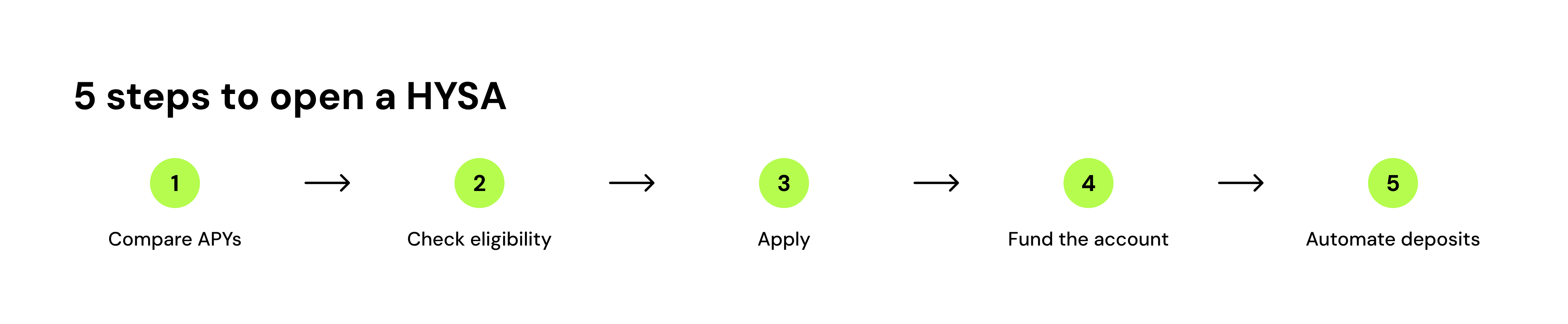
1. Compare APYs and account features
Look at your own bank, at least one credit union, and at least one online bank. Rates can differ a lot from one institution to the next.
Compare offers by annual percentage yield (APY). APY already includes compounding (the interest you earn on your interest), so you don't need to compare how often each account compounds. Once you've narrowed the list, check fees, minimums, withdrawal limits, and insurance.
2. Check eligibility requirements
Read the fine print before you apply. Some accounts need a minimum opening deposit or balance. Some banks save their best rate for customers who also have a checking account with them. The account disclosures spell all of this out before you apply.
3. Apply online or in person
You can typically apply online, at a branch, or by phone, with digital banks requiring online applications.
Most applications ask for:
- Your name, date of birth, and address
- Your Social Security number (some banks accept an ITIN instead)
- Your phone number and email
- A government-issued photo ID
- Account and routing numbers for the account you’ll transfer your deposit from
You might also need proof of address, if the bank can’t confirm it electronically.
4. Fund your account
Once you’re approved, your next step is funding the account. You can usually do this with an electronic transfer from your current bank. Ask how long it takes to land in your new account.
5. Set up direct deposit or automatic transfers
Saving is easiest when you don’t have to remember to do it. Set up a recurring transfer from checking to your high-yield account for the day after payday. Or, if your employer lets you split direct deposit, send a set amount of each paycheck straight to savings and the rest to checking.
Keep the money you use to pay everyday bills in your checking. Savings accounts can limit transfers, and moving money back might take a few days, which is too slow when rent is due.
Read more >> How to Build an Emergency Fund
Make the bills you already pay count. On-time payments for rent and everyday bills usually don’t appear on your credit report on their own.
Kikoff can change that:
• Rent reporting adds your monthly rent payments, which is often your biggest bill.
• Bill reporting adds bills like your cell provider, so payments you’re already making can build credit history.
What to look for in a high-yield savings account
Annual percentage yield (APY)
APY tells you how much interest you’d earn in a year, including compounding.
Say you put $1,000 in an account with a 3% APY. After a year, you’d have about $1,030. If the rate stayed the same, you’d have about $1,159.27 after five years, all without adding another dollar.
HYSA rates are variable, which means the bank can lower your rate anytime after you open the account. Some accounts also advertise an introductory rate that drops after a few months. The account disclosures show you how long the advertised rate lasts.
Minimum balance requirements
Some accounts charge a fee or pay a lower APY if your balance drops below a specified amount. If you’re starting small, look for an account with no minimum.
Fees
A monthly maintenance fee can quickly eat into your earnings. Even $5 a month is $60 a year, which can be higher than the interest you earn.
Check the account’s fee schedule for maintenance and other fees, like those for withdrawals, transfers, or overdrafts.
Access and withdrawal limits
Until 2020, a Federal Reserve rule limited some savings withdrawals and transfers to six a month. The Fed dropped that cap, but it doesn’t require banks to drop their own limits, which means some still have them.
The account agreement lists the limit and any fee for going over, so check it before you count on moving your money quickly.
FDIC or NCUA insurance
Your money is protected if the bank fails, as long as the bank is insured. Deposits at FDIC-insured banks and federally insured credit unions are covered up to $250,000 per depositor, per bank, for each account ownership category. The NCUA applies the same limits to credit unions.
Two situations worth a second look:
- Several state-chartered credit unions are insured by private insurers instead of the NCUA.
- If you open an account through a fintech app that isn’t a bank, FDIC insurance may cover the partner bank holding your money, and not the app company itself.
Look up any bank in the FDIC BankFind Suite to confirm insurance status. For a credit union, use the NCUA Credit Union Locator.
Read more >> Are High-Yield Savings Accounts Safe?
How to find the bank behind an app. If the app isn’t a bank, the name of the app usually isn’t the name to search. Three places to find the partner bank:
• The app’s disclosures, often in fine print on the signup or home screen. Look for “Banking services provided by [Bank], Member FDIC.”
• Your account agreement, which names the institution holding your deposits.
• The confirmation email when you open the account, which often names the bank even when the app doesn’t display it prominently.
If no bank is named anywhere, treat that as the answer. And note that “FDIC insured” in marketing copy isn’t the same as a named, verifiable institution. In 2024, the collapse of Synapse, a company that connected fintech apps to their partner banks, left many customers unable to reach their money they thought was insured.
Who should open a high-yield savings account?
A high-yield savings account is a good spot for money you want safe, within reach, and earning more than a traditional account, like an emergency fund or a specific savings goal in the next year or two.
For money you won’t touch for a while, a certificate of deposit lets you lock in a rate for a set term, which means it won’t change with the market.
Read more >> How to Open a CD Account (and Keep the Interest You Earn)
Bottom line
Opening a high-yield account takes a few minutes and can help you earn higher rates on your savings than a traditional account. Compare APYs at a bank, a credit union, and an online bank, and check the fees and withdrawal limits. Automate your deposits so the account keeps growing without you thinking about it.
Your high-yield savings account will grow, but it won't show up on your credit report. Lenders can't see what you've saved, only how you've paid. A Kikoff Credit Account reports your on-time payments to all three credit bureaus, with no credit check to sign up. Plans start at $5 a month.
Frequently Asked Questions
Article Sources
Disclaimer: The information provided in this blog post is meant for informational purposes only and does not constitute financial advice.