.jpg)
.jpg)



Studying in another country comes with enough new systems to figure out. U.S. credit can feel like one more, especially when lenders ask for identification, income, and a credit history you may not have yet.
The good news is that international students can build U.S. credit. Your best starting point depends on your age, income, identification, and the requirements of the account you choose.
How to build credit as an international student in the U.S.
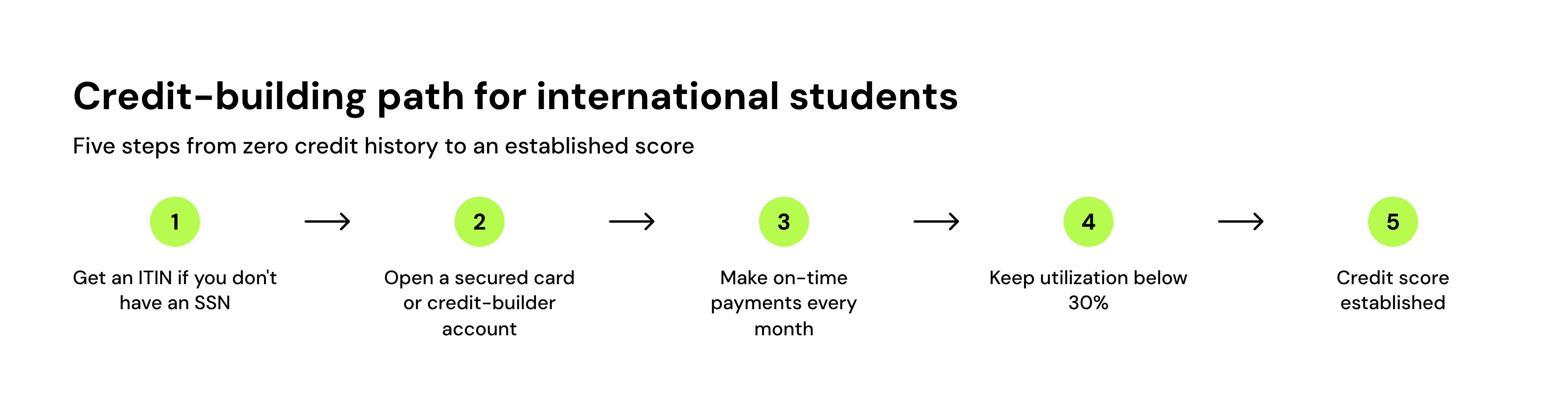
International students can begin establishing credit in several ways. Before applying, confirm that the provider accepts your identification and reports account activity to the credit bureaus.
Consider a secured credit card
A secured credit card can be a useful starting point if you have limited or no U.S. credit history. You provide a cash deposit that usually helps determine your credit limit.
The deposit protects the card issuer if the account goes unpaid, but it does not replace your monthly payments. You still need to make at least the required payment by each due date.
Before applying, check which forms of identification the issuer accepts, whether it reports to all three credit bureaus, and what it charges in fees and interest. You usually receive your deposit back after paying the balance and closing the account. Some issuers may also upgrade you to an unsecured card, but that is not guaranteed.
Use the card only for purchases you can afford, and try to pay the full statement balance each month to avoid interest.
Consider a student credit card
Student credit cards are unsecured cards designed for college students with limited credit histories. Approval is not automatic, and the issuer may consider your income, age, identification, U.S. address, and other application details.
If you are under 21, federal rules generally require you to show an independent ability to make the payments or apply with a qualifying cosigner, guarantor, or joint applicant who is at least 21. Not every card issuer allows cosigners, so check before applying.
Compare annual fees, interest rates, foreign transaction fees, and credit-bureau reporting. The issuer may raise your credit limit after a period of responsible use, but an increase is not guaranteed.
Consider a credit-building product
Credit-building products come in several forms, including revolving accounts, credit-builder loans, and payment-reporting services. Before signing up, check the total cost, required monthly payment, accepted identification, credit bureaus used, and consequences of missing a payment.
Kikoff’s Credit Account is a free revolving credit line used for purchases in the Kikoff Store. It charges no interest and reports your on-time payments to all three credit bureaus, with no hard credit check to sign up. Applicants can verify their identity with an SSN or ITIN, but eligibility requirements still apply.
Become an authorized user
If you have a trusted relative or friend who manages a credit card responsibly, you could ask them about adding you as an authorized user. Before moving forward, ask the issuer whether it reports authorized users to the credit bureaus and what identification it requires.
If the account is reported, it may appear on your credit reports. A long history of on-time payments and manageable balances may help, while missed payments or high balances may hurt. The effect depends on the account, the information reported, and the scoring model.
Remember that the primary cardholder controls the account and is legally responsible for the balance. Agree in advance on whether you can use the card and how you will repay any purchases.
Read more >> What Is Credit Piggybacking and Does It Work?
How the U.S. credit system works
The United States has three nationwide credit bureaus:
- Equifax
- Experian
- TransUnion
These companies collect information from lenders and other businesses to create credit reports. Reports may include your credit accounts, payment history, balances, credit limits, and hard inquiries from credit applications. The bureaus may not all receive the same information.
Credit-scoring companies such as FICO and VantageScore use information from those reports to calculate credit scores. For the general population, FICO groups that information into five categories:
- Payment history: 35%
- Amounts owed: 30%
- Length of credit history: 15%
- New credit: 10%
- Credit mix: 10%
These are general weights, and their importance can vary based on the person and credit profile. Different scoring models can also produce different scores.
You can review your free credit reports at AnnualCreditReport.com. These reports do not necessarily include a free credit score.
Read more >> How to Read a Credit Report
Can you build credit without a Social Security number?
In some cases, yes. However, each lender sets its own identification requirements, so your options may be more limited without a Social Security number.
A student visa alone does not make you eligible for an SSN. In general, the Social Security Administration issues original SSNs to noncitizens who have permission to work from the Department of Homeland Security. F-1, M-1, and J-1 students may need different documents depending on their work authorization, so begin with your designated school official or program sponsor and review the SSA requirements.
An ITIN is different. The IRS issues an ITIN for federal tax purposes to people who need a U.S. taxpayer identification number but are not eligible for an SSN. You should not apply for an ITIN solely to open a credit account.
Some lenders accept an ITIN as a taxpayer identification number, while others require an SSN. They may also request a passport, proof of a U.S. address, and income documentation. Ask what the lender accepts before applying, particularly if the application may involve a hard credit inquiry.
Know what an ITIN does: An ITIN does not authorize you to work, change your immigration status, or serve as identification outside the federal tax system. If you are unsure whether you have a qualifying tax reason, speak with your school’s international student office or a qualified tax professional before applying. Review the IRS requirements.
Read more >> What’s the Difference Between ITIN and SSN?
How early should you build credit?
Start building credit when you can qualify for an account that fits your budget and manage it consistently. A longer credit history can be helpful, but there is no reason to take on unnecessary debt or pay interest just to begin.
One manageable account that reports your activity can establish a credit history over time. What matters most is making payments on time and avoiding balances you cannot afford.
How visa status can affect your options
International students in the United States commonly hold one of these visa types:
- F-1: Academic study
- J-1: Exchange program
- M-1: Vocational or other nonacademic study
Your visa category does not directly determine your credit score. However, it can affect your work authorization, income, SSN eligibility, and the documents a lender requests. Employment rules depend on your status and circumstances, so speak with your designated school official or J-1 program sponsor before accepting work.
Federal lending rules allow creditors to consider immigration status when it is relevant to their rights and remedies for repayment. They cannot use national origin as a basis for discrimination.
Before submitting an application, ask the lender which forms of identification, address documentation, income, and credit history it requires. If you believe a lender discriminated against you based on national origin, review any adverse action notice you received and consider contacting legal aid or submitting a complaint to the CFPB.
Common mistakes to avoid
When you are new to the U.S. credit system, avoid these common mistakes:
- Applying before checking the issuer’s identification and income requirements
- Submitting several credit applications within a short period
- Missing payment due dates
- Assuming a secured-card deposit counts as a monthly payment
- Carrying high balances or treating 30% utilization as a safe cutoff
- Paying only the minimum without understanding the interest cost and payoff time
- Carrying a balance because you think paying interest helps build credit
- Applying for an ITIN solely to qualify for credit
There is no universal utilization percentage that guarantees a particular result. Lower reported revolving balances are generally better, but the effect varies by scoring model and credit profile.
Paying at least the minimum by the due date prevents a late payment for that billing cycle, but consistently paying only the minimum can cost more in interest and keep your balance high. You do not need to carry a balance or pay interest to build credit.
Bottom line
Building credit as an international student is possible, but the right paperwork comes first. Apply for an SSN only if you are eligible, and consider an ITIN only if you have a federal tax purpose and are not eligible for an SSN.
Before applying for an account, confirm that the lender accepts your identification and reports to the credit bureaus. Once you have an account, make every payment on time, keep your balance manageable, and review your credit reports for accuracy.
Kikoff’s Credit Account reports your on-time payments to all three credit bureaus, with no hard credit check to sign up. Applicants can verify their identity with an SSN or ITIN, but eligibility requirements apply. Get started.
Frequently Asked Questions
Article Sources
Disclaimer: The information provided in this blog post is meant for informational purposes only and does not constitute financial advice.