


.jpg)
.jpg)


.jpeg)
Immigrating to the United States is a tremendous undertaking. Once you get settled in, you’ll be ready to build your new future. If you want to establish a solid financial footing in your new home, you can start by focusing on your credit.
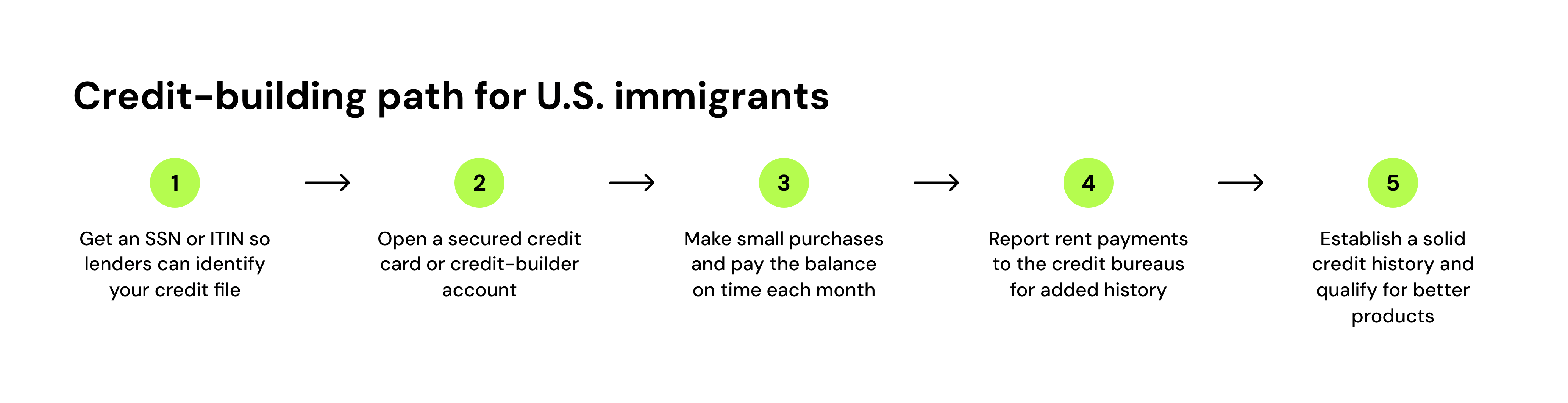
You can build credit as an immigrant through a secured credit card, an authorized-user account, or another product that reports your payments. The first step is finding an option that accepts your identification and fits your budget.
How the U.S. credit system works
The U.S. credit system helps lenders assess how you have handled borrowing and repayment. Three nationwide credit bureaus, Experian, Equifax, and TransUnion, collect information about credit accounts and payments to create credit reports.
A credit report and a credit score are different. Scoring models such as FICO and VantageScore use information from your reports to calculate scores.
FICO uses these five categories, with the following general weights:
- Payment history: 35%
- Amounts owed: 30%
- Length of credit history: 15%
- New credit: 10%
- Credit mix: 10%
Credit utilization, or how much of your available revolving credit you use, falls within amounts owed. These weights can vary by credit profile, and other scoring models work differently.
Higher scores can help you qualify for lower interest rates and better loan terms, but lenders also consider factors such as income and existing debt. Limited credit history can make approval harder, even if you have never missed a payment.
Credit information can also affect rental applications. Some employers review credit reports with your written permission, subject to state and local restrictions.
Read more >> How to Read a Credit Report
Can you build credit without a Social Security number?
Yes. Some lenders accept an Individual Taxpayer Identification Number (ITIN) instead of a Social Security number (SSN), although you still need to meet their other requirements.
If you are eligible for an SSN and do not already have one, review the SSA application process. Applying is free, but the steps and documents depend on your circumstances. You may need to visit a Social Security office to complete the process.
If you are not eligible for an SSN, an ITIN may be an option only if you have a federal tax purpose. You cannot obtain one solely to build credit.
Before submitting a credit application, ask which identification the lender accepts and whether you need additional documents, such as a passport, proof of address, or proof of income.
Before applying for an ITIN: An ITIN does not authorize work or change your immigration status. If you are unsure whether you need one for taxes, a qualified tax professional or IRS-authorized acceptance agent can help you understand the requirements.
Read more >> What’s the Difference Between ITIN and SSN?
How to build credit as an immigrant to the U.S.
Want to start building your credit? Here are a few strategies to help you get started.
Apply for a student credit card or secured credit card
If you are enrolled in college, a student credit card may be an option. These cards are often designed for applicants with limited credit histories, but approval still depends on the issuer’s requirements.
If you are under 21, you generally need to show an independent ability to pay or have a qualifying cosigner, guarantor, or joint applicant who is at least 21. Not every issuer offers those arrangements.
A secured credit card is another option, even if you are not a student. You provide a deposit that usually helps determine your credit limit, but you still have to make monthly payments. The deposit does not pay your bill for you.
You usually get the deposit back after paying off the balance and closing the account. Some issuers return it when you qualify for an upgrade to an unsecured card, but policies vary.
With either option, check accepted identification, fees, interest rates, and credit-bureau reporting before applying.
Use a credit-builder app
Some credit-building apps accept an ITIN, including Kikoff. Before choosing one, check its eligibility requirements, costs, and which credit bureaus receive your account information.
Kikoff’s Credit Account is a free revolving credit line used only for purchases in the Kikoff Store. Here’s how it works:
- If you apply and are approved, you can use the credit line for eligible store purchases.
- You repay those purchases over time, without interest.
- Kikoff reports your on-time payments to all three credit bureaus.
You can apply using an SSN or ITIN, with no hard credit check to sign up. Other eligibility requirements still apply.
Ask to be added as an authorized user
If a trusted family member or friend has a credit card with a history of on-time payments and low balances, ask whether they would consider adding you as an authorized user. First, confirm that the issuer reports authorized users to the credit bureaus and accepts your identification. If it reports the account, that history may help you establish credit.
However, this method isn’t foolproof. If the owner of the account maxes out the card or misses payments, your credit can be damaged along with theirs.
Agree on any spending limits and how you will repay purchases, since the primary cardholder is responsible for the balance.
Read more >> What Is Credit Piggybacking and Does It Work?
How early should you build credit?
Start when you can afford and consistently manage an account. A longer credit history can be helpful, but taking on payments you cannot afford can set you back.
Begin with one manageable account and make payments on time. You do not need to carry a credit-card balance or pay interest to build credit.
Common mistakes to avoid
Learning a new financial system takes time. A few mistakes to watch for include:
- Applying without checking which identification the lender accepts
- Choosing an account without comparing fees or confirming credit-bureau reporting
- Missing payments or spending more than you can repay
- Applying for several credit cards within a short period
- Assuming a checking account or debit card builds credit by itself
- Paying someone who promises guaranteed approval or a new credit identity
A bank account can help you manage bills, but using cash is not itself a credit mistake. For credit building, focus on accounts that report your activity and payments you can comfortably afford.
If an application or agreement is unclear, ask the provider to explain it before signing. Getting help from someone you trust is fine, but keep control of your accounts and understand any debt taken out in your name.
Bottom line
Building credit as an immigrant takes time, but you can start small. Find an account that accepts your identification, reports to the credit bureaus, and has payments you can afford.
If you need an SSN, check your eligibility first. An ITIN is an option only when you have a federal tax purpose and are not eligible for an SSN.
Kikoff’s Credit Account reports your on-time payments to all three credit bureaus, with no hard credit check to sign up. Eligible applicants can use an SSN or ITIN. Start building a positive credit history with Kikoff.
Frequently Asked Questions
Article Sources
Disclaimer: The information provided in this blog post is meant for informational purposes only and does not constitute financial advice.