

.jpg)
.jpg)


Dealing with a debt collector can leave you feeling pressured or unsure of what you have to do. The Fair Debt Collection Practices Act gives you rights when certain collectors contact you about personal debt.
The law limits when and how collectors can contact you, requires them to provide information about the debt, and prohibits harassment, deception, and unfair collection practices. It does not erase a valid debt, but it gives you ways to verify what you owe and respond when a collector crosses the line.
What is the Fair Debt Collection Practices Act?
The Fair Debt Collection Practices Act, or FDCPA, is a federal law that regulates covered debt collectors. It generally applies to collection agencies, many debt buyers whose principal business is collecting debts, and lawyers who regularly collect consumer debts.
The law covers debts primarily incurred for personal, family, or household purposes, including:
- Credit-card debt
- Medical debt
- Auto loans
- Personal loans
- Mortgages
- Student loans
The FDCPA generally does not cover an original creditor collecting its own debt under its own name. However, other federal laws and state collection laws may provide additional protections, including protections against original creditors.
For example, imagine you owe a medical provider $500. If the provider contacts you directly, the FDCPA may not apply. If the account is transferred or sold to a collection agency, the FDCPA generally applies to that collector.
Why the FDCPA was created
Congress enacted the FDCPA in 1977 to stop abusive, deceptive, and unfair collection practices. The law prohibits conduct such as:
- Threatening violence or arrest
- Repeatedly calling to harass you
- Misrepresenting the amount or legal status of a debt
- Pretending to be a lawyer, government official, or law enforcement officer
- Adding interest or fees that are not authorized by your agreement or the law
- Using documents designed to look like official court papers when they are not
The Consumer Financial Protection Bureau and Federal Trade Commission enforce federal debt-collection rules. The FDCPA also allows people to bring private lawsuits against covered debt collectors.
Read more >> What Is the Consumer Credit Protection Act?
Your rights under the FDCPA
The FDCPA and its implementing rule, Regulation F, give you several protections when a covered debt collector contacts you.
Protection from harassment
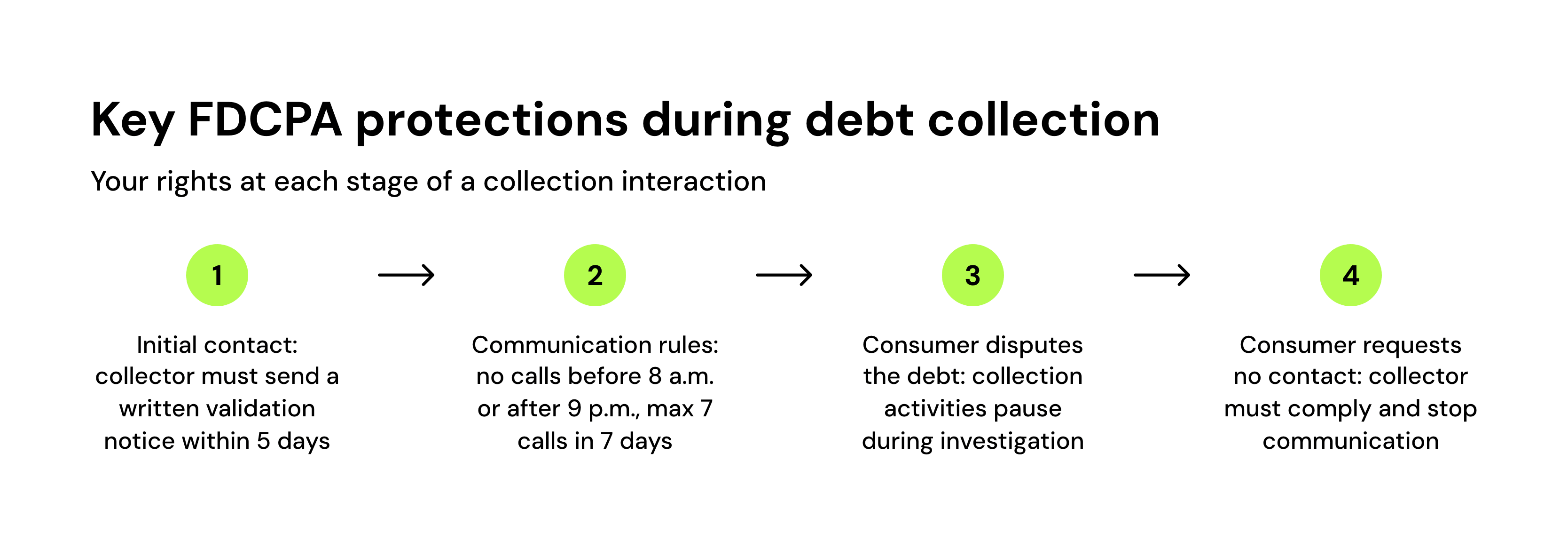
Debt collectors cannot call repeatedly with the intent to annoy, abuse, or harass you. Regulation F also establishes presumptions based on how frequently a collector calls about a particular debt.
A collector is generally presumed to violate the rule if it:
- Places more than seven calls within seven consecutive days about a particular debt
- Calls within seven consecutive days after speaking with you by phone about that debt
These are presumptions, not a simple seven-call allowance. Fewer calls could still violate the law if the overall conduct is harassing, and certain calls do not count toward the limits.
Collectors generally cannot contact you before 8 a.m. or after 9 p.m. in your local time unless you agree to another time. They also cannot contact you at work if they know your employer prohibits those communications.
The right to limit contact
You can tell a collector to stop using a particular communication method, such as calls to a specific phone number or messages sent to an email address. The collector generally must honor that request.
If you want a collector to stop contacting you through every channel, send the request in writing and keep proof that it was delivered. After receiving it, the collector may generally contact you only to confirm that communication will stop or to tell you about a specific legal action it may take.
Stopping contact does not erase the debt: A collector may still report accurate information or pursue other lawful collection methods, including a lawsuit. Review the debt and any court papers instead of assuming that silence means the matter is closed.
The right to information about the debt
A debt collector generally must provide validation information during its first communication or within five days afterward. The notice should include details such as:
- The collector’s name and mailing address
- Your name
- The creditor’s name
- An itemization of the debt
- The current amount claimed
- Instructions and a deadline for disputing the debt
Review the notice before providing financial information or agreeing to pay. If you do not recognize the collector, contact the original creditor using independently verified contact information.
The right to dispute the debt
The validation notice should identify the end of a 30-day dispute period. If you dispute all or part of the debt in writing during that period, the collector must generally pause collection of the disputed amount until it provides verification.
Your written response should identify the account and explain what you dispute. During the 30-day dispute period, you can also request the name and address of the original creditor if it differs from the current creditor.
Put the dispute in writing: You may still question a debt after the 30-day period, but waiting can affect your right to make the collector pause collection while it responds. Keep a copy of your letter and proof of delivery.
Protection from threats and deception
A collector cannot threaten to arrest or physically harm you. It also cannot threaten a lawsuit, wage garnishment, property seizure, or another action that it cannot legally take or does not intend to take.
Collectors cannot lie about who they are, how much you owe, or whether documents are legal papers. They also cannot collect fees or interest unless those charges are authorized by your agreement or applicable law.
The right to privacy
Debt collectors generally cannot discuss your debt with friends, coworkers, neighbors, or other third parties. They may contact someone for limited location information, but they generally cannot reveal that you owe a debt.
If a collector knows that an attorney represents you regarding the debt and can readily obtain the attorney’s contact information, it generally must communicate with the attorney instead.
Read more >> How to Remove Collections From Your Credit Report
What to do if a debt collector violates the FDCPA
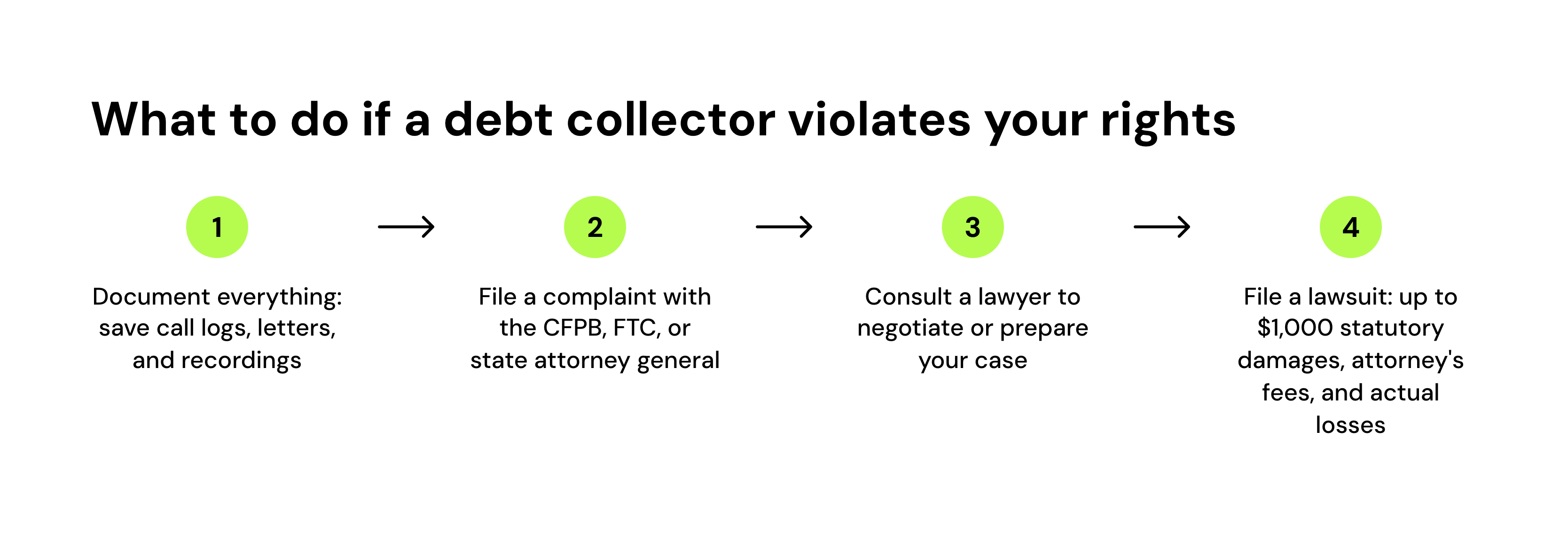
If you believe a collector has violated your rights, preserve the evidence before taking the next step.
Document what happened
Save letters, emails, text messages, voicemails, and screenshots. Keep a written log that includes:
- The date and time of each contact
- The phone number or address used
- The name of the collector or company
- What the collector said or threatened
- Any requests you made to limit communication
- Copies and delivery records for letters you sent
Recording laws differ by state, so check the law or speak with an attorney before recording a telephone conversation.
File a complaint
You can report collection problems to:
- The Consumer Financial Protection Bureau
- The Federal Trade Commission
- Your state attorney general
A complaint creates a record and may lead to a response or investigation. Filing one does not pause a collection lawsuit or extend the deadline for responding to court papers.
Consult a consumer-law attorney
A consumer-law attorney can help you determine whether the collector violated federal or state law. Legal aid organizations may provide free or reduced-cost help if you qualify.
If you receive a summons or complaint, respond by the court’s deadline. Ignoring a lawsuit can result in a default judgment, even if you believe the debt is wrong or too old to sue over.
Consider whether to file a lawsuit
An individual may sue a covered collector for violating the FDCPA. A successful claim may allow recovery of actual damages, court costs, reasonable attorney’s fees, and up to $1,000 in additional statutory damages.
An FDCPA lawsuit generally must be filed within one year of the violation. A collection violation does not automatically cancel an otherwise valid debt.
Before paying an older debt: The deadline for filing a collection lawsuit varies by state and debt type. In some states, making a payment or acknowledging the debt can restart that period. Check the applicable law or speak with a consumer-law attorney before agreeing to pay an older debt.
Bottom line
The FDCPA gives you the right to receive information about a debt and limits how covered collectors can communicate with you. If something seems wrong, document the contact, review the validation notice, and respond in writing.
Do not ignore court papers or rush into paying an older debt before checking the legal timeline. A consumer-law attorney or legal aid organization can help if a collector threatens legal action or you believe your rights were violated.
Resolving a collection and building positive payment history are separate steps. Kikoff Debt Negotiation, available through Kikoff Premium and Ultimate, can request an offer for eligible collections or charge-offs with your permission. You decide whether to accept any offer.
The Kikoff Credit Account reports your on-time payments to all three credit bureaus, with no hard credit check to sign up. Start building positive credit history with Kikoff.
Frequently Asked Questions
Article Sources
Disclaimer: The information provided in this blog post is meant for informational purposes only and does not constitute financial advice.