.jpg)
.jpg)


If you have applied for a mortgage, auto loan, or credit card, you have probably seen documents listing the annual percentage rate, fees, payment schedule, and other terms. Regulation Z is one reason lenders must provide that information.
Regulation Z is the federal rule that implements the Truth in Lending Act, or TILA. It requires standardized disclosures for many consumer credit products and establishes protections for certain mortgages, credit cards, home-equity products, and other loans.
These rules can help you understand and compare offers. They do not guarantee approval, limit most interest rates, or make every loan affordable.
What is Regulation Z?
You can find Regulation Z in 12 CFR Part 1026. The Consumer Financial Protection Bureau, or CFPB, maintains and enforces many of its requirements.
TILA is the federal law passed by Congress. Regulation Z contains the detailed rules that put the law into practice, including what creditors must disclose, when they must provide the information, and how certain protections work.
The regulation covers many forms of consumer credit, including:
- Mortgages
- Home equity lines of credit
- Credit cards
- Auto and other installment loans
- Certain student loans
It generally does not cover credit issued primarily for business, commercial, or agricultural purposes.
Read more >> What Is the Truth in Lending Act (TILA)?
What does Regulation Z require lenders to disclose?
The exact disclosures depend on the product, but Regulation Z commonly requires creditors to explain costs and payment terms before you become obligated on a loan or account.
For a closed-end loan, such as an auto loan, that information may include:
- Annual percentage rate, or APR
- Finance charge
- Amount financed
- Total of payments
- Number and amount of scheduled payments
- Late-payment terms
- Whether a prepayment penalty may apply
APR is especially useful when comparing offers because it expresses the cost of credit as a yearly rate and may include certain mandatory fees. It is not necessarily the same as the loan’s stated interest rate.
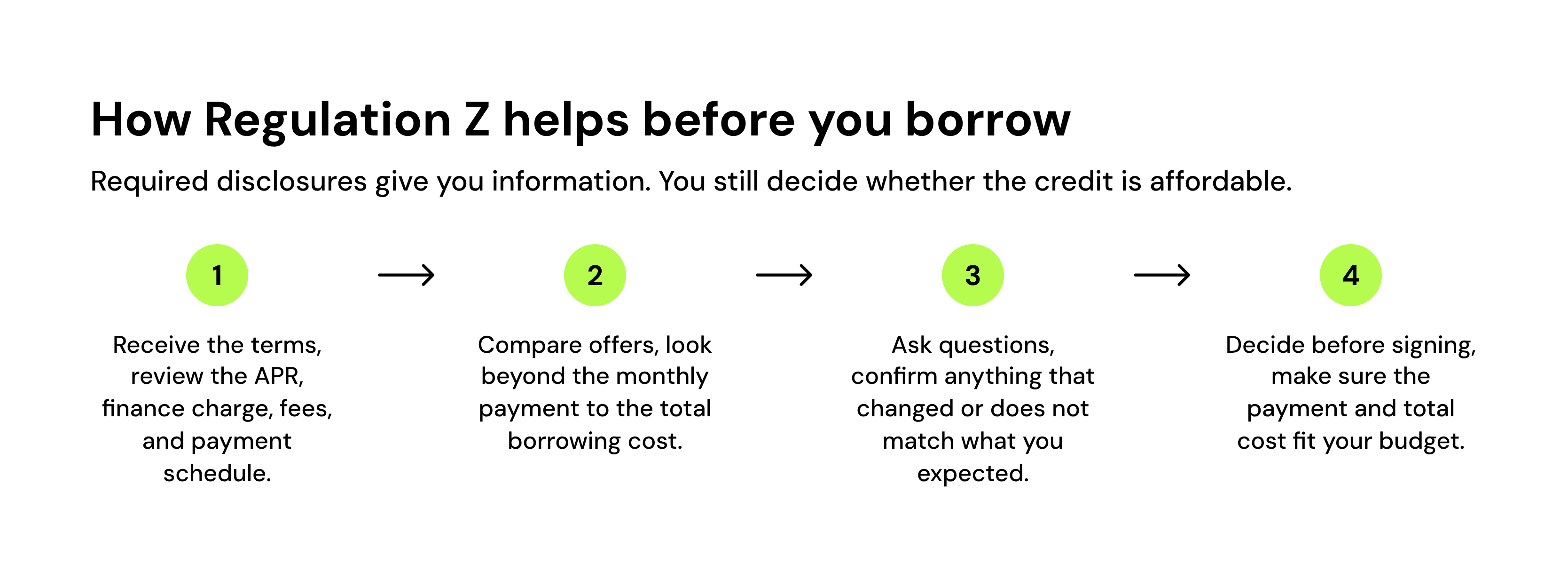
Before you sign: Confirm that the amount financed, APR, payment schedule, and total of payments match what you expected. A required disclosure tells you what the credit will cost. It does not tell you whether the payment fits your budget.
How Regulation Z protects you by credit type
Regulation Z applies differently depending on the type of credit involved.
Mortgages
For many mortgages, lenders must provide two important documents:
- Loan Estimate: Shows the estimated interest rate, monthly payment, closing costs, and other terms. It generally must be delivered or mailed within three business days of your application.
- Closing Disclosure: Shows the final loan terms and closing costs. You must generally receive it at least three business days before closing.
Compare your Closing Disclosure with your most recent Loan Estimate. If the interest rate, payment, or cash needed to close changed, ask the lender to explain why before you sign.
Regulation Z also includes the Ability-to-Repay rule. For covered mortgages, the creditor must make a reasonable, good-faith determination that you can repay the loan according to its terms.
A qualified mortgage, or QM, must meet specific requirements involving underwriting, loan features, pricing, points, and fees. Qualified mortgages give creditors certain legal protections related to Ability-to-Repay compliance. They do not protect a lender from every possible claim or guarantee that a borrower will be able to make every payment.
Mortgage refinances, home equity loans, and HELOCs
Regulation Z gives borrowers a right to cancel certain credit transactions secured by their principal residence.
For most refinances and home equity loans that are not being used to purchase the home, you generally have until midnight of the third business day after all of the following have occurred:
- You sign the credit agreement.
- You receive the required material disclosures.
- You receive the required notice explaining your cancellation rights.
The rules work somewhat differently for a home equity line of credit, or HELOC. If your principal residence secures the HELOC, you generally have three business days after opening the account or receiving the account-opening disclosures, whichever happens later, to cancel in writing.
The right to cancel generally does not apply to a mortgage used to purchase or build your primary home. Other exceptions may also apply. The CFPB provides more information about the right of rescission.
Three business days can pass quickly: Saturdays count, but Sundays and federal holidays do not. If you are unsure whether you can cancel, contact the lender and consider speaking with a consumer-law attorney promptly.
Auto loans
Before you sign an auto loan contract, the lender or dealer must provide a Truth-in-Lending disclosure showing key costs and terms.
Review the APR, finance charge, amount financed, total of payments, and payment schedule. Also check whether the contract includes a prepayment penalty.
Do not look at the monthly payment alone. A longer loan term can lower the payment while increasing the total amount you pay.
If credit is making the financing process more difficult, see how to get an auto loan with bad credit.
Credit cards
Regulation Z requires credit card issuers to disclose rates, fees, grace periods, and other account terms in a clear format. It also includes rules for billing errors, unauthorized use, rate changes, and an applicant’s ability to make the required minimum payments.
Important protections include:
- Your liability for unauthorized credit card use generally cannot exceed $50. You may owe nothing if only your account number was stolen or you reported a lost card before it was used.
- To preserve your federal billing-error rights, you generally must send a written notice within 60 days after the charge first appeared on your statement.
- After receiving a qualifying billing-error notice, the issuer generally has two complete billing cycles or 90 days, whichever is shorter, to resolve the matter.
- Issuers generally must provide 45 days’ advance notice before making certain significant changes to rates or fees.
- Before opening an account or increasing its limit, an issuer must consider your ability to make the required minimum payments based on your income or assets and current obligations.
If you see an incorrect charge, contact the issuer immediately and follow the billing-error instructions on your statement. The CFPB explains how to dispute a credit card charge.
Read more >> What Is the Credit CARD Act of 2009?
What Regulation Z does not do
Regulation Z provides important disclosures and protections, but it does not eliminate the need to review an offer carefully.
The regulation generally does not:
- Cap the interest rate a lender may charge
- Require a lender to approve your application
- Guarantee that a loan is affordable
- Eliminate all fees or penalties
- Apply to every business or personal transaction
- Protect you from the consequences of missing payments
Use the required disclosures to compare competing offers, but also consider whether the payment leaves enough room for housing, food, savings, and unexpected expenses.
What to do if a lender violates Regulation Z
If you believe a creditor failed to provide a required disclosure or violated one of your rights, gather your statements, agreements, emails, and records of any calls.
Contact the company first and explain the problem clearly. For a credit card billing error, use the billing-inquiry address and instructions listed on your statement so you do not miss the written-notice requirements.
If the company does not resolve the issue, you can:
- Submit a CFPB complaint
- Contact the federal or state regulator overseeing the lender
- Contact your state attorney general
- Consult a consumer-law attorney or legal aid organization
Legal rights and filing deadlines depend on the transaction and the alleged violation. Consider getting legal advice promptly if your home, a large amount of money, or an approaching deadline is involved.
Bottom line
Regulation Z gives you standardized information that can make credit offers easier to compare. Before signing, review the APR, finance charge, total payments, payment schedule, and any terms that could change later.
The disclosures cannot decide whether a loan is right for you. They give you the information you need to make that decision.
If you are preparing to apply for credit in the future, the free Kikoff Credit Account is a revolving credit line used only in the Kikoff Store. It reports on-time payments to all three credit bureaus, and no hard credit check is required to sign up.
Frequently Asked Questions
Article Sources
Disclaimer: The information provided in this blog post is meant for informational purposes only and does not constitute financial advice.