.jpg)
.jpg)


A charge you do not recognize, a payment that was never credited, or the same purchase listed twice can leave you wondering whether you still need to pay the bill. The Fair Credit Billing Act gives you a process for challenging certain errors on credit card and other revolving-credit statements.
The protections are time-sensitive. To preserve your rights under the law, you generally need to send the card issuer a written billing-error notice within 60 days after it sent the first statement showing the problem.
What is the Fair Credit Billing Act?
The Fair Credit Billing Act, or FCBA, is a federal law passed in 1974 as an amendment to the Truth in Lending Act. It establishes rules for correcting billing errors on open-end credit accounts.
The law generally applies to:
- Credit cards
- Retail charge accounts
- Other revolving credit accounts
- Home equity lines of credit
It does not use the same dispute process for debit cards or installment loans such as mortgages, auto loans, and personal loans. Debit-card errors fall under a different federal law and can have different reporting deadlines.
The FCBA also limits your potential liability for unauthorized credit card use. Federal law generally caps that liability at $50, although the exact protection depends on how the card was used and when you notified the issuer. If only your account number was stolen and you still have the card, you generally are not responsible for unauthorized charges.
Many issuers provide broader zero-liability policies, but those policies come from the issuer rather than the FCBA. Check your card agreement for its current terms.
What kinds of billing errors does the FCBA cover?
The FCBA dispute process covers several types of errors on revolving-credit statements.
Unauthorized charges
A charge may be unauthorized when someone who did not have permission to use your credit card made the purchase.
Using your card in a way you did not expect is not always legally unauthorized. For example, if you gave someone permission to use the card, purchases that exceeded your private instructions may still be treated as authorized until you tell the issuer that the person may no longer use it.
Report a lost card, stolen card, or unfamiliar charge immediately. Contacting the issuer quickly can stop additional transactions and may reduce your potential liability.
If the charge may involve identity theft, report it at IdentityTheft.gov and follow the recovery plan provided.
Incorrect or duplicate charges
You can dispute transactions that show the wrong date or amount, as well as purchases that appear more than once.
You can also dispute mathematical or accounting errors on the statement.
Purchases that were not delivered as agreed
A qualifying billing error may include a charge for something you did not accept or that was not delivered according to the agreement you made with the seller.
This is different from simply being unhappy with the quality of a product or service. Quality disputes may fall under separate credit card protections and can involve additional requirements. Contact the seller promptly and review your card agreement if the purchase itself is defective or unsatisfactory.
Do not let a merchant dispute use up your deadline: You can contact the seller to seek a refund, but keep track of the FCBA’s 60-day window. A slow response from the merchant does not necessarily extend the time available to send your billing-error notice.
Payments or credits that were not posted
You may dispute a payment that the issuer failed to credit to your account.
The same applies when an expected credit, such as a return or refund, does not appear on your statement. Keep receipts, payment confirmations, and correspondence that show when the payment or credit should have been applied.
Statements sent to the wrong address
Failure to send a statement to your current address may qualify as a billing error if the issuer received your written address change at least 20 days before the billing period ended.
Charges that need clarification
You can ask the issuer to explain a charge or provide written evidence of the transaction when you believe the statement contains an error.
Read more >> How to Report Identity Theft
How the dispute process works under the FCBA
Calling the issuer or filing an online dispute can be a useful first step. To protect your FCBA rights, follow the billing-error instructions on your statement. An electronic notice can satisfy the written-notice requirement if the issuer says it accepts disputes through that method. Otherwise, send a written notice to the listed billing-inquiry address.
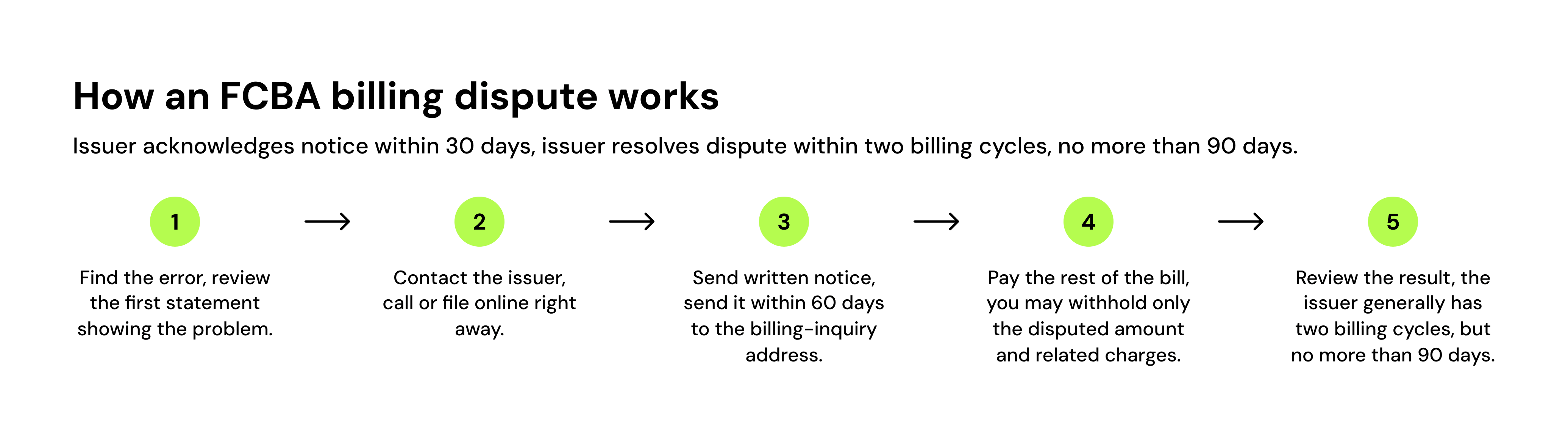
1. Review the statement
Identify the specific transaction, payment, credit, or fee you believe is wrong. Note the date, amount, and reason for the dispute.
Gather copies of receipts, payment confirmations, return records, delivery information, and any communication with the seller. Keep the original documents for your records.
2. Contact the issuer immediately
Call the number on your statement or the back of your card. This may help stop additional unauthorized activity or resolve a straightforward mistake quickly.
If your card or account information may have been stolen, ask whether the issuer should close the card and issue a replacement.
3. Send a written billing-error notice
To preserve your FCBA rights, make sure the issuer receives your billing-error notice within 60 days after it sent the first statement containing the error.
Use the address listed for billing inquiries. It may be different from the address where you send payments.
Include:
- Your name and address
- Your account number
- The amount you believe is incorrect
- The date of the disputed transaction
- A clear explanation of the problem
- Copies of documents supporting your position
Keep a copy of everything you send. Consider using certified mail or another trackable delivery method so you can show when the issuer received it.
The 60-day clock matters: An issuer may still agree to investigate a late dispute, but you could lose protections provided by the FCBA if you miss the written-notice deadline.
4. Pay the undisputed portion
You may withhold the disputed amount and related finance charges while the issuer investigates. You still need to pay the rest of your bill on time.
Continue reviewing your statements during the investigation. The disputed charge may remain visible, but the statement should indicate that you are not required to pay it while the review is underway.
5. Review the issuer’s decision
The issuer generally must acknowledge your written notice within 30 days unless it resolves the issue sooner. It must finish its investigation within two complete billing cycles and no more than 90 days.
If the issuer agrees that the bill is wrong, it must correct the account and remove related finance or other charges.
If it concludes that all or part of the charge is correct, it must explain the decision in writing. The notice should state how much you owe and when you must pay to avoid additional charges.
What creditors must do during an FCBA investigation
Once the issuer receives a qualifying written notice, it must follow specific procedures.
During the investigation, the issuer generally may not:
- Require payment of the disputed amount
- Treat your failure to pay that amount as a default
- Report you as late because you withheld the disputed amount, provided you paid the undisputed portion on time
The issuer may continue reporting the account or disputed amount as being in dispute. Additionally, the issuer may continue to accrue finance charges on the disputed amount while it investigates. If it confirms the billing error, it must credit applicable finance and other charges. If it finds no error, you may owe charges that accrued during the investigation.
If the issuer decides that you owe the amount, it must give you time to pay after explaining the result. If you still disagree, your billing statement or card agreement may explain how to provide further written notice.
Read more >> What Happens if You Miss a Credit Card Payment
What to do if an issuer does not follow the FCBA
Start by contacting the issuer and documenting the problem. Save your statements, letters, mailing records, dispute confirmations, and the issuer’s response.
If the issue remains unresolved, you can:
- Submit a complaint to the Consumer Financial Protection Bureau
- Report the issue to the Federal Trade Commission
- Contact your state attorney general’s office
- Talk with a consumer-law attorney or legal aid organization
Government agencies may use complaints to supervise companies or identify patterns, but they do not necessarily represent you or resolve every individual dispute.
The FCBA can provide legal remedies when an issuer fails to follow the required process, but the available remedies depend on the circumstances. A consumer-law attorney can help you understand your options and any deadline for filing a claim.
Read more >> What Is the Fair Credit Reporting Act?
Bottom line
The Fair Credit Billing Act gives you a structured way to challenge certain errors on credit card and other revolving-credit statements. The most important step is sending a written notice to the correct billing-inquiry address within 60 days after the issuer sent the first statement showing the error.
Contact the issuer quickly, keep copies of your supporting documents, and continue paying the portion of the bill that is not in dispute. If the issuer does not follow the required process, consider filing a complaint or asking a consumer-law attorney for help.
Once the error is resolved, check your credit reports to make sure the account is being reported accurately. If you find a credit-reporting mistake, Kikoff’s dispute tool can help you create a personalized dispute letter.
The Kikoff Credit Account also reports on-time payments to all three credit bureaus, with no hard credit check to sign up. Start building a positive credit history with Kikoff.
Frequently Asked Questions
Article Sources
Disclaimer: The information provided in this blog post is meant for informational purposes only and does not constitute financial advice.