.jpg)
.jpg)


When you apply for credit, rent a home, or go through certain background checks, a company may use information from a consumer report to make its decision. That makes the accuracy and use of this information important.
Regulation V is the federal regulation that implements parts of the Fair Credit Reporting Act, or FCRA. It establishes detailed rules for companies that collect, report, share, and use consumer information.
Regulation V cannot prevent every reporting error or case of identity theft. It does, however, help define what companies must do when handling consumer reports and disputes.
What is Regulation V?
You can find Regulation V in 12 CFR Part 1022. It applies the FCRA to specific areas of consumer reporting.
The FCRA and Regulation V are closely connected, but they are not interchangeable:
- The FCRA is the federal law that establishes consumer-reporting rights and responsibilities.
- Regulation V contains detailed rules that implement specific parts of that law.
Regulation V addresses topics such as information accuracy, disputes submitted directly to furnishers, risk-based pricing notices, affiliate marketing, medical information, identity theft, and access to consumer reports.
FCRA or Regulation V? Many protections discussed in this article originate in the FCRA. Regulation V supplies more detailed requirements for particular notices, procedures, and business responsibilities.
Read more >> What Is the Fair Credit Reporting Act?
Who must follow Regulation V?
Regulation V generally applies to several groups involved in consumer reporting:
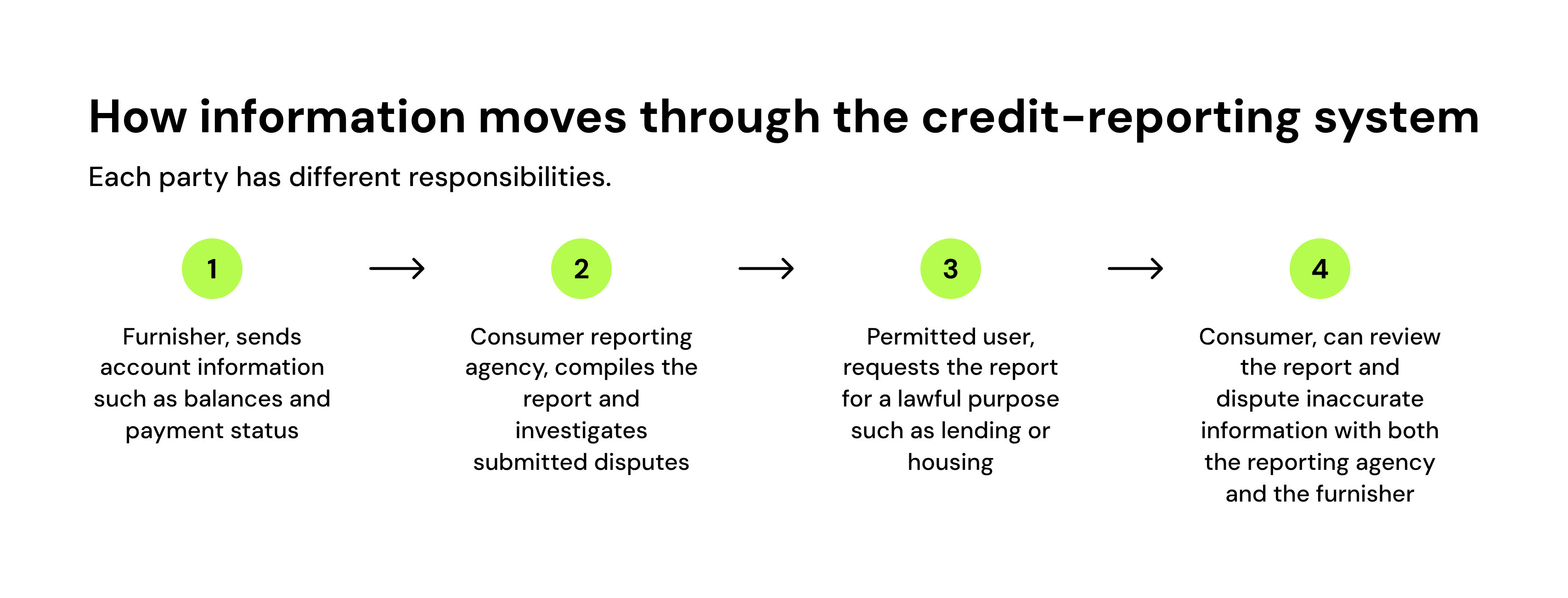
- Consumer reporting agencies: Companies that compile and sell consumer reports. This includes Equifax, Experian, TransUnion, and specialty reporting companies.
- Furnishers: Banks, lenders, landlords, debt collectors, and other companies that send information to reporting agencies.
- Users of consumer reports: Lenders, landlords, employers, insurers, and other organizations that obtain reports for legally permitted purposes.
- Companies sharing information among affiliates: Businesses that use consumer information for certain marketing or eligibility decisions.
A consumer report is not always a traditional credit report. Tenant-screening, employment-background, insurance, and checking-account reports may also be covered by the FCRA.
How Regulation V and the FCRA protect you
Your rights depend on who is handling your information and what they are doing with it. These are some of the most important protections.
Accuracy and furnisher responsibilities
Regulation V requires furnishers to maintain reasonable policies and procedures concerning the accuracy and integrity of the information they provide to consumer reporting agencies.
Accuracy means more than getting the balance right. Reported information should identify the correct person and accurately describe that person’s responsibility for and activity on the account.
If you find an account that is not yours, an incorrect balance, or a payment reported late when it was made on time, dispute the information rather than assuming it will correct itself.
Credit-report disputes
You can dispute inaccurate or incomplete information with the consumer reporting agency and the company that furnished it.
A consumer reporting agency generally has 30 days to investigate. In certain circumstances, the investigation may take up to 45 days. The company must generally send the results within five business days after completing the investigation.
A furnisher that receives an eligible direct dispute generally must:
- Conduct a reasonable investigation
- Review the information and documents you submitted
- Report the results to you
- Correct or remove information found to be inaccurate or unverifiable
- Notify the reporting agencies that received the incorrect information
The furnisher may reject a dispute that does not contain enough information or falls within an exception to the direct-dispute rule. Include the account, the exact information you dispute, your explanation, and copies of supporting documents.
Permissible purposes
A consumer reporting agency cannot provide your report to just anyone. The person or company requesting it must have a purpose permitted under the FCRA.
Permissible purposes may include:
- Reviewing a credit application or existing account
- Evaluating a rental application
- Underwriting insurance
- Collecting a debt
- Responding to a court order
- Using a report for employment purposes with your written permission
Your consent is not required for every permissible use. For example, a lender may review your report when you apply for credit. However, an employer generally must obtain your written permission before accessing a consumer report for employment purposes.
The CFPB provides a fuller explanation of who can request your credit report.
Adverse action and risk-based pricing notices
If a lender denies your application based partly or entirely on a consumer report, it generally must provide an adverse action notice.
That notice should identify the reporting company that supplied the report and explain your right to request a free copy. You generally have 60 days after receiving the notice to request that report.
Different rules can apply when a lender approves you but offers materially less favorable terms because of information in your report. In that situation, you may receive a risk-based pricing notice or a credit-score disclosure permitted under an exception.
Review either notice carefully. An unexpected denial or unusually expensive offer could be a reason to check the report used in the decision.
Identity theft protections
Regulation V contains identity-theft provisions involving active-duty alerts, proof-of-identity procedures, and how users of reports respond to address discrepancies.
The related Red Flags Rule requires covered financial institutions and some creditors with covered accounts to maintain written identity theft prevention programs. It is not a blanket requirement for every company subject to Regulation V.
These business requirements do not replace your own precautions. Continue monitoring your accounts, protect your login information, and respond quickly to unfamiliar activity.
Read more >> How to Dispute Credit Report Errors
Your rights to access credit reports
Federal law entitles you to request a free report from each nationwide credit bureau every 12 months. The three bureaus have also permanently extended a program allowing you to check each report once a week for free through AnnualCreditReport.com.
You may qualify for additional free reports if:
- A company took an adverse action based on your report
- You believe your report contains information resulting from fraud
- You placed a fraud alert
- You are unemployed and plan to apply for work within 60 days
- You receive public assistance
- Your state provides additional rights
Accessing your own credit report does not create a hard inquiry or affect your credit scores.
How long negative information can be reported
Consumer reporting companies can generally report most negative account information for up to seven years. Bankruptcies may remain for up to 10 years.
Some exceptions allow older information to appear in reports prepared for high-value credit, life insurance, or certain high-paying employment decisions. The treatment of a specific account can also depend on the type of information and the date used to calculate the reporting period.
Accurate negative information generally cannot be removed simply because you dispute it. The dispute process is for information you believe is inaccurate, incomplete, or unverifiable.
Read more >> How to Read a Credit Report
What to do if your rights may have been violated
If you find a problem with a consumer report, begin by identifying who reported the information and which reports contain it.
Then:
- Save your records. Keep the report, statements, letters, emails, and any documents supporting your position.
- Dispute the information with the reporting agency. Follow the instructions included with the report.
- Dispute it with the furnisher. Send the company the specific information you contest and copies of your evidence.
- Keep proof of delivery. Save confirmation numbers or use a mailing method that provides tracking.
- Review the results. Confirm that corrections appear on every affected report.
Before submitting a CFPB complaint about inaccurate or incomplete information, you generally must first dispute the item directly with the consumer reporting agency. If the dispute does not resolve the problem, you can submit a CFPB complaint.
If the issue has caused a loan denial, housing problem, financial loss, or another serious consequence, consider speaking with a consumer-law attorney or legal aid organization. Legal deadlines may apply.
If you believe the information resulted from identity theft, report it at IdentityTheft.gov and follow the recovery plan created for you.
Read more >> How to Report Identity Theft
Bottom line
Regulation V helps define how companies collect, report, use, and correct consumer information. Its protections work alongside the FCRA, so the exact requirement depends on whether you are dealing with a reporting agency, a furnisher, or a user of your report.
Check your reports regularly and dispute information you believe is wrong. Clear documentation and prompt action can make the process easier.
Kikoff’s credit dispute tool can help you prepare personalized dispute letters for information you believe is inaccurate. If you also want to add positive payment history, the free Kikoff Credit Account reports on-time payments to all three credit bureaus, with no hard credit check to sign up.
Frequently Asked Questions
Article Sources
Disclaimer: The information provided in this blog post is meant for informational purposes only and does not constitute financial advice.