.jpg)
.jpg)



Paying the minimum on your credit card by the due date satisfies that month’s payment requirement. It is better than missing the payment, but it does not necessarily mean your debt is under control.
If you continue making purchases or your payment barely exceeds the interest and fees charged, your balance may fall very slowly. That can keep your interest costs and credit utilization higher for longer.
Does paying only the minimum hurt your credit?
Making at least the minimum payment by the due date means the payment is not late. However, the remaining balance can still affect your credit through utilization and other balance-related factors.
The problem is the balance left behind. Credit-scoring models consider how much revolving credit you are using compared with your available limits. This percentage is called your credit utilization ratio.
For example, a $2,400 balance on a card with a $3,000 limit represents 80% utilization. Making the minimum payment may reduce that percentage slightly, but new interest and purchases can keep the reported balance high.
Card issuers periodically report account information to the credit bureaus. The balance on your credit report may therefore differ from the balance you see when you sign in to your account. Paying before the due date does not guarantee that a lower balance will be reported during that particular reporting cycle.
On time does not mean interest-free: Paying the minimum by the due date can keep your account current, but you generally need to pay the full statement balance to avoid interest on purchases when your card offers a grace period.
Read more >> What Happens if You Miss a Credit Card Payment
Why minimum payments cost more
Credit card issuers use different formulas to calculate minimum payments. Your minimum may be based on a percentage of the balance, interest and fees, a fixed floor, or some combination of those amounts.
Making only the minimum usually means:
- It takes longer to pay off the balance
- You pay more interest
- Less credit becomes available for other needs
- Your utilization may remain elevated
- New purchases can offset your repayment progress
Many issuers calculate interest daily using an average daily balance. When interest is accruing, paying earlier or paying more can reduce the balance used to calculate future interest.
Your monthly statement includes a minimum-payment warning showing how long repayment could take if you make no new purchases and pay only the minimum. It also generally shows the estimated monthly payment needed to repay the current balance in three years.
Those figures are based on the balance and terms shown on that statement. New purchases, fees, rate changes, or missed payments can change the result.
Check for deferred interest
A promotion advertised as “no interest if paid in full” is not necessarily the same as a standard 0% introductory APR.
With a deferred-interest offer, failing to pay the promotional balance by the deadline can cause interest to be charged back to the purchase date. Minimum payments are often not enough to clear the balance before that deadline.
Check your statement for the promotional expiration date and calculate the monthly amount needed to pay the balance before it ends.
How much should you pay?
If you can afford it, paying the full statement balance by the due date is generally the simplest way to avoid purchase interest when your card has a grace period.
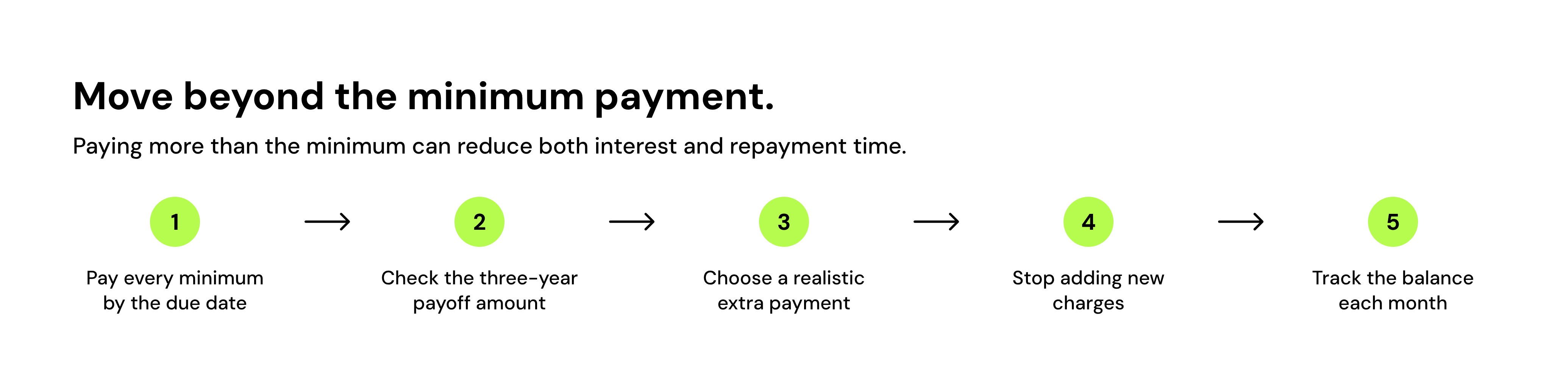
If paying in full is not realistic, pay at least the minimum on time and choose a fixed amount above it that fits your budget. Even a modest extra payment can reduce the time and interest required to repay the balance.
When deciding how much extra to send:
- Cover essential expenses such as housing, food, utilities, transportation, and healthcare.
- Make at least the minimum payment on every card.
- Keep a small emergency cushion when possible.
- Direct extra money toward one balance.
- Avoid adding new charges to the card you are paying down.
Your statement’s three-year repayment estimate can provide a useful target. You are not required to pay that amount, but it shows how a larger payment could change the repayment timeline.
Choose a payoff strategy
If you have several credit card balances, two common approaches are:
- Debt avalanche: Direct extra money to the card with the highest APR while making minimum payments on the others. This generally saves the most interest.
- Debt snowball: Direct extra money to the card with the smallest balance. This may provide a quicker early payoff and help you stay motivated.
The best method is the one you can follow consistently without missing payments on your other accounts.
If one card contains balances at different APRs, such as purchases and cash advances, amounts paid above the minimum generally must be applied to the balance with the highest APR first. The issuer may have more discretion over how it applies the minimum portion.
Read more >> How to Manage and Pay Off Credit Card Debt
What if you cannot afford the minimum?
Do not wait until the payment is late to ask for help. Contact the card issuer immediately and explain:
- Why you cannot make the required payment
- How much you can currently afford
- When you expect your situation to change
- What temporary payment or hardship options you are requesting
The issuer may offer a lower payment, reduced rate, fee waiver, or temporary hardship plan. Availability and terms vary, so ask how an arrangement will affect interest, fees, account access, and credit reporting before agreeing.
A nonprofit credit counselor can also review your budget and explain whether a debt-management plan or another option fits your situation. Ask about fees and services before enrolling.
Be cautious of debt-relief companies that guarantee results, charge fees before settling a debt, or tell you to stop communicating with your card issuer.
Bottom line
Making the minimum payment on time protects you from missing that billing cycle’s required payment. The long-term problem is that minimum payments can extend repayment, increase interest costs, and leave your utilization elevated.
Start with the amount you can reliably afford. Pay at least the minimum on every account, direct extra money toward one balance, and avoid new charges that move the finish line further away.
If minimum payments are already straining your budget, focus first on stabilizing those payments and reducing balances before adding another account. If you are also looking to establish positive payment history, Kikoff’s Credit Account is a free revolving credit line used only in the Kikoff Store. On-time payments are reported to all three credit bureaus, and there is no hard credit check to sign up.
Frequently Asked Questions
Disclaimer: The information provided in this blog post is meant for informational purposes only and does not constitute financial advice.