







Refinancing a mortgage replaces your current loan with a new one, usually to get a lower interest rate and monthly payment. But if you've missed some payments, you may have a hard time getting approved.
Your options depend on how far behind you are, the type of mortgage loan you have, and your lender.
Can you refinance a mortgage if you're behind on payments?
A mortgage refinance is a brand-new loan application, so you'll need to go through a full credit check when you apply. Depending on the type of loan, a single 30-day late payment may be survivable, but many programs and lenders require you to be current.
What lenders typically require
Payment status requirements vary by loan type, but here's what to expect for the main loan programs:
- Conventional loans: Fannie Mae, which buys a large share of conventional loans, requires your existing mortgage to be current when you apply, meaning no more than 45 days since your last paid installment. It also won't buy a loan if your credit report shows a delinquency that's 60 days or longer in the past 12 months.
- FHA loans: You'll need to be current on your loan and meet a seasoning requirement of at least six payments made, at least six months since your first payment was due, and at least 210 days since closing.
- VA loans: You need to be current on the loan and have made at least six consecutive monthly payments before refinancing.
- USDA loans: A streamlined refinance requires the mortgage to have been paid as agreed for the 180 days before you apply, and the streamlined-assist option wants a full 12 months.
Read more >> How to Refinance a Mortgage With Poor Credit
How many missed payments disqualify you
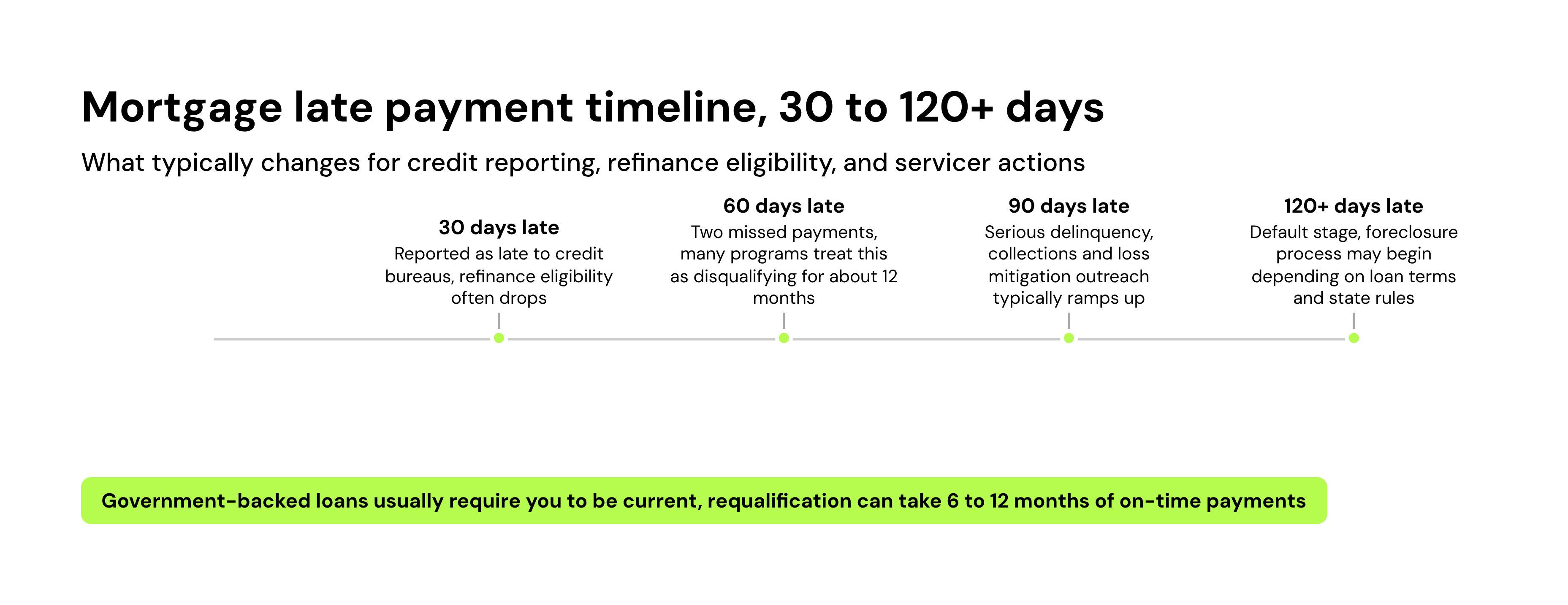
Your mortgage lender reports a payment as late once it's 30 days past due. And with most loan programs, that's enough to sink a refinance application on its own. While a conventional lender may be willing to accept a loan with a missed payment until it's 45 days past due, missing two months in a row typically disqualifies you for a full year.
Government-backed loans require you to be current on your loan to be able to refinance. If you miss a payment, you may need to show consecutive on-time payments for six to 12 months before you can qualify, depending on the program.
Read more >> How to Refinance a Government-Backed Mortgage
What "current" actually means
Lenders mean something stricter than "I haven't been reported late yet." Your servicer charges a late fee once the grace period ends, often 15 days in. That fee never reaches your credit report. At 30 days, the missed payment does.
Fannie Mae's rule runs on its own clock: 45 days from the due date of the last payment you actually made, and you have to pass on the day you apply. So the window can close about two weeks before the late shows up on your report. Separately, if you were 60 days or more behind on any mortgage in the past year, lenders who sell to Fannie Mae can't approve you. Caught up or not.
Why it's harder to refinance when you're behind
Missed payments affect your ability to refinance your mortgage loan in a couple of ways.
Credit score damage from late payments
Payment history is the most influential factor in your credit score, and even a single 30-day late payment can cost you enough points to drop below a lender’s minimum.
Even if it doesn't, it’s likely to result in less favorable terms, and you may not save enough to cover the closing costs.
Lender risk assessment
When you borrow money, a lender's top priority is to get repaid on time, and a late payment in your credit file makes that look less likely. That said, underwriters weigh how recent the late payment was and how far behind you got, so a 30-day late payment from two years ago carries less weight than one from last month.
They also check whether the delinquency is isolated or part of a pattern across your other accounts.
Options if you can't refinance right now
If your payment history rules out a refinance, you might have more time than the notices suggest. For most mortgages on a home you live in, your servicer can't make the first foreclosure notice or filing until your loan is more than 120 days delinquent (roughly four missed payments) with narrow exceptions. Use that window on one of these four alternatives.
Loan modification
A loan modification permanently changes the terms of your existing loan. Depending on the situation, your lender may offer to lower your interest rate, extend your term, move part of the balance to the end of the loan, or in rare cases reduce it.
Consider this option if your financial situation has changed in a way that likely won't be fixed anytime soon.
Forbearance agreement
Mortgage forbearance pauses or reduces your monthly payments for a set period of time. Depending on the situation, you might pay the full amount you missed at the end of your forbearance period or at the end of your mortgage term, or your lender may allow you to pay off the amount over time with your normal monthly payments.
Repayment plan
If you're no more than three months behind on payments, your lender may allow you to repay those past-due amounts over up to six months, on top of your regular monthly payments. A repayment plan works when the hiccup’s already passed and your income has recovered.
Government assistance programs
Reach out to your state's housing finance agency to learn about mortgage assistance programs. You can also look to other financial assistance programs to help with other expenses, which can free up cash for your mortgage payment.
Call 211 to learn about government and community organization programs that can point you to local help.
Read more >> How To Lower Your Monthly Mortgage Payment
⚠️ Free help exists — and nobody legitimate charges you upfront
A HUD-approved housing counselor can walk through your options for free and tell you which ones your servicer is required to consider. Call 800-569-4287 or use the CFPB's housing counselor directory. Calling your servicer's loss mitigation department costs nothing either. If you've received a notice of default or a sale date, that's the point to bring in a licensed attorney. Foreclosure procedures vary by state.
Be wary of anyone who reaches out to you first. Once a default hits public record, foreclosure-rescue offers start arriving by mail, phone, and text. Under the federal MARS rule, a company can't collect a fee until you've accepted a written offer from your servicer. It also can't tell you to stop talking to your servicer, or imply it's affiliated with the government or your lender. If you see any of these things, walk away.
How to get back on track to qualifying for refinancing
Missing a payment can be a setback, but it's possible to avoid having your refinance plans derailed entirely.
- Get your mortgage current. Getting current is what unlocks every refinancing program, so it’s the first thing to ask your servicer about, including whether a repayment plan or modification can get you there without paying a lump sum.
- Build your credit score. Order your free credit reports at AnnualCreditReport.com, and review them for areas you can improve, like paying your bills on time, reducing your credit card balances, and disputing any errors you find.
- Wait out seasoning requirements. Depending on the loan program, you may need to wait six or 12 months before you can apply for a refinance loan. Once you catch up on payments, continue to make on-time payments to avoid another delay.
Bottom line
Getting current is the requirement every program shares, so that's where this starts: with your servicer, and with whichever hardship plan gets you there.
Clearing the waiting period may get you an approval, but your score is what gets you the rate, on the full balance, for the life of the loan. Adding on-time payment history builds your score.
The Kikoff Credit Account reports to Equifax, Experian, and TransUnion. No credit check to open, and plans start at $5 a month.
Frequently Asked Questions
Article Sources
Disclaimer: The information provided in this blog post is meant for informational purposes only and does not constitute financial advice.