


.jpg)



You may be able to refinance a conventional mortgage soon after closing, but there is no single waiting period for every loan. Your timeline depends on your current mortgage, the kind of refinance you want, the investor or government agency behind the loan, and any extra rules your lender applies.
Government-backed streamline refinances often have specific seasoning rules. Cash-out refinances may require more time than a rate-and-term refinance, which replaces your loan without letting you take substantial cash from your equity.
Before you apply, ask your servicer or prospective lender which program rules apply and what date starts the clock. Being allowed to refinance does not necessarily mean the new loan will save you money.
How soon can you refinance by mortgage type?
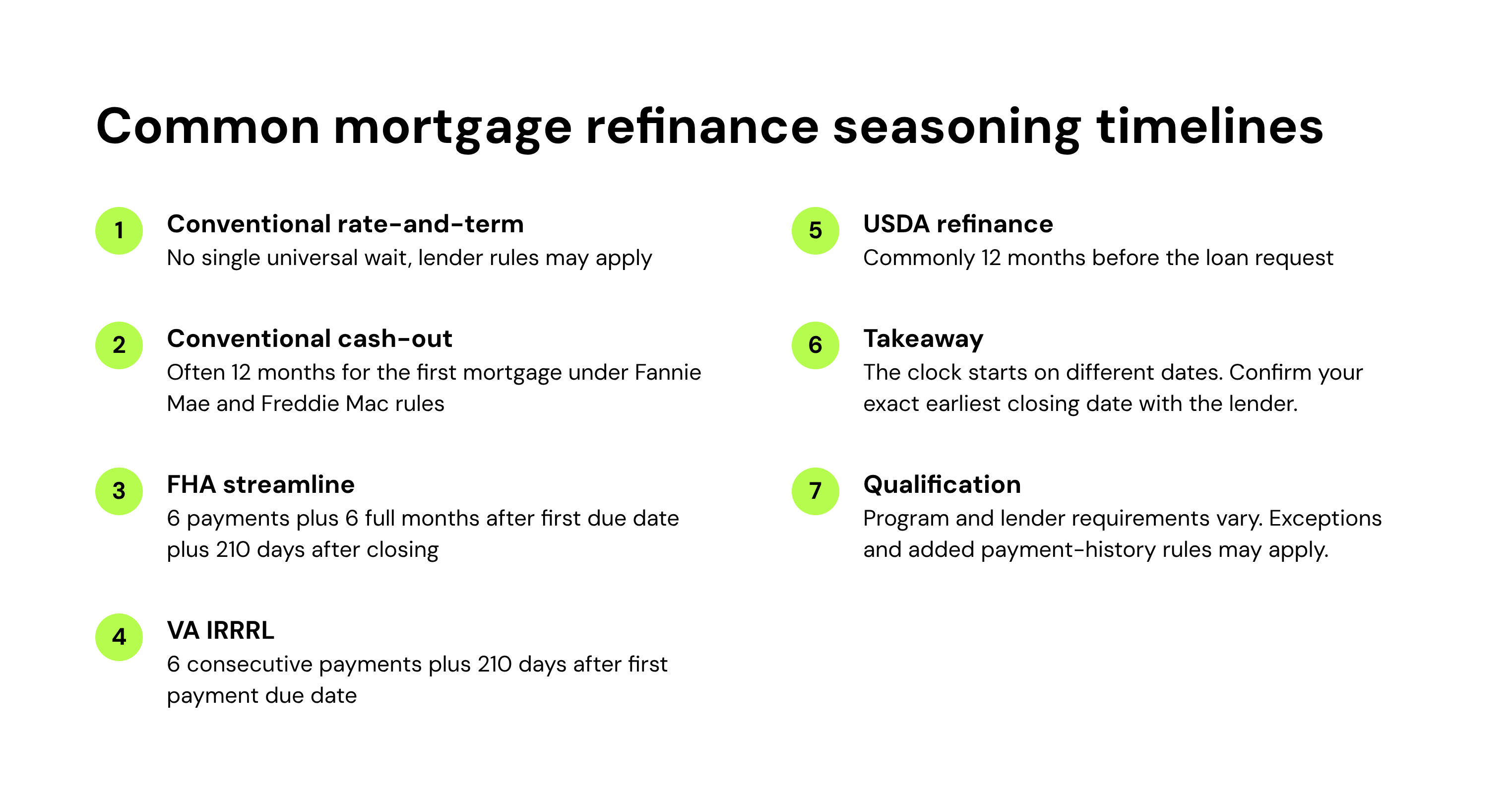
The following timelines describe common program rules, not specific approval dates. A lender may have stricter requirements, and late payments, forbearance, loan modifications, occupancy, equity, or a recent prior refinance can change your eligibility.
Conventional mortgage
A conventional rate-and-term refinance may not have a broad program-wide six- or 12-month waiting period. However, your lender may still require a minimum payment history or impose its own waiting period. You must also qualify for the new loan based on factors such as your income, debts, credit, property value, and payment history.
Cash-out rules are stricter. Under Fannie Mae's current cash-out refinance requirements, an existing first mortgage being paid off generally must be at least 12 months old. Fannie Mae also generally requires the borrower to have owned the property for at least six months, although limited exceptions apply.
Freddie Mac likewise generally requires 12 months of seasoning for the first mortgage being paid off in a cash-out refinance.
Cash-out eligibility also depends on your loan-to-value ratio, or LTV. LTV compares the amount you borrow with the home's appraised value. The maximum varies by property type, occupancy, loan program, and lender, so 80% is a common benchmark rather than a universal cap.
FHA loan
For an FHA streamline refinance, the mortgage must already be FHA-insured and current. Under the current FHA Single Family Housing Policy Handbook, you generally must have made at least six payments, at least six full months must have passed since the first payment due date, and at least 210 days must have passed since the mortgage closed.
The refinance must also provide a net tangible benefit under FHA rules.
An FHA streamline refinance is not a cash-out option. HUD says borrowers may receive no more than $500 in incidental cash from the transaction. FHA cash-out refinancing has separate occupancy, ownership, payment-history, appraisal, and equity requirements, so ask an FHA-approved lender to review your exact situation.
VA loan
A VA Interest Rate Reduction Refinance Loan, or IRRRL, refinances an existing VA-backed loan. The existing loan generally must have at least six consecutive monthly payments, and the new loan cannot close until at least 210 days after the first payment due date.
An IRRRL must also meet VA benefit requirements and generally cannot provide cash proceeds or be used to take equity out of the home.
VA cash-out refinancing follows different rules. When a VA cash-out refinance pays off an existing VA-backed loan, the VA Lenders Handbook applies the same basic seasoning test: six consecutive monthly payments and at least 210 days after the first payment due date.
The VA-to-VA seasoning rule does not apply in the same way when the loan being refinanced is not VA-backed, but other eligibility and underwriting requirements still do.
USDA loan
USDA offers non-streamlined, streamlined, and streamlined-assist refinance options for eligible USDA borrowers. USDA's Section 502 refinance guidance lists a 12-month seasoning period before the loan request. Payment-history, income, occupancy, property, and benefit requirements vary by option.
For a streamlined-assist refinance, the existing loan generally must have been paid as agreed for the prior 12 months, and the refinance must create the required monthly payment reduction. Confirm the current requirements with a USDA-approved lender because the documentation and underwriting path depends on which refinance option you use.
Read more >> How to refinance a government-backed mortgage
What does mortgage seasoning mean?
Seasoning is the amount of time a mortgage, payment history, or ownership interest must exist before a particular refinance can qualify. The starting point is not always your original closing date. Some programs count from the first payment due date, while others compare the note dates on the old and new loans.
That distinction matters. A rule requiring 210 days after your first payment due date may keep you from refinancing longer than 210 days after closing. A required number of consecutive payments can also extend the timeline if you entered forbearance or missed a payment.
Ask the new lender to identify the exact seasoning rule, the date it starts, and the earliest date you could close. Do not rely only on a general online estimate.
How soon can you refinance after a previous refinance?
You can refinance more than once, but the next transaction may restart a seasoning clock. The applicable rule depends on the loan you have now and whether the new transaction is rate-and-term, streamline, or cash-out.
Even when another refinance is allowed, repeated closing costs can erase the benefit. Compare the new Loan Estimate with your current loan and with at least one competing offer. If the lower payment mainly comes from stretching the remaining balance over a new 30-year term, you could pay for longer and potentially pay more total interest.
Do you have to wait two years to remove PMI?
No. A two-year waiting period is not a universal federal rule for private mortgage insurance, or PMI, and refinancing is not the only way to remove it.
For many conventional mortgages on a principal residence, you can ask your servicer to cancel PMI when the balance is scheduled to reach 80% of the home's original value. PMI generally terminates automatically when the scheduled balance reaches 78%, as long as you are current. The Consumer Financial Protection Bureau explains the federal cancellation requirements.
Different rules may apply if you want cancellation based on the home's current value rather than its original value. For example, Fannie Mae's current-value rules generally require at least two years of seasoning and an LTV of 75% or less when the loan is two to five years old.
The two-year minimum may be waived when qualifying improvements caused the increase in value, subject to an 80% LTV limit and other requirements.
You may also be able to refinance into a new conventional loan without PMI if the new appraisal and loan amount put your LTV at or below the lender's threshold. But closing costs and the new rate may make that more expensive than requesting cancellation on your current loan. FHA mortgage insurance follows different rules from conventional PMI.
When is it worth refinancing?
The best time to refinance is when you qualify, the new loan supports your goal, and the expected benefit outweighs the cost. There is no rate-drop percentage that makes refinancing worthwhile for everyone.
Compare the full cost, not just the rate
Review the interest rate, annual percentage rate, monthly principal and interest, mortgage insurance, points, lender credits, cash needed at closing, loan term, and total five-year cost. A lower rate can still be a poor trade if the fees are high or you expect to sell or refinance again soon.
Calculate a simple break-even period by dividing the refinance costs you pay by the monthly savings. For example, $4,800 in costs divided by $160 in monthly savings equals 30 months. That estimate is only a starting point because taxes, insurance, changes in loan balance, and a longer or shorter term can affect the result.
Be careful with “no-closing-cost” offers. The CFPB explains that lenders typically recover those costs through a higher interest rate or a larger loan balance.
Check whether your finances are ready
A stronger credit profile may help you qualify for more favorable terms, but it does not assure approval or a particular rate. Lenders also evaluate income, employment, debts, payment history, cash reserves, equity, property condition, and the loan program.
Before applying, check your credit reports for errors, avoid taking on debt you cannot comfortably repay, and gather income and asset documents. Then request Loan Estimates from multiple lenders so you can compare actual offers instead of relying on advertised rates.
Read more >> How to refinance a mortgage with bad credit
Confirm your equity and appraisal risk
Home appreciation can increase equity, but the lender's valuation may differ from an online estimate. If the appraisal comes in lower than expected, you may qualify for less cash, face mortgage insurance, receive less favorable terms, or be unable to complete the refinance as planned.
Cash-out refinancing also converts home equity into debt secured by your house. Consider the higher loan balance, closing costs, repayment period, and foreclosure risk before using home equity to pay other expenses.
For guidance specific to your mortgage and budget, consider speaking with a HUD-approved housing counselor or a financial advisor who can review the offers with you.
Bottom line
How soon you can refinance your house depends on the loan and transaction. Some conventional rate-and-term refinances may be available quickly, while FHA and VA streamline programs generally require six payments plus a defined time period. USDA options commonly use a 12-month seasoning period, and conventional cash-out refinances can have longer rules than rate-and-term loans.
Eligibility is only the first test. Compare closing costs, monthly savings, the new loan term, mortgage insurance, and the amount of equity you are giving up. Ask the lender to show you when you would break even and how much the loan would cost over the period you expect to keep it.
If building positive credit history is part of your longer-term plan, the free Kikoff Credit Account is a revolving line of credit used for eligible Kikoff Store purchases. Subject to approval and identity verification, there is no hard credit check to sign up, and Kikoff reports account activity to Equifax, Experian, and TransUnion.
Paid Kikoff Credit Service plans and store purchases have separate costs. Late or missed payments may negatively affect your credit, and no credit product can promise a mortgage approval, rate, or score change.
Frequently Asked Questions
About the editor

Disclaimer: The information provided in this blog post is meant for informational purposes only and does not constitute financial advice.