


.jpg)
.jpg)


If you have an FHA, VA or USDA mortgage, you may be able to replace it with another government-backed loan or a conventional mortgage. Refinancing could lower your rate, change your term, reduce your monthly payment or let you borrow against your home equity.
However, a lower payment does not always mean a less expensive loan. Closing costs, mortgage insurance, government program fees and a longer repayment term could increase the total amount you pay.
What is refinancing a government-backed mortgage?
Government-backed mortgages are made by private lenders and insured or guaranteed by a federal agency. The three primary programs are:
- Federal Housing Administration loans.
- Department of Veterans Affairs loans.
- Department of Agriculture loans.
When you refinance, a new mortgage pays off and replaces your current loan. Depending on your eligibility and goals, you may refinance into another loan backed by the same agency, a different government-backed program or a conventional mortgage.
Common reasons to refinance include:
- Lowering the interest rate or monthly payment.
- Switching from an adjustable to a fixed rate.
- Shortening or extending the repayment term.
- Removing an eligible borrower from the mortgage.
- Replacing an FHA or USDA loan with a conventional mortgage.
- Borrowing against home equity through a cash-out refinance.
If your goal is to eliminate mortgage insurance or an annual government fee, confirm that the new loan actually accomplishes that. An FHA-to-FHA refinance generally continues to include FHA mortgage insurance, while eligibility to remove private mortgage insurance through a conventional refinance depends partly on your equity and lender requirements.
Compare the costs before refinancing
Refinancing has many of the same expenses as obtaining an original mortgage. Depending on the loan, you may pay:
- Origination and underwriting charges.
- Appraisal fees.
- Title services and title insurance.
- Credit-report fees.
- Recording fees.
- Discount points.
- FHA mortgage insurance, a VA funding fee or a USDA guarantee fee.
- Prepaid interest and escrow deposits.
Compare the new loan with your current mortgage using the rate, APR, total monthly payment, closing costs and expected cost over the period you plan to keep the loan.
You can estimate your break-even point by dividing your closing costs by your monthly savings. For example, $6,000 in costs divided by $150 in monthly savings equals 40 months. If you expect to move or refinance again before then, you may not recover the upfront expense.
Read more >> How Soon Can You Refinance Your House?
How to refinance an FHA loan
FHA borrowers may have several options, including an FHA streamline refinance, an FHA cash-out refinance or a conventional refinance.
FHA streamline refinance
An FHA streamline refinance is available only when the existing mortgage is already FHA-insured. It cannot refinance a conventional, VA or USDA loan into an FHA mortgage.
According to the Department of Housing and Urban Development, the existing mortgage must be current and the new loan must provide a net tangible benefit. That means the refinance must deliver a qualifying benefit, such as an acceptable reduction in the combined rate and mortgage-insurance cost or a move from an adjustable to a fixed rate.
FHA seasoning rules generally require:
- At least six payments on the existing FHA loan.
- At least six full months since the first payment became due.
- At least 210 days between the original closing and the new FHA case number.
Additional payment-history requirements apply, including special rules for borrowers who recently completed a forbearance plan.
FHA offers credit-qualifying and non-credit-qualifying streamline options. A non-credit-qualifying refinance generally requires less income, credit and asset documentation. However, the lender may impose its own requirements.
An appraisal is generally not required. Cash back is limited to no more than $500, excluding certain adjustments.
“Streamline” does not mean free. FHA generally does not allow ordinary closing costs to be added to the new streamline mortgage balance. You may pay them at closing or accept a higher rate in exchange for lender-paid costs.
FHA cash-out refinance
An FHA cash-out refinance replaces your mortgage with a larger FHA loan and provides part of the difference in cash. The existing mortgage does not have to be FHA-insured.
The maximum FHA cash-out loan is generally limited to 80% of the home’s appraised value. The home must generally be your principal residence, and FHA ordinarily requires a documented ownership, occupancy and mortgage-payment history.
Unlike a non-credit-qualifying streamline refinance, an FHA cash-out refinance requires a new appraisal and complete income, asset and credit underwriting.
FHA does not establish a universal 580 minimum specifically for every cash-out refinance. FHA’s broader credit and LTV rules apply, and individual lenders may set stricter minimum scores.
A cash-out refinance reduces your equity and increases the mortgage debt secured by your home. Using the proceeds to pay credit cards or other unsecured debt may lower the interest rate on that debt, but it also moves the balance behind your home. Missing mortgage payments could eventually lead to foreclosure.
Read more >> Cash-Out Refinance vs. Home Equity Loan: What’s the Difference?
Refinancing an FHA loan into a conventional mortgage
You may also replace an FHA loan with a conventional mortgage. This can be useful if you have enough equity and qualify for competitive conventional terms.
A conventional refinance may eliminate FHA mortgage insurance, but private mortgage insurance could still apply if your equity does not meet the lender’s requirements.
Compare:
- The new interest rate and APR.
- Private mortgage insurance, if required.
- FHA mortgage-insurance costs being eliminated.
- Closing costs.
- Monthly payment.
- Remaining term on the FHA loan versus the new term.
- Total interest over the time you expect to keep the mortgage.
How to refinance a VA loan
VA borrowers generally have two main options: an Interest Rate Reduction Refinance Loan or a VA-backed cash-out refinance.
VA Interest Rate Reduction Refinance Loan
A VA Interest Rate Reduction Refinance Loan, or IRRRL, is available only for an existing VA-backed mortgage.
According to the Department of Veterans Affairs, an IRRRL may help you:
- Lower the interest rate and monthly payment.
- Replace an adjustable rate with a fixed rate.
- Change the loan term when VA requirements are satisfied.
You must certify that you currently live in or previously lived in the home. The loan must also meet VA seasoning and net-tangible-benefit requirements.
Seasoning generally requires both:
- At least 210 days since the first payment due date on the current loan.
- At least six consecutive monthly payments.
A standard VA appraisal and complete credit-underwriting package are generally not required. However, additional review may apply in certain circumstances, and lenders can impose their own requirements.
IRRRLs include closing costs and may require a VA funding fee. Allowable costs may be added to the new balance, or a lender may cover them in exchange for a higher interest rate. Either approach can increase the long-term cost.
VA-backed cash-out refinance
A VA-backed cash-out refinance may replace an existing VA or non-VA mortgage. You do not necessarily have to receive cash at closing to use this program.
To qualify, you generally must:
- Have an eligible VA Certificate of Eligibility.
- Meet VA and lender credit and income standards.
- Use the home as your residence.
- Complete a new VA appraisal.
- Meet applicable loan-seasoning and benefit requirements.
VA rules may permit financing up to the home’s reasonable value in some circumstances, but the actual amount depends on the appraisal, entitlement, program rules and lender limits. Do not assume every lender will allow a 100% LTV cash-out refinance.
A funding fee and other closing costs may apply. Compare the amount of cash received with the larger balance, new rate, monthly payment and total repayment cost.
How to refinance a USDA loan
USDA refinance programs are generally limited to borrowers with existing USDA Section 502 direct or guaranteed loans.
Borrowers must typically continue to occupy the property as their principal residence and meet applicable household-income limits.
USDA Streamlined Assist refinance
The Streamlined Assist program is intended to simplify refinancing for eligible USDA borrowers.
Under current USDA Rural Development guidance, this option generally:
- Does not use the borrower’s credit history or DTI ratio for qualification.
- Requires verification of recent mortgage payment history.
- Does not usually require a new appraisal, except in limited cases involving direct loans with subsidy recapture.
- Requires at least a $50 reduction in the total monthly principal, interest and applicable annual-fee payment.
- Allows eligible closing costs and the upfront guarantee fee to be included in the new loan.
- Permits borrowers to be added but generally allows removal only when a borrower is deceased.
Although a new credit report and DTI calculation are generally not required, the borrower must still meet USDA household-income limits. The original article’s statement that income verification is generally unnecessary was inaccurate.
USDA streamlined refinance
USDA also offers a streamlined refinance option. Compared with Streamlined Assist, it provides different underwriting and borrower-change rules.
A USDA streamlined refinance may allow eligible borrowers to be added or removed. It generally does not require a new appraisal, except in limited direct-loan subsidy situations, but applicable credit, income and underwriting requirements still apply.
Because USDA offers multiple refinance paths with similar names, ask a participating lender to identify the specific program being offered and explain:
- Whether credit and DTI will be reviewed.
- Whether an appraisal is required.
- Which borrowers may be added or removed.
- Whether the payment must decrease.
- Which closing costs can be financed.
- Whether subsidy recapture applies to a direct loan.
How to refinance a government-backed mortgage
The exact process varies by program, but most refinances follow these steps.
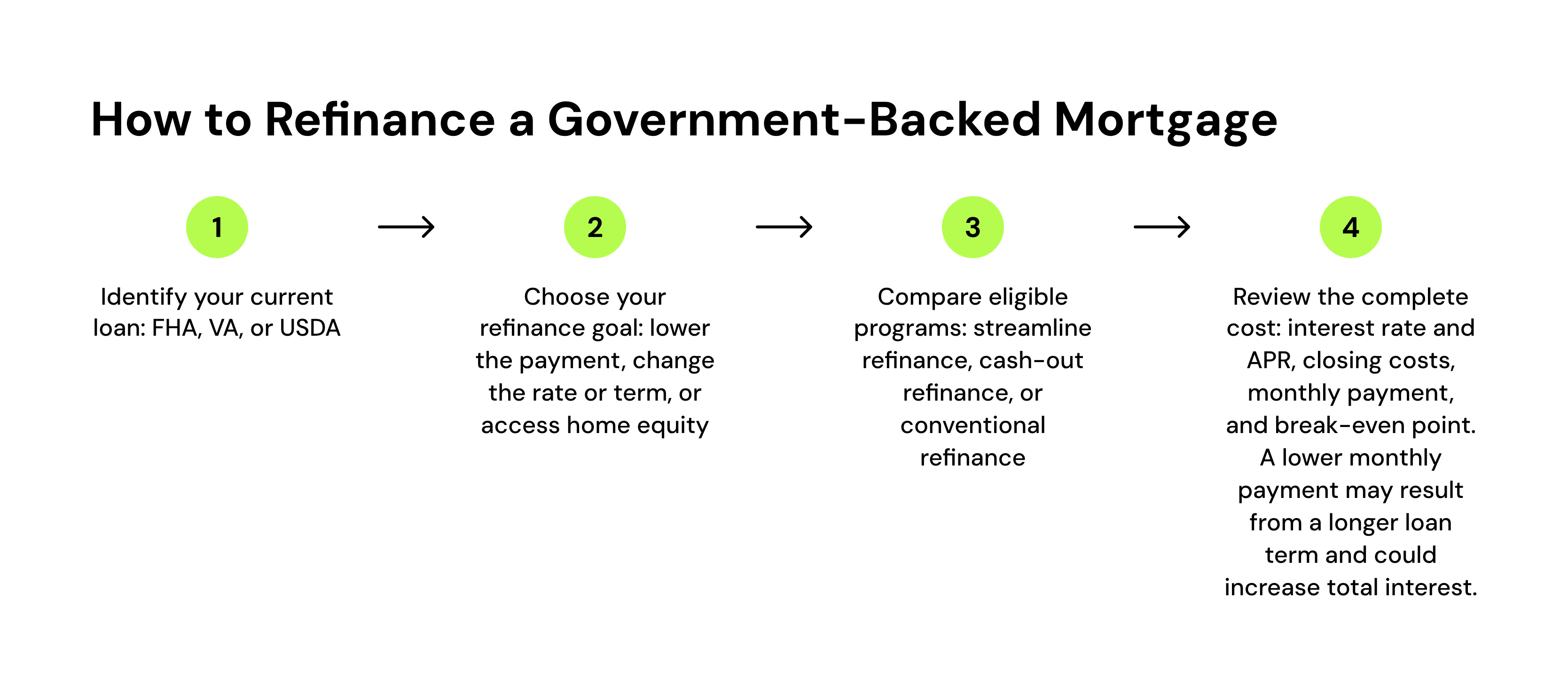
Step 1: Identify your current mortgage
Confirm whether your loan is FHA-insured, VA-backed, USDA direct, USDA guaranteed or conventional. Check your mortgage statement or contact your servicer if you are unsure.
Step 2: Define your goal
Decide whether you want to lower the rate, reduce the payment, change the term, remove a borrower or receive cash.
A streamline loan cannot accomplish every goal. For example, FHA streamline cash back is limited, and removing a borrower may trigger additional underwriting.
Step 3: Check program eligibility
Review the applicable agency requirements, including:
- Loan seasoning.
- Mortgage payment history.
- Occupancy.
- Net tangible benefit.
- Income limits.
- Credit and DTI requirements.
- Appraisal requirements.
A government agency’s minimum rules do not guarantee approval. Private lenders may apply stricter standards.
Step 4: Compare multiple lenders
FHA, VA and USDA generally do not lend directly through these refinance programs. Private lenders issue the mortgages, and rates and fees vary.
Request Loan Estimates for the same loan type, amount and term. Compare:
- Interest rate and APR.
- Monthly principal and interest.
- Mortgage insurance or annual fees.
- Upfront program fees.
- Origination charges.
- Discount points and lender credits.
- Cash needed to close.
- Five-year borrowing cost.
The Consumer Financial Protection Bureau’s Loan Estimate guide explains where to find each cost.
Step 5: Complete underwriting
Depending on the program, underwriting may involve income documents, bank statements, a credit check, an appraisal or only a limited review.
Respond promptly to documentation requests and do not open new credit accounts or make major financial changes before closing without first discussing them with the lender.
Step 6: Review the Closing Disclosure
For most refinances, you should receive a Closing Disclosure at least three business days before closing. Compare it with your Loan Estimate and verify the:
- Loan amount.
- Interest rate and APR.
- Monthly payment.
- Mortgage insurance or program fees.
- Closing costs.
- Cash needed to close.
- Fixed or adjustable rate.
- Prepayment penalty or balloon payment, if any.
Ask the lender to explain unexpected changes before you sign.
Bottom line
FHA, VA and USDA borrowers may have access to streamlined or fully underwritten refinance programs. The appropriate option depends on your existing mortgage, payment history, income, credit, equity and reason for refinancing.
Do not judge a refinance only by its new monthly payment. Compare the rate, APR, fees, loan term, total cost and break-even point. If you need independent guidance, a HUD-approved housing counselor can help you evaluate your options.
If you are preparing for a fully underwritten refinance, Kikoff’s Credit Account reports on-time payments to all three credit bureaus, with no hard credit check to sign up. Refinancing approval and terms depend on the lender and your complete financial profile.
Frequently Asked Questions
Article Sources
Disclaimer: The information provided in this blog post is meant for informational purposes only and does not constitute financial advice.