


.jpg)




An FHA loan is a mortgage insured by the Federal Housing Administration, built for buyers who don't fit conventional lending rules. You can qualify with a credit score of 580 and 3.5% down, or with a score as low as 500 if you put 10% down. The trade-off is mortgage insurance that, for most FHA borrowers, lasts as long as the loan.
What is an FHA loan?
An FHA loan is a type of mortgage insured by the Federal Housing Administration. Because the government backs the loans, lenders can approve borrowers they'd otherwise turn down, including people with:
- Lower credit scores
- Short credit histories
- Little saved for a down payment
FHA requires a credit score of at least 580 for the minimum 3.5% down payment. With a score from 500 to 579, you'll need at least 10% down. Lenders can set their own higher minimums, however.
Conventional loans, which aren't backed by a government agency, work differently. Fannie Mae no longer sets a minimum score for loans run through its automated system, but lenders still set their own. Down payments can be as low as 3%, though required insurance and fees can be high if your score is low.
FHA lenders can also accept a higher debt-to-income ratio, or how much of your monthly income goes toward debt payments. If a borrower defaults, FHA insurance pays the lender.
How does an FHA loan work?
FHA loans come from private lenders, like banks, credit unions, and mortgage companies. The Federal Housing Administration insures them, which lowers the lender's risk.
In exchange, you pay for that insurance, called a mortgage insurance premium (MIP), in two parts:
- Upfront MIP — 1.75% of the loan amount, paid at closing or added to the loan
- Annual MIP — 0.55% of the loan amount each year for most borrowers who put down less than 5%, folded into monthly payments
Your lender collects MIP, property taxes, and homeowners insurance as part of your monthly payment and holds them in an escrow account until they're due.
How long you pay annual MIP depends on your down payment. Put down at least 10%, and it ends after 11 years. Put down less, and it lasts as long as the loan unless you refinance.
4 steps to apply for an FHA loan
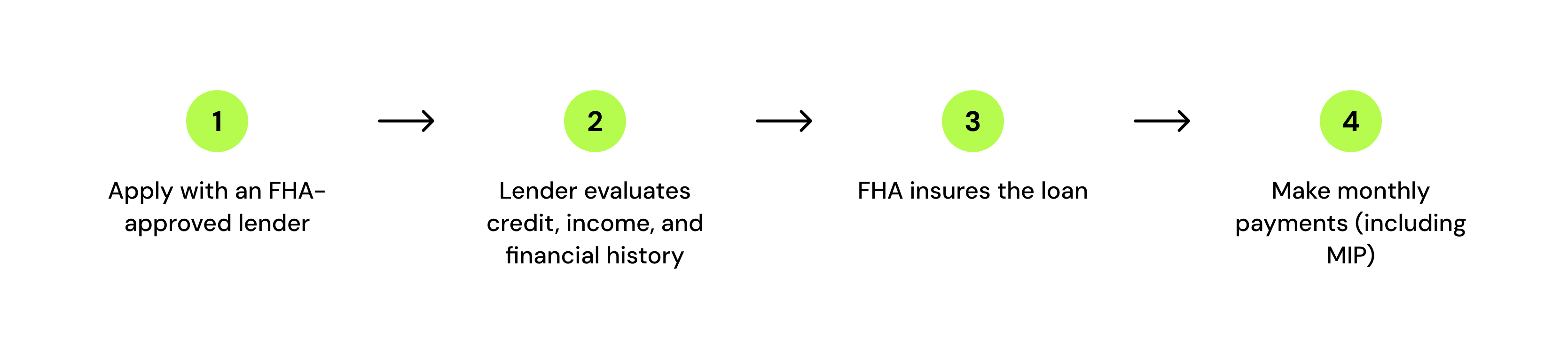
- Apply with an FHA-approved lender. Use HUD's lender search to find one by location.
- The lender reviews your credit, income, debts, and employment history.
- If you're approved, FHA insures the loan.
- You make monthly payments that include MIP.
FHA loan requirements
If your score is between 500 and 579, getting to 580 before you apply can save you real money. On a $250,000 home, it cuts the minimum down payment from $25,000 to $8,750.
Run the numbers >> Use Kikoff’s FHA mortgage calculator to see how 3.5% down compares with 10%, including mortgage insurance.
FHA loan limits
FHA caps how much you can borrow, and that max depends on where you buy. For 2026, the limit for a single-family home is $541,287 in lower-cost areas and $1,249,125 in the highest-cost areas.
HUD resets the limit each year based on local home prices. Look up your county with HUD's FHA mortgage limits tool.
FHA loan pros and cons
Pros
- Lower credit score minimums
- Down payments as low as 3.5%
- More room for existing debt
Cons
- Upfront mortgage insurance of 1.75% of the loan
- Annual mortgage insurance lasts the life of the loan if you put down less than 10%
- Loan limits can rule out higher-priced homes
- Home must be your primary residence and meet FHA property standards
Read more >> Are FHA Loans Worth It?
FHA loan vs. conventional loan
Note that last line: FHA charges the same mortgage insurance at 580 as at 780. Conventional pricing rewards a higher score.
If the quotes are hard to compare, a HUD-approved housing counselor can walk through the options with you for free or at low cost.
Bottom line
FHA makes a mortgage possible with a lower score and a smaller down payment. Your score still shapes what you're offered, including the rate, and the rate applies to every dollar of the loan for years.
The Kikoff Credit Account reports your on-time payments to Equifax, Experian, and TransUnion. There's no credit check to sign up, and plans start at $5 a month.
Frequently Asked Questions
Article Sources
Disclaimer: The information provided in this blog post is meant for informational purposes only and does not constitute financial advice.