.jpg)
.jpg)



Buying a home is one of the biggest financial milestones in many people's lives. If your credit is less than ideal, you may worry that homeownership is out of reach.
It may still be possible to qualify for a mortgage with bad credit, but no single credit score determines approval or denial. Your options will depend on the loan program, the lender's requirements, and the rest of your financial profile.
If you're wondering how to buy a house with bad credit, start by learning what lenders consider, comparing mortgage programs, and giving yourself time to prepare.
Can you buy a house with bad credit?
Yes, potentially. “Bad credit” is not a universal mortgage category, and credit score requirements vary by loan program and lender. Mortgage lenders may also use different credit score models from the ones you see in consumer apps, so the score they obtain may not match the score you monitor.
Credit is only one part of a mortgage application. Lenders may also review your:
- Income and employment history
- Monthly debt payments
- Debt-to-income ratio, or DTI
- Savings and other assets
- Down payment
- Recent payment history
- Loan amount and property details
Your DTI compares your required monthly debt payments with your gross monthly income. A lower DTI can make it easier to show that you have room in your budget for a mortgage, but acceptable limits vary by loan program and application.
Keep in mind: Meeting a program's minimum eligibility rules does not mean your application will be approved. A lender may apply additional requirements and will evaluate your full application.
Mortgage options for borrowers with lower credit scores
The right mortgage is not necessarily the one with the lowest advertised credit threshold. Compare the interest rate, annual percentage rate, mortgage insurance, upfront fees, down payment, and total cash needed at closing.
Read more >> Can I Get Approved for an FHA Loan With a 500 Credit Score?
Conventional loans
Conventional loans are not insured by a federal agency. A score of 620 is still a common reference point, but it is not a universal cutoff for every conventional application. Under Fannie Mae's current credit score rules, manually underwritten fixed-rate loans generally require a minimum score of 620, while loan files evaluated through Desktop Underwriter do not have a fixed minimum score. The automated system evaluates multiple risk factors, and lenders may impose their own requirements.
Some conventional programs allow low down payments for eligible borrowers. However, a smaller down payment can mean a higher monthly payment and private mortgage insurance.
FHA loans
FHA loans are issued by private lenders and insured by the Federal Housing Administration. Under current FHA policy, borrowers with credit scores of 580 or higher may be eligible with a down payment as low as 3.5%. Borrowers with scores from 500 through 579 may be eligible with a down payment of at least 10%.
Individual lenders may require a higher score, and meeting the score and down payment rules does not mean your application will be approved. FHA loans also generally include upfront and annual mortgage insurance premiums, so compare the full cost with other options.
VA loans
VA-backed loans are available to eligible service members, veterans, and certain surviving spouses. The Department of Veterans Affairs does not set a minimum credit score, but lenders can set their own minimums and must still approve the borrower's income, debts, assets, and credit history.
Nearly 90% of VA-backed loans are made without a down payment, according to the VA's home loan overview. Most borrowers must pay a one-time VA funding fee unless they qualify for an exemption, and other closing costs can still apply.
USDA loans
USDA Section 502 loans can provide 100% financing for eligible borrowers purchasing a primary residence in an eligible rural area. The USDA program has no program-wide credit score requirement, but applicants must demonstrate the ability and willingness to manage debt. Lenders may still have their own underwriting standards.
USDA loans also have household income and location requirements, so eligibility depends on more than credit.
Non-qualified mortgage loans
Non-qualified mortgage, or non-QM, loans may use alternative documentation or serve borrowers whose income or credit profile does not fit standard mortgage guidelines. These loans can carry higher rates, fees, or prepayment penalties. Review the APR and terms carefully, and compare them with government-backed and conventional options before committing.
How to buy a house with bad credit step by step
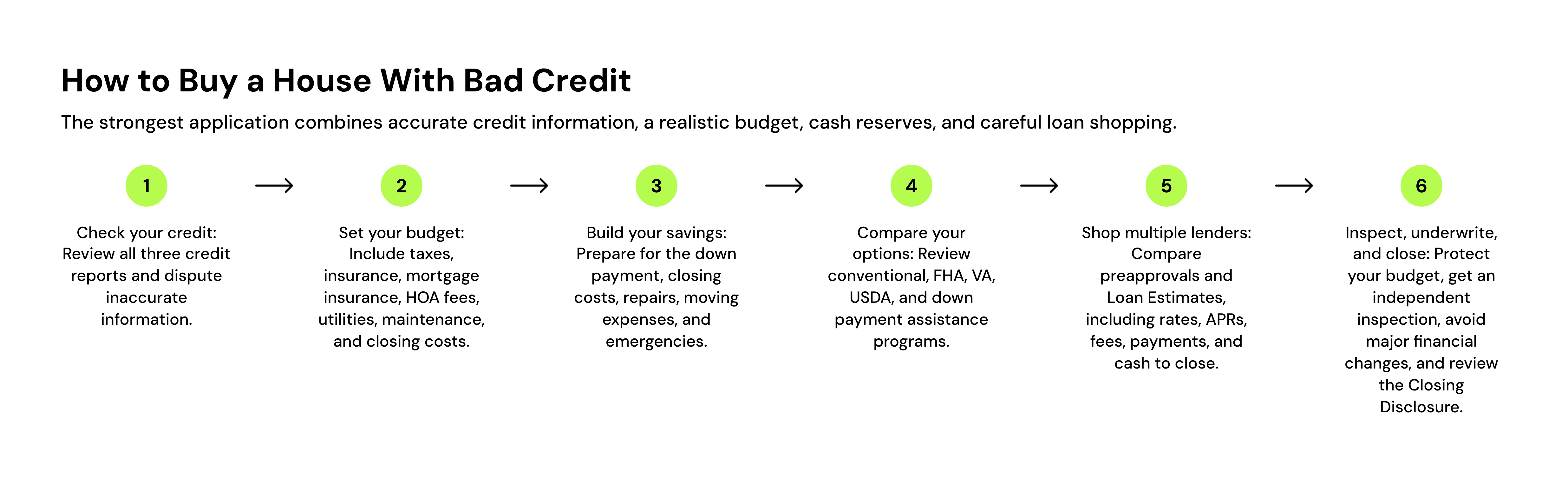
You may have more than one path to a mortgage. These steps can help you understand your options and prepare a stronger application.
Read more >> How Can I Buy a House for the First Time?
Step 1: Check your credit reports
Review your credit reports from Equifax, Experian, and TransUnion before you apply. You can get a free report from each bureau every week through AnnualCreditReport.com, the federally authorized source.
Look for accounts you do not recognize, incorrect late payments, wrong balances, or other inaccurate information. If you find an error, dispute it with the credit bureau and the company that supplied the information. Correcting an error may affect your credit scores, depending on the information involved and the scoring model.
Step 2: Estimate the full cost of homeownership
Your budget needs to cover more than principal and interest. Consider:
- Property taxes
- Homeowners insurance
- Mortgage insurance, if applicable
- Homeowners association fees
- Utilities
- Maintenance and repairs
- Closing costs and prepaid expenses
Property taxes and homeowners insurance may be included in your monthly payment if your loan has an escrow account. If it does not, you will pay those expenses separately. Use the lender's Loan Estimate to review the projected payment and cash needed at closing, not just an online principal-and-interest estimate.
Step 3: Build your cash cushion
Your down payment is only one part of the money you may need. Save for closing costs, prepaid taxes and insurance, moving expenses, immediate repairs, and an emergency reserve.
Do not assume that putting down more is always the best choice. A larger down payment may reduce the loan amount or mortgage insurance, but draining your savings can leave you unprepared for repairs or income disruptions. Ask lenders to compare scenarios with different down payments.
Step 4: Compare loan programs and assistance
Compare conventional, FHA, VA, and USDA options for which you may qualify. State and local down payment assistance programs may offer grants or loans, but income limits, repayment terms, property rules, and first-time buyer definitions vary.
A HUD-participating housing counselor can help you review your budget and home loan options. Counseling is especially useful if you are unsure which program fits, have recently missed payments, or need help preparing before applying.
Step 5: Shop with multiple lenders
Ask multiple lenders for preapprovals and official Loan Estimates so you can compare rates, APRs, fees, mortgage insurance, and cash to close. According to the Consumer Financial Protection Bureau, multiple mortgage credit checks within a 45-day window are recorded as a single inquiry on your credit report.
A preapproval is conditional, not a final loan commitment. Your finances, the property, and the supporting documents still need to pass underwriting.
Step 6: Work with a real estate agent and protect your budget
An experienced real estate agent can help you identify homes within your price range, write an offer, and negotiate with the seller. Give your agent a firm budget based on a monthly payment you can sustain, not simply the maximum amount a lender says you may borrow.
Consider an independent home inspection before closing. The lender's appraisal estimates value for lending purposes, but it is not a substitute for an inspection of the home's condition.
Step 7: Complete underwriting and closing
After the seller accepts your offer, the lender will verify your documents, review the appraisal, and complete underwriting. Respond promptly to requests, but avoid opening new credit, financing furniture, changing jobs, or moving large sums between accounts without first talking with your loan officer.
Before signing, compare your Closing Disclosure with your most recent Loan Estimate. Lenders generally must provide the Closing Disclosure at least three business days before closing, giving you time to review the final rate, payment, fees, and cash to close.
Ways to build credit before buying a house
If you are not planning to apply immediately, you may be able to strengthen your credit profile before you shop for a mortgage.
Make every payment on time
Payment history is an important credit scoring factor. Set reminders or automatic payments where appropriate, and make at least the required minimum by the due date. Late payments can remain on your credit reports for years, although their effect can lessen over time.
Pay down revolving balances
High credit card balances can increase your credit utilization, which may affect your scores. Paying down revolving debt can lower utilization and may reduce the minimum monthly payments included in your DTI.
Choose a repayment strategy that fits your goal. Paying the highest-interest balance first can reduce interest costs, while paying the smallest balance first may provide faster milestones. Continue making at least the minimum payment on every account.
Dispute inaccurate information
You have the right to dispute information you believe is inaccurate. Gather supporting records, submit the dispute to the appropriate credit bureau, and keep copies of what you send. Do not dispute accurate negative information simply because it hurts your scores.
Avoid unnecessary new credit
A new credit application can add a hard inquiry, and a new payment can increase your DTI. If you expect to apply for a mortgage soon, ask your lender before opening or closing an account or making another major credit decision.
Give yourself time
Credit scores can change as lenders and card issuers update account information, but no specific number of points or timeline is predictable. Focus on accurate reports, on-time payments, manageable balances, and a budget you can maintain.
Bottom line
Buying a house with bad credit may be possible, but the best path depends on more than a single score. Compare mortgage programs, review the full cost of each offer, and be realistic about the payment and cash reserve you can afford. If you need individual guidance, a HUD-participating housing counselor can help you evaluate your next steps.
If you have time before applying and want to add positive payment history, Kikoff’s free Credit Account reports on-time payments to Equifax, Experian, and TransUnion with no hard credit check. Results vary, and a particular score or mortgage outcome is not promised. If you expect to apply soon, check with your mortgage lender before opening any new account.
Frequently Asked Questions
Article Sources
Disclaimer: The information provided in this blog post is meant for informational purposes only and does not constitute financial advice.