






Falling behind on your mortgage is stressful, but missing a payment doesn't have to mean losing your home. If your monthly payment has become more than you can manage, a loan modification may lower it to an amount that fits your budget. Read on to learn what a modification is, how to apply, and whether you're likely to qualify.
What is a mortgage loan modification?
A mortgage loan modification is a permanent change to the terms of your existing home loan. Rather than replacing your loan the way refinancing does, your servicer restructures your current loan to make your monthly payment more affordable. The goal is to help you stay current and avoid foreclosure. Lenders use modifications to keep struggling borrowers in their homes.[1,2]
How to get a mortgage loan modification
The exact steps vary by servicer and loan type, but the process generally follows the same path.
1. Gather your financial documents
Servicers want to see proof of a genuine financial hardship along with evidence that you can afford a lower payment. Common documents may include:[3]
- Recent pay stubs
- Tax returns
- Bank statements
- Hardship letter explaining your situation
- Recent utility bill
- Recent homeowners association bill
Having everything ready before you apply speeds up the review process
2. Contact your loan servicer early
Your servicer is the company you send your monthly payment to, and its contact information is listed on your mortgage statement.[4] Ask to speak with the loss mitigation or loan modification department as soon as you think you may miss a payment. Reaching out early gives you more options and helps you avoid extra late fees.
3. Submit a loan modification application
Your servicer will provide the application and tell you whether to submit it online or by mail. Fill it out completely and include every requested document. If you miss any items, it could delay your approval. Also, make sure you keep copies of everything you send.
4. Wait for the servicer's review
Once your application is complete, the servicer evaluates your income, expenses, and hardship against the guidelines set by whoever owns your loan. This review can take anywhere from 30 to 90 days or longer.[5]
Many servicers also require a trial period of roughly three months, during which you make the proposed new payment on time to prove you can handle it. If you miss a payment during this time, the lender may cancel the modification and pursue foreclosure.[6]
5. Review and accept the modified terms
If you're approved, compare your new payment, interest rate, and total cost against your original loan before signing. Watch for terms that only lower your payment temporarily or that add a balloon payment at the end.
What a loan modification can change
A modification can adjust one or more parts of your loan, which may include:[7,8]
- A lower interest rate: Your servicer may reduce your rate to shrink your monthly payment.
- A longer term: Stretching repayment from 30 to 40 years lowers the monthly amount, though you pay more interest over time.
- A different loan structure: Switching from an adjustable rate to a fixed rate can steady a payment that keeps climbing.
- Deferred principal: Part of your balance may be moved to the end of the loan, reducing what you pay each month now.[1,2]
Who qualifies for a mortgage loan modification?
Not every lender offers modifications, and those that do set their own rules. In general, you'll need to show a documented financial hardship such as a job loss, medical event, divorce, or death of a co-borrower.
You'll also typically need to live in the home as your primary residence and be behind on payments or facing imminent default. Investment properties and vacation homes usually don't qualify for these programs.[7,8]
Loan modification vs. refinancing
Both can lower your payment, but they work differently. Refinancing replaces your current loan with a brand-new one, which means qualifying again based on your credit and income and paying closing costs.
A modification changes the loan you already have, so it doesn't require a new approval and is often available when refinancing isn't. Refinancing makes sense when you have solid credit and rates have dropped, while a modification is built for borrowers in hardship.
How a loan modification affects your credit
A modification may appear on your credit report because it signals that you're not paying as you originally agreed. In some cases, it may be reported as a settlement, which remains on your credit reports for seven years.
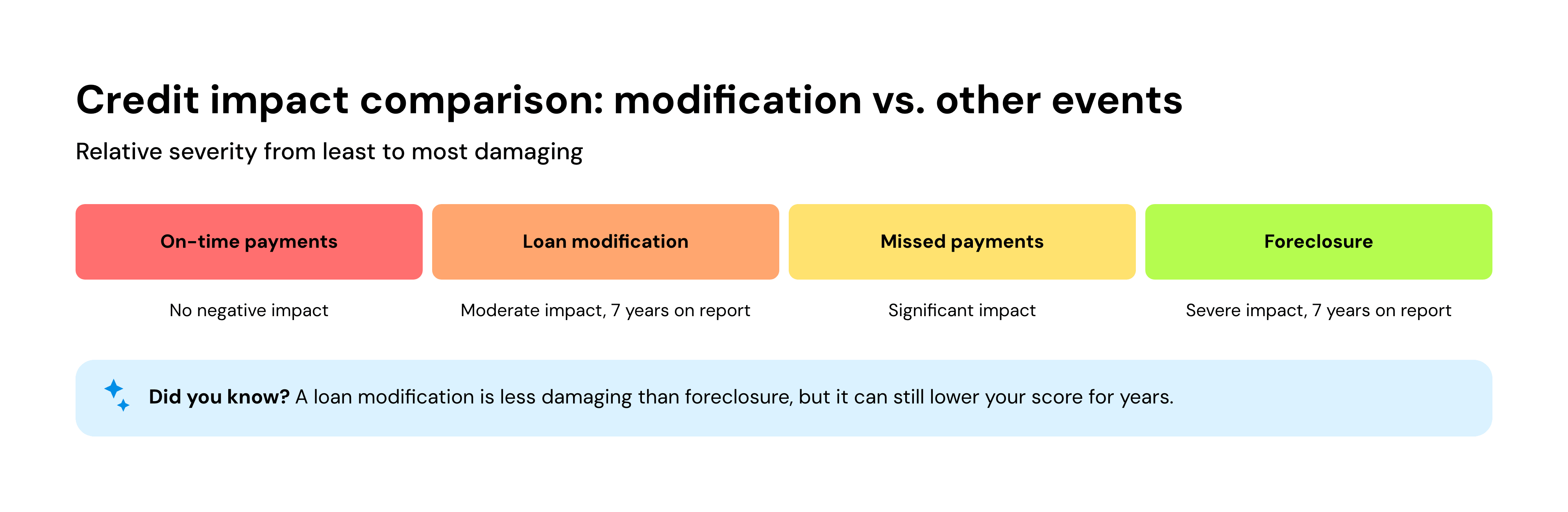
That said, it won't impact your credit score as much as a foreclosure. Also, the bigger hit often comes from the payments you miss before or during the process, since payment history is the largest factor in your credit score.[9]
From there, adding positive payment history through a credit-building tool like the Kikoff Credit Account can help you work toward stronger credit.
The bottom line
A loan modification won't erase your mortgage, but it can turn a payment you can't afford into one you can. The key is to act early, document your hardship clearly, and read every term before you sign. If you're struggling, contacting your servicer or a HUD-approved housing counselor is the fastest way to understand your options.
Take a step toward stronger credit habits with Kikoff.
Frequently Asked Questions
About the editor

Article Sources
Disclaimer: The information provided in this blog post is meant for informational purposes only and does not constitute financial advice.