



If your mortgage payment feels tighter than it used to, you have more options than just waiting out high interest rates. Refinancing, recasting, removing PMI, and even appealing your property tax bill can all bring your monthly payment down. Some of these moves take months, others take a single phone call, and a few cost nothing at all.
Read on to learn about the most practical ways to lower your mortgage payment right now, plus how your credit profile factors into the equation.
Ways to lower your monthly mortgage payment
Some of these options work on your loan directly, while others target the extras that ride along in escrow, like taxes and insurance. Understanding each choice can help you determine the right path forward for you.
Refinance to a lower interest rate
Refinancing replaces your current mortgage with a new one, ideally at a lower rate. As of June 2026, the average interest rate for a 30-year fixed-rate mortgage is 6.49%.1 If your existing rate is meaningfully higher than that, a refinance could lower your payment.
Refinancing tends to make sense when you can drop your rate by at least a full percentage point. That said, it's important to consider closing costs, which may run from 2% to 5% of the loan amount.2
Even with a lower rate, it may take years to break even on those upfront costs. To check your breakeven point, divide the estimated closing costs by your potential monthly savings.
Refinance to a longer loan term
Even if you can't qualify for a lower interest rate, refinancing can allow you to extend your loan term, spreading your remaining balance over more years and lowering your payment.
The trade-off is more total interest over the life of the loan, since you're financing the same balance over a longer period. This option works best as a short-term fix if your cash flow is tight and you need relief now, even if it costs more later.
Recast your mortgage
A mortgage recast lets you lower your payment without refinancing. You make a lump-sum payment toward your principal, and your lender recalculates your remaining payments using your existing interest rate and loan term.
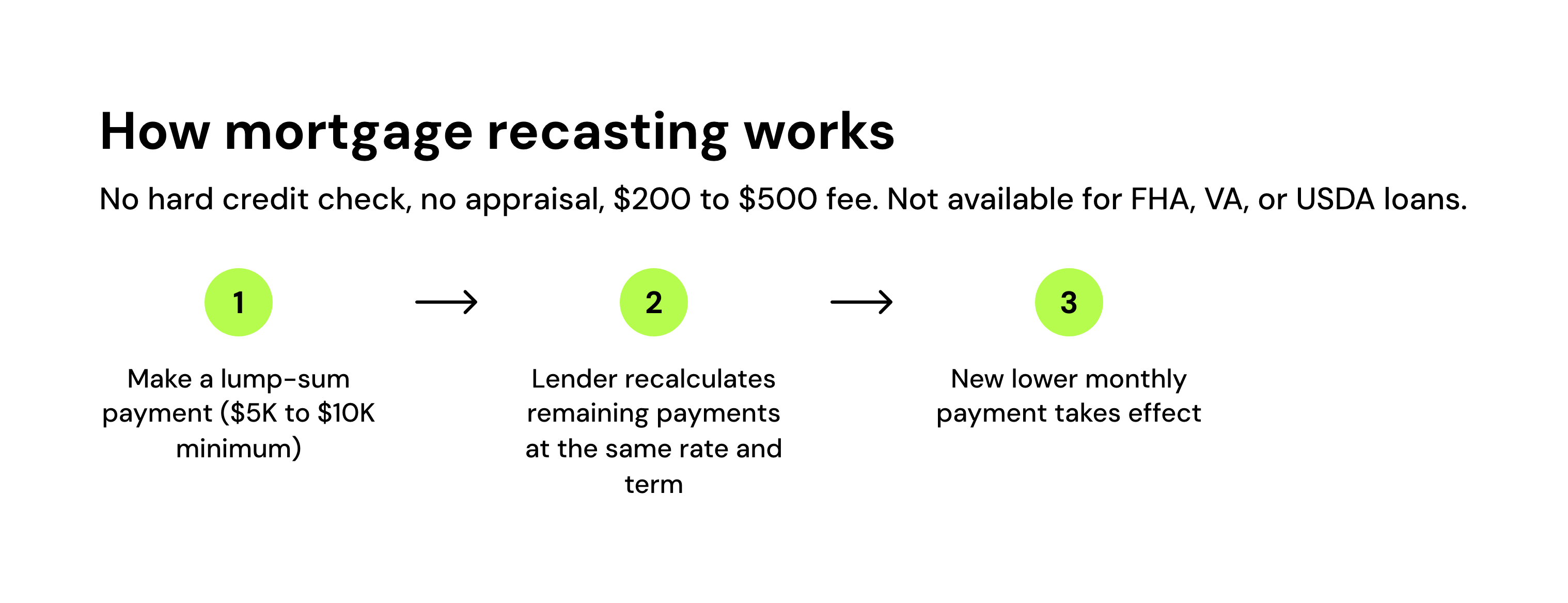
Most lenders require a minimum lump sum of $5,000 to $10,000, or a set percentage of your remaining balance, plus $200 to $500 in processing fees.3 That said, there's no new credit check, no appraisal, and no closing costs.
You may consider this option if you have a low interest rate you don't want to lose, but you've recently received a windfall of cash, such as an inheritance or proceeds from your old home. Just keep in mind that FHA, VA, and USDA loans generally aren't eligible.3
Remove private mortgage insurance (PMI)
If you put down less than 20% on a conventional loan, you're likely paying PMI, and dropping it can meaningfully reduce your bill. Under federal law, PMI must be automatically removed once your loan balance hits 78% of the original value, as long as you're current on payments. However, you can request cancellation once you reach 20% equity, based on your original home value.4
If your home has appreciated since you bought it, you may already have enough equity even if your amortization schedule says otherwise. A new appraisal can confirm this and speed up the process.
Appeal your property tax assessment
Property taxes are baked into most monthly payments through escrow, so a lower tax bill means a lower payment. According to a 2025 report from Realtor.com, more than 40% of properties are overassessed, with median savings of over $500.5
Start by checking your property record card for factual errors, like incorrect square footage or bedroom count. These are among the easiest wins. Deadlines are strict and vary by county, so check yours before your assessment window closes.
Shop for cheaper homeowners insurance
Homeowners insurance is another escrow line item that's easy to overlook once it's set. Rates vary significantly between insurers for the same coverage, and premiums have climbed in many states in recent years.
Getting quotes from three or four insurers every year or two can turn up real savings, especially if you haven't shopped around since closing.
Bundling your home and auto policies, raising your deductible, or asking about discounts you're not already enjoying can also bring your premium down.
Make a larger down payment (before closing)
This one only applies if you haven't closed on your loan yet. A larger down payment reduces your loan amount, which lowers your principal and interest payment. It can also help you avoid PMI entirely if you reach the 20% threshold, and it may qualify you for a better interest rate.
If you're still house hunting, it's worth weighing a larger down payment against the other items on this list, since it's the only one you can act on before your loan closes.
How your credit score affects your mortgage payment
Your credit score plays a major role in the interest rate a lender offers you, and even moving up one tier can affect your monthly payment. Here's a look at estimated interest rates and monthly payments by credit score for a $300,000 loan, according to July 2026 data from Curinos LLC6:
| FICO Score | Rate | Monthly Payment |
|---|---|---|
| 780+ | 6.61% | $1,918 |
| 760+ | 6.71% | $1,938 |
| 740+ | 6.77% | $1,950 |
| 720+ | 6.91% | $1,978 |
| 700+ | 6.94% | $1,984 |
| 680+ | 7.08% | $2,012 |
| 660+ | 7.12% | $2,020 |
| 640+ | 7.25% | $2,047 |
| 620+ | 7.46% | $2,089 |
The bottom line
If you're struggling to keep up with your mortgage payments, there are several options available for reducing what you owe each month. Take time to research and assess each one to determine the best fit for you.
Whether you're planning to refinance your loan, switch homeowners insurance, or apply for a new loan, building a positive payment history over time can help you secure better loan terms and lower insurance premiums.8
Kikoff's free Credit Account reports your on-time payments to all three credit bureaus, making it an easy way to add positive payment history before your next mortgage move.
Frequently Asked Questions
About the editor

Article Sources
Disclaimer: The information provided in this blog post is meant for informational purposes only and does not constitute financial advice.