


%20(1).png)



With the cost of college, you likely have student loan debt after graduation. Your debt can be a strain on your budget and a significant stressor, so figuring out how to pay off your student loans faster may be top of mind. There are several strategies you can use to pay off your education debt quickly and save money on interest.
Key takeaways
- On average, borrowers owe $33,255 in student loans, according to Experian.1
- Making extra payments, signing up for autopay, and using your windfalls toward your debt are effective ways to pay off your student loans faster.
- Refinancing could help you save money and accelerate your repayment.
How can you pay off student loans faster?
On average, college students graduate with over $30,000 in outstanding debt. It can take 10 years or more to pay off your student loan balance, and having that debt on your shoulders can make it harder to go after other goals like buying a home or starting a family.
To pay off your student loan and become debt-free faster, try these nine ideas:
1. Make payments while you're still in school or during your grace period
With many student loans, you don't have to make payments while you're still in school or during the grace period (the six-month period after you graduate or leave school). But if you can, making payments, even small ones of $10 or $25 per month, can help cut down on the amount of accrued interest, making it easier to pay off your debt later.
2. Sign up for automatic payments
Signing up for automatic payments is a great way to ensure you make your payments on time. And, as an added perk, you may qualify for an interest rate reduction.
Typically, signing up for autopay will reduce your interest rate by 0.25% percentage points. But for a limited time, federal Direct Loan borrowers can qualify for a 1% interest rate discount, which can cut down on your overall repayment cost.2
3. Use the debt avalanche method
If you have multiple student loans, the debt avalanche method is a repayment strategy that targets your highest-interest debt first. Continue making the minimum payments for all of your loans, but dedicate any extra cash toward the student loan with the highest interest rate.
Once the loan is paid off in full, take the payment from that loan and roll it into the payments on the loan with the next-highest interest rate. Continue this process until all of your debt is gone.
By tackling your loans with the highest interest rates first, you'll pay off your debt faster and save more money on interest.
4. Stick to a standard repayment plan
Depending on the type of loans you have, you may have the option of contacting your student loan servicer to enroll in an alternative payment plan that reduces your payment amount. But these loans tend to have longer repayment terms; depending on the plan, you could be in repayment for 20 to 30 years.
If possible, stick to the standard repayment plan to pay off your loans faster and save on interest.
5. Pay more than the minimum
Paying more than the minimum monthly payment is one of the best ways to reduce your loan term by months or even years, and even small extra payments can make a difference. Over time, you can chip away at the principal balance of the loan.
For example, say you had $30,000 in student loan debt at 7% interest and a 10-year term. Under a standard repayment plan, your monthly payment would be about $348 per month. If you increased your payment by $25 per month, you'd pay off your loans 11 months sooner and save nearly $1,200 in interest. If you increased your payments by $50 per month, you'd pay off your loans 20 months sooner and save over $2,100.
| Minimum Loan Payment | Extra $25 Monthly Payment | Extra $50 Monthly Payment | |
|---|---|---|---|
| Payment Amount | $348.33 | $373.33 | $398.33 |
| Time in Repayment | 120 months | 109 months | 100 months |
| Total Repaid | $41,799.05 | $40,599.75 | $39,627.27 |
| Total Savings | Not applicable | $1,199.06 | $2,171.54 |
*Example assumes $30,000 in loans at 7% interest and a 10-year loan term.
6. Put any windfalls toward your student loans
Money you get for your birthday, earnings from a side hustle, a bonus from work, or a tax refund are all windfalls you can use to make lump-sum extra payments toward your debt. A single, one-time payment can significantly cut down on interest and help you get out of debt sooner.
For example, say you used your tax refund to pay down debt. For the 2026 tax season, the average tax refund was $3,276.3 If you had $30,000 at 7% with 10 years left on your repayment term and made a lump sum payment of $3,276 toward your loans, you'd pay off your loans 17 months sooner, and you'd save nearly $3,000 in interest.
7. Make biweekly payments
With student loans, you can split the minimum payment amount into two and pay that amount every two weeks. Over the period of one year, you'll actually make 13 monthly payments instead of 12, helping to pay down your interest and save money. You can use a biweekly loan calculator to estimate how biweekly payments can help you get out of debt faster.
8. Ask your employer for help
More and more employers are using student loan repayment assistance benefits as a tool to attract and retain talent. In fact, the Employee Benefit Research Institute reported that 26% of employers offered student loan repayment benefits in 2025, but more employers are considering adding the benefit.4
If your employer offers student loan repayment, they may match a portion of your payments, up to a percentage of your salary. For example, they may match every dollar of your payments, up to 5% of your annual salary. Taking advantage of this perk helps you cut down your total repayment cost.
9. Refinance
Student loan refinancing replaces your existing loans with one new loan with different terms. If you have good credit and a reliable source of income, you may be eligible for a loan with a lower interest rate. And, opting for a shorter term could give you a lower rate so you can save more over time.
For example, say you had $30,000 in student loans at 7% interest and a 10-year term. If you refinance your student loans and qualify for a seven-year term at 5.75% interest, you'd pay off the loan three years earlier and save over $5,000.
| Original Loan | Refinanced Loan | |
|---|---|---|
| Interest Rate (APR) | 7% | 5.75% |
| Loan Term | 120 months | 84 months |
| Payment Amount | $348.33 | $434.67 |
| Total Repaid | $41,799.05 | $36,512.28 |
| Total Savings | Not applicable | $5,286.77 |
The trade-off? Refinancing federal loans transitions them into private loans, and you'll no longer be eligible for income-driven repayment plans or federal student loan forgiveness programs, so refinancing makes sense for borrowers who aren't eligible for those benefits.
How does paying off student loan debt affect your credit?
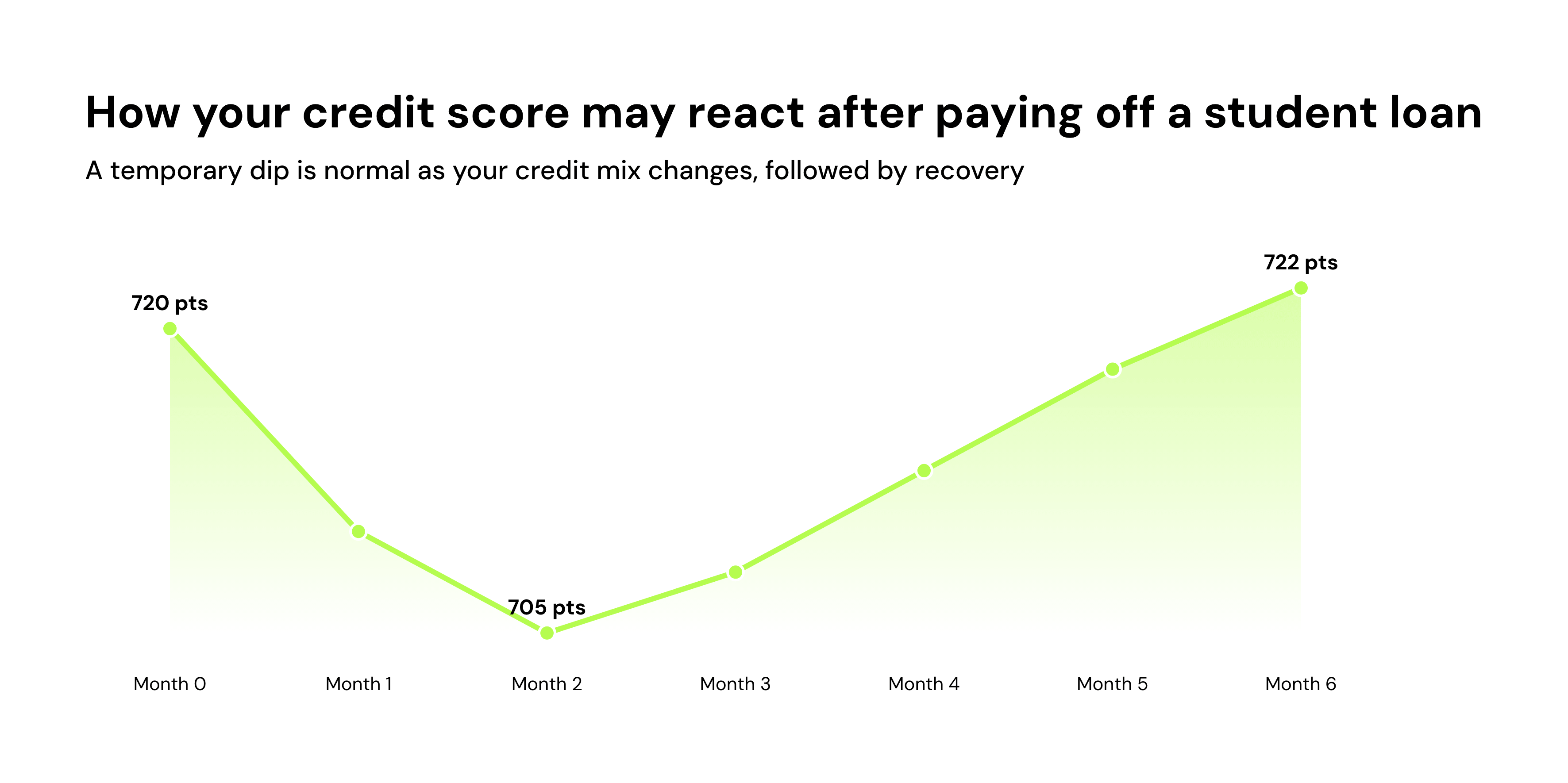
Paying off your student loans is a huge financial milestone, but it can cause a slight dip to your credit score. Student loans are a type of installment loan, and having an installment loan on your credit report can improve your credit mix. When you pay it off ( assuming it's your only installment loan), you have less of a credit mix, so your credit score may decrease.5
However, the dip is usually temporary, and less debt improves your debt-to-income ratio and frees up debt for savings.
Take a step toward stronger credit habits with Kikoff.
Frequently Asked Questions
About the editor

Article Sources
Disclaimer: The information provided in this blog post is meant for informational purposes only and does not constitute financial advice.