
Moving to a new country comes with lots of financial hurdles, and one of the biggest is building credit from scratch in the U.S.
Without a U.S. credit history, most traditional credit cards are basically off the table.
Luckily, there are credit cards specifically designed for immigrants and newcomers that can help you get started, even if you have no Social Security number or U.S. credit file.
In this post, we'll cover the best credit cards for U.S. immigrants, what to look for, and how to build your credit score once you have a card in hand.
Let's jump in!
Best credit cards for U.S. immigrants
Every individual who is new to the U.S. faces the same core challenge: lenders want to see a credit history before they approve you, but you can't build a credit history without being approved first.
This creates what's sometimes called the "credit catch-22," and it's a problem lots of immigrants run into right away.
The good news is that several card issuers have built products specifically to solve this, either by using alternative approval criteria, accepting ITINs in place of SSNs, or offering secured card options that don't require a credit check at all.
Here's a breakdown of our top picks.
1. Firstcard secured credit card
The Firstcard secured credit card is one of the most accessible options for immigrants looking to start building U.S. credit from day one.
It's designed specifically for people without an SSN or ITIN, meaning you can apply with just your passport when you first arrive in the U.S. There's no hard credit check required, and approval isn't tied to a credit history you haven't had the chance to build yet.
Firstcard offers 0% APR, no foreign transaction fees with a Premium membership, and reports payment activity to all three major credit bureaus, so every on-time payment is actively building your credit profile. It also earns up to 1% unlimited cashback on all purchases with Firstcard Premium, and up to 15% cashback at thousands of partner merchants.
For immigrants who want a low-risk, no-overspending-risk way to establish U.S. credit from the moment they arrive, Firstcard is a super strong starting point.
2. Kikoff secured credit card
The Kikoff secured credit card is one of the most accessible options for immigrants who are just getting started with U.S. credit.
There's no hard credit check to apply, which means your approval odds aren't tied to a credit history you haven't had the chance to build yet.
The card is a no-fee secured credit card issued through Kikoff's partner bank, and your activity is reported to all three major credit bureaus, which is primarily what matters when you're trying to establish a credit file.
This means every on-time payment you make is working toward building your credit score from the ground up.
Because it reports to Equifax, Experian, and TransUnion simultaneously, it's generally a faster way to establish a credit profile than products that only report to one bureau.
For someone new to the U.S. who wants a simple, low-cost way to start building credit, the Kikoff secured card is a super straightforward option.
Start building a positive credit history with Kikoff.
3. Nova Credit credit card (for select nationalities)
Nova Credit is a unique service that effectively translates your home-country credit history into a format U.S. lenders can understand.
It partners with select issuers like American Express and MPOWER Financing to allow immigrants from certain countries, including India, Mexico, Canada, Australia, and the UK, to apply using their existing credit records.
This said, Nova Credit's coverage is limited by country and card issuer, so it won't work for every immigrant.
If your home country is supported, it can be a no-brainer way to bypass the "no U.S. history" problem entirely.
Just make sure to check Nova Credit's current list of supported countries and partner cards before applying, as the program is still expanding.
4. Deserve EDU Mastercard (for international students)
The Deserve EDU Mastercard is mainly aimed at international students studying in the U.S.
It accepts applicants without a Social Security number and uses alternative data, like your bank account and academic history, to make approval decisions.
There are no foreign transaction fees, which makes it useful for students who still make purchases in their home currency.
The card also comes with a few perks like cell phone protection and Amazon Prime Student reimbursement for the first year.
It's generally a solid entry point for students who want a Mastercard with real-world benefits while they build their U.S. credit profile.
5. Bank of America travel rewards credit card for students
Bank of America offers a student travel card that's accessible to some international students with limited U.S. credit history.
It earns unlimited points on all purchases and has no annual fee.
This said, Bank of America does typically require some form of U.S. credit history or a relationship with the bank to approve you, so it's usually more accessible if you already have a Bank of America checking or savings account.
For students who have banked with them for at least a few months, it can be a worthwhile option to consider.
6. Capital One secured Mastercard
The Capital One secured Mastercard is one of the more widely accessible secured cards for immigrants who may not yet have a Social Security number.
It accepts Individual Taxpayer Identification Numbers (ITINs) in place of SSNs, which lots of immigrants have even before they receive a Social Security number.
The card requires a refundable security deposit, and Capital One reports your activity to all three major credit bureaus.
It has a low annual fee and offers the possibility of a credit limit increase after making your first five monthly payments on time.
For immigrants looking for a straightforward secured card from a major issuer, this is generally a reliable option.
7. Petal 2 Visa credit card
Petal is a fintech card issuer that uses a "cash score" model to evaluate applicants, which effectively means they look at your income and banking history rather than your credit score.
This makes it one of the more newcomer-friendly unsecured card options on the market, since you don't need an existing credit file to be considered.
The Petal 2 card has no fees of any kind, no foreign transaction fees, and earns cash back on every purchase.
Cash back rates increase the longer you make on-time payments, which creates a built-in reward for responsible use.
It's a great option for immigrants who have U.S. bank account history and steady income but haven't yet established a credit file.
8. Greenlight + Invest debit/prepaid card (for minors)
For immigrant families with children who want to start learning about money management early, Greenlight offers a debit and investing card for kids and teens.
It's not a credit card and won't build credit on its own, but it can be a useful tool to introduce younger family members to financial concepts while adults focus on building the family's credit profile.
Greenlight does require a monthly subscription fee to use.
Why building U.S. credit matters for U.S. immigrants
Your U.S. credit score is a number between 300 and 850 that paints a picture to lenders for how "risky" it is to loan you money.
Lenders, landlords, employers, and even utility companies use this number to make decisions about you.
For immigrants, having no U.S. credit history is basically the same as having a bad credit score in practice, because lenders have no data to evaluate you with.
Building credit early gives you access to better financial products, lower interest rates, and more housing options as you settle in.
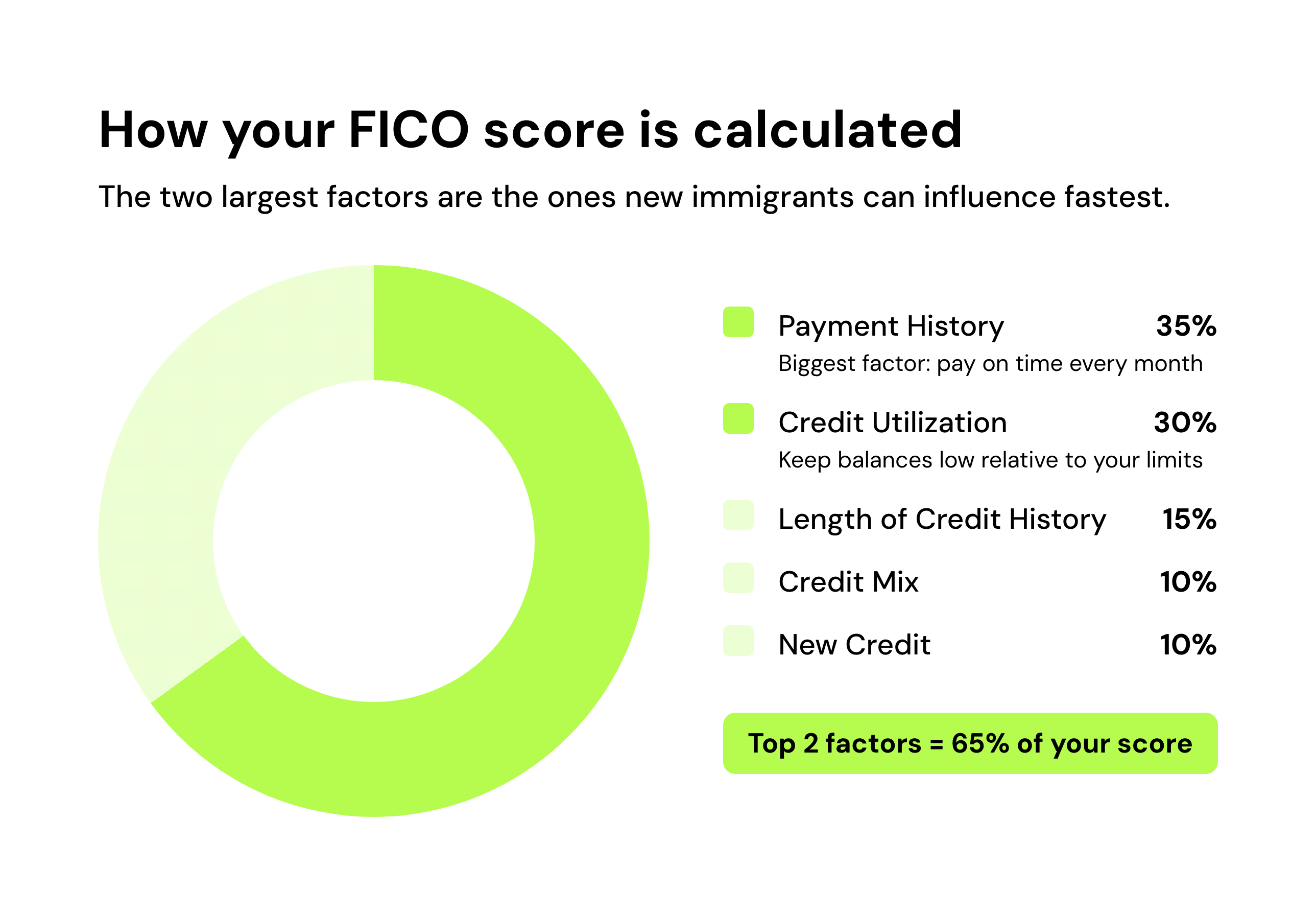
The single most important factor in your credit score is payment history, which accounts for 35% of your FICO score, followed by credit utilization at 30%.
This means every on-time payment you make goes a long way, especially early on.
What to look for in a credit card as a U.S. immigrant
Not every credit card is accessible to newcomers, so it's worth knowing what features to prioritize.
Here are the main things to consider:
- No SSN requirement or ITIN acceptance
- No credit history required to apply
- Reports to all three major credit bureaus
- No annual fee or low annual fee
- No foreign transaction fees if you still transact in your home currency
Secured cards are generally the most accessible starting point, since they require a refundable deposit instead of relying on creditworthiness.
Unsecured cards that use alternative data, like income or banking history, are also worth exploring once you have a few months of U.S. banking history under your belt.
How to build U.S. credit fast as an immigrant
Getting approved for a card is just the first step.
Using it strategically is mainly what determines how quickly your credit score develops.
Here are the most effective habits to build credit fast:
- Pay your balance in full every month, on time
- Keep your credit utilization below 30% of your limit (formula: balance divided by credit limit, multiplied by 100)
- Don't apply for too many cards at once, as each hard inquiry can temporarily lower your score
- Consider adding a rent reporting service to get credit for rent you're already paying
Kikoff's rent reporting feature is a super accessible way to build credit using payments you're already making every month.
Verified rent payments are reported to Equifax, which means you're adding positive history to your credit file without taking on any new debt.
Add positive payment history to your credit profile with Kikoff.
Credit cards vs. credit-builder accounts for U.S. immigrants
Lots of immigrants wonder whether a credit card or a credit-builder account is the better starting point.
Credit cards, especially secured ones, are generally the more efficient option because they affect two major scoring factors at once: payment history (35%) and credit utilization (30%).
A credit-builder loan, by contrast, mainly builds payment history and locks up your money for the duration of the loan term, often while charging interest and fees.
Unless you specifically need to add an installment account to your credit mix, a credit account is the more flexible and efficient tool for getting started.
This said, every individual who is building from zero can benefit from having multiple positive accounts over time, so the two products don't have to be mutually exclusive.
Conclusion
Building U.S. credit as a U.S. immigrant doesn't have to be complicated.
The right credit card, used responsibly, is basically the most direct path to establishing a credit file and unlocking better financial products over time.
Whether you're an international student, a new permanent resident, or somewhere in between, there are options available that don't require a long U.S. credit history to get started.
Frequently Asked Questions
Yes. Several card issuers accept Individual Taxpayer Identification Numbers (ITINs) in place of Social Security numbers, including Capital One and some secured card providers. You can apply for an ITIN through the IRS if you don't yet have an SSN.
Not automatically. Services like Nova Credit can translate credit histories from select countries for use with certain U.S. lenders, but coverage is limited by country. For most immigrants, it's necessary to start building a U.S. credit file from scratch.
You can typically establish an initial credit score within three to six months of opening your first U.S. credit account, provided you're making on-time payments. A strong score generally takes one to two years of consistent positive activity to build.
Generally, yes. Secured cards are among the most accessible credit products for newcomers because approval is based on your security deposit rather than your credit history. Just make sure the card you choose reports to all three major credit bureaus so your activity counts toward your score.
Sources
Disclaimer: The information provided in this blog post is meant for informational purposes only and does not constitute financial advice.