

.jpg)
.jpg)



Credit card terms can be difficult to compare when interest rates, fees, and penalties appear in different places. The Fair Credit and Charge Card Disclosure Act requires issuers to present certain costs and terms clearly when they market credit and charge cards.
Today, you will usually find those details in a standardized table commonly called a Schumer box. Knowing how to read it can help you compare cards before applying.
What is the Fair Credit and Charge Card Disclosure Act?
The Fair Credit and Charge Card Disclosure Act, or FCCCDA, is a federal law passed in 1988. It amended the Truth in Lending Act to add disclosure requirements for credit and charge card applications and solicitations.
The law focuses on offers for open-end credit and charge card accounts. It requires issuers to disclose applicable rates, fees, and other costs in a consistent format.
The FCCCDA is one part of a larger set of federal credit card protections. Later laws, including the Credit CARD Act of 2009, added rules governing interest-rate changes, fees, payment due dates, and credit cards marketed to younger consumers.
Read more >> What Is the Credit CARD Act of 2009?
Why the FCCCDA was created
Before standardized disclosures, issuers could present important terms in different formats and locations. That made it harder to compare one card with another.
The FCCCDA was intended to make key costs easier to find before you apply. Its disclosure requirements now appear in Regulation Z, the federal regulation that implements the Truth in Lending Act.
The law does not determine whether a card is affordable for you or prevent every fee. It gives you information you can use to compare offers.
A disclosure is not a recommendation: Seeing a term in the table means the issuer disclosed it. It does not mean the government has approved the card or determined that it is a good fit for you.
What disclosures are required?
The exact disclosures depend on the type of card and the terms being offered. A credit card application or solicitation may need to show:
- The annual percentage rate, or APR, for purchases
- Introductory APRs and how long they last
- The APR that applies after an introductory period
- Variable-rate information
- APRs for balance transfers and cash advances
- Penalty APRs and what may trigger them
- Annual or other periodic fees
- Balance-transfer and cash-advance fees
- Foreign-transaction fees
- Late-payment and returned-payment fees
- Minimum interest charges
- Grace-period information
Charge cards do not work exactly like traditional credit cards. They commonly require the balance to be paid in full, so some credit card disclosures may not apply. Issuers still must provide the disclosures that are relevant to the account.
How the Schumer box works
The term “Schumer box” refers to the table used to organize required card terms. It lets you find several major costs without searching through the entire card agreement.
Current federal rules generally require the table to appear prominently with an application or solicitation. For electronic applications, the table must appear in close proximity to the application. A link can satisfy this rule if applicants cannot bypass the disclosures before submitting the application.
Certain figures, including applicable APRs and specified fees, must appear in bold. The purchase APR generally must appear in at least 16-point type. Other highlighted disclosures generally must be readily noticeable and use at least 10-point type.
Here is what to look for when comparing offers:
The Schumer box is a summary, not the entire agreement. Review the full terms for information about rewards, minimum payments, account eligibility, dispute procedures, and situations not covered by the table.
How to compare credit card disclosures
Start with the terms that are most likely to cost you money based on how you expect to use the card.
If you expect to pay in full
Look at the annual fee, transaction fees, and grace period. A low APR may matter less if you consistently pay the full statement balance by the due date and retain the grace period.
If you may carry a balance
Compare the ongoing purchase APR, not just the introductory rate. The amount of interest you pay depends on the applicable APR, your balance, and how long you carry it.
A card with a rewards program may still cost more than the rewards are worth if you regularly pay interest.
If you are considering a balance transfer
Check the transfer fee, introductory APR, length of the promotional period, and ongoing APR. Also confirm when the transfer must be completed to qualify for the offer.
If you travel internationally
Review the foreign-transaction fee. A card with no annual fee can still become expensive if it charges a fee on every eligible purchase made abroad.
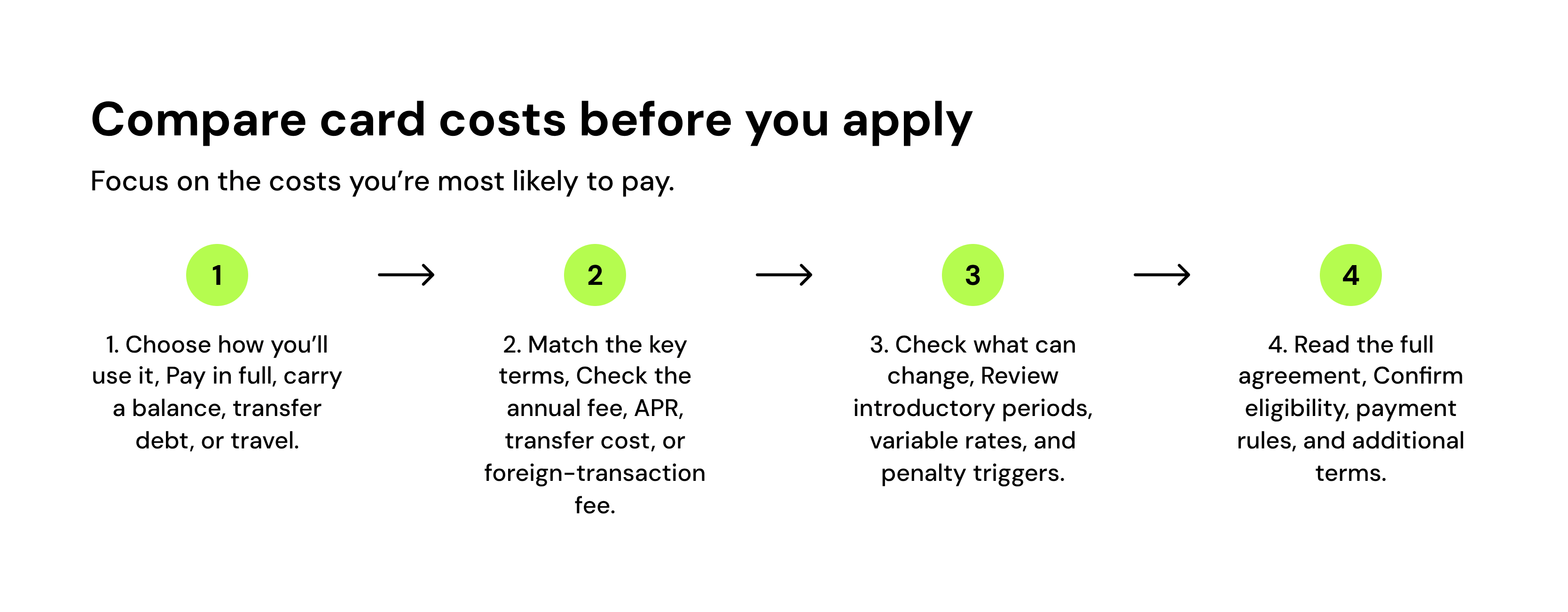
Look beyond the largest number: The purchase APR may be the most prominent figure, but an annual fee, short introductory period, balance-transfer fee, or penalty APR can change the total cost.
What the FCCCDA does not do
The FCCCDA improves disclosure, but it does not:
- Guarantee that you will receive the advertised terms
- Require an issuer to approve your application
- Prevent an issuer from charging every disclosed fee
- Make the lowest advertised APR available to every applicant
- Replace the full cardholder agreement
- Resolve billing errors after an account is open
Billing errors are generally handled under the Fair Credit Billing Act. If your statement includes an unauthorized, duplicate, or incorrectly posted charge, follow the issuer’s billing-error instructions promptly.
The Fair Credit Reporting Act covers a different set of issues, including access to consumer reports and disputes involving inaccurate credit-report information.
Read more >> What Is the Fair Credit Reporting Act?
What to do if required terms are missing
First, save a copy or screenshot of the application, solicitation, disclosure table, and full agreement. Online offers can change, so keep a record of the terms you reviewed.
Contact the issuer and ask where the missing term is disclosed. If the issuer does not resolve the issue, you can:
- Submit a complaint to the Consumer Financial Protection Bureau
- Report the issue to the Federal Trade Commission
- Contact your state attorney general’s office
- Speak with a consumer-law attorney or legal aid organization
Multiple federal and state agencies may have authority over credit card issuers. The appropriate agency can depend on the issuer and the problem involved.
If missing or misleading disclosures caused significant financial harm, a consumer-law attorney can help you evaluate your rights, possible remedies, and applicable deadlines.
Bottom line
The Fair Credit and Charge Card Disclosure Act makes it easier to find and compare important credit and charge card terms. The standardized table shows applicable APRs, fees, penalty terms, and grace-period information before you apply.
Use the table as a starting point, then review the full agreement. Pay particular attention to what happens after a promotional period, how transaction fees are calculated, and what may trigger a penalty APR.
If you decide to open an account, make sure its costs and payment requirements fit your budget. The Kikoff Credit Account reports on-time payments to all three credit bureaus, with no hard credit check to sign up.
Frequently Asked Questions
Article Sources
Disclaimer: The information provided in this blog post is meant for informational purposes only and does not constitute financial advice.