


.jpg)
.jpg)



Credit card terms were not always as predictable as they are today. Before 2009, an issuer could make certain rate and fee changes with little warning, leaving cardholders with a more expensive account than they expected.
The Credit Card Accountability Responsibility and Disclosure Act of 2009, better known as the Credit CARD Act, added federal protections for consumer credit card accounts. It limits certain rate increases and fees, sets billing rules, and requires clearer disclosures.
What is the Credit CARD Act of 2009?
The Credit CARD Act amended the Truth in Lending Act, which governs how lenders disclose the cost and terms of consumer credit. The law applies primarily to consumer credit cards, not debit cards or most business credit cards.
Its protections cover areas such as:
- Interest-rate and fee changes
- Billing statements and payment due dates
- How certain payments are applied
- Over-limit fees
- Credit cards marketed to college students
- Applications from consumers under age 21
The law does not prevent every rate increase or fee. Instead, it limits when issuers can make certain changes and requires them to explain important terms more clearly.
Read more >> What Is the Fair Credit and Charge Card Disclosure Act?
Why was the Credit CARD Act created?
Congress passed the law following concerns about credit card practices that made it difficult for consumers to understand or manage the cost of their accounts.
Before the law took effect, cardholders could face issues such as:
- Interest-rate increases with limited notice
- Higher rates applied to existing balances
- Short windows between receiving a statement and owing a payment
- Payments applied in ways that left higher-interest balances unpaid
- Over-limit fees charged without the cardholder requesting over-limit coverage
- Aggressive credit card marketing on college campuses
The Credit CARD Act addressed these practices by adding restrictions and standardizing parts of the billing process. Issuers still set their own rates and fees, but they must follow federal rules when disclosing or changing many of those terms.
How the Credit CARD Act limits interest-rate increases
The law does not guarantee that your credit card’s annual percentage rate, or APR, will remain the same. It does, however, limit when an issuer can raise a rate and how that increase may apply.
Advance notice for many rate increases
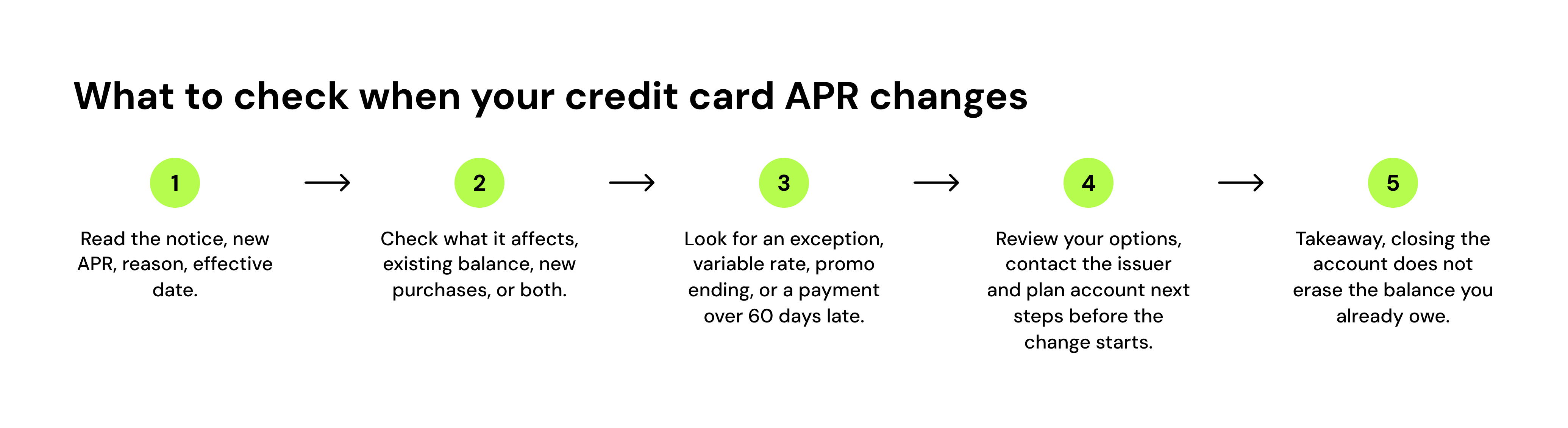
Card issuers generally must give you 45 days’ notice before making certain significant changes, including some increases to interest rates and fees.
The notice should explain the change and when it will take effect. A 45-day notice requirement does not apply to every change, including certain increases tied to a variable-rate index.
You may have the right to close the account before a new rate applies to future transactions. Closing the card does not eliminate the balance you already owe, and it may affect your available credit, so review the consequences before deciding.
Limits on increases to existing balances
An issuer generally cannot apply a higher rate to an existing balance simply because it raises the rate on new purchases. Several exceptions apply, including the expiration of a properly disclosed promotional rate, changes to certain variable rates, and serious payment delinquency.
If the issuer does not receive your required minimum payment within 60 days after the due date, it may be permitted to increase the rate on an existing balance. The issuer must provide notice explaining the increase.
If that increase resulted from the delinquency, the issuer must restore the previous rate on qualifying transactions when it receives the next six consecutive minimum payments on time, beginning with the first payment due after the increase takes effect.
First-year protections
An issuer generally cannot increase a credit card’s rate during the first year after the account is opened. Exceptions include:
- A variable rate changing with its stated index
- A promotional rate ending after at least six months
- A rate increase under a workout or temporary hardship arrangement
- A minimum payment becoming more than 60 days overdue
This is a restriction on certain rate increases, not a grace period. A grace period is the time you may have to pay purchases without owing interest.
Review of some rate increases
When an issuer increases an APR because of factors such as your credit risk or market conditions, federal rules may require it to review the account at least once every six months. If the circumstances supporting the increase have changed, the issuer may be required to reduce the rate.
That does not guarantee a return to the original APR. Check notices from your issuer to understand why a rate changed and whether the account will receive periodic reviews.
Payment and billing protections under the Credit CARD Act
The Credit CARD Act also changed how issuers handle statements, due dates, payments, and certain fees.
More time between your statement and due date
Issuers must use reasonable procedures to ensure that periodic statements are mailed or delivered at least 21 days before the payment due date. They cannot treat a required minimum payment as late if it is received within the applicable 21-day period after the statement is delivered.
Your due date must generally fall on the same numerical day each month, such as the 15th.
Payment cutoff times
A card issuer may set a cutoff time for receiving payments, but it generally cannot be earlier than 5 p.m. on the due date at the location specified for payment.
If a due date falls on a day when the issuer does not accept payments by mail, such as a holiday or weekend, a payment received on the next business day generally must be treated as timely. This rule does not mean that every weekend due date automatically moves.
Allocation of payments
Your card may have different APRs for purchases, cash advances, or balance transfers. Under the payment-allocation rule, the portion of a payment above the required minimum generally must be applied first to the balance with the highest APR.
The issuer may still have discretion over how it applies the required minimum payment. Special rules also apply to deferred-interest offers.
Limits on double-cycle billing
The law restricts a practice commonly called double-cycle billing. An issuer generally cannot calculate finance charges resulting from the loss of a grace period using balances from billing cycles before the most recent cycle.
This helps prevent interest from being charged on certain balances that were already paid during an earlier cycle.
Over-limit fees require consent
An issuer generally cannot charge an over-limit fee unless you have opted in to allow transactions that exceed your credit limit. You can revoke that consent later.
Even if you do not opt in, the issuer may choose to approve an over-limit transaction. The important distinction is that it generally cannot charge an over-limit fee without your prior consent.
Late-fee limits can change: The Credit CARD Act requires penalty fees to be reasonable and proportional, but it does not establish one permanent dollar cap for every issuer. Review your card agreement and current disclosures instead of relying on an older fee amount.
Read more >> What Happens if You Miss a Credit Card Payment?
Protections for younger applicants and college students
The Credit CARD Act added rules intended to reduce aggressive marketing and unaffordable borrowing among younger consumers.
An issuer generally cannot open an account for someone under age 21 unless the applicant submits a written application and either:
- Shows an independent ability to make the required minimum payments
- Applies with a cosigner, guarantor, or joint applicant who is at least 21 and agrees to be responsible for the debt
The law also restricts issuers from offering tangible gifts to college students to encourage applications on or near a campus or at a school-sponsored event. Issuers and colleges must also disclose certain campus marketing agreements.
These rules do not prevent a qualified person under 21 from getting a credit card. They require the issuer to take additional steps before approving the account.
What the Credit CARD Act does not do
The Credit CARD Act created meaningful protections, but it does not make every credit card inexpensive or risk-free.
The law does not:
- Set a general cap on credit card APRs
- Eliminate annual fees, late fees, or other permitted charges
- Guarantee approval for a credit card
- Require every card to offer a grace period
- Prevent interest from building when you carry a balance
- Cover unauthorized debit card transactions
- Resolve every credit card billing dispute
The Fair Credit Billing Act provides separate protections for certain billing errors, including charges you did not authorize and payments that were not properly credited.
Read more >> What Is the Fair Credit Billing Act?
What to do if you believe an issuer violated the law
Start by reviewing your statements, card agreement, and any notices the issuer sent. Write down the dates, amounts, and account terms involved, and save copies of relevant communications.
Contact the issuer using the instructions for the problem you are reporting. For a billing error, call or file online if the issuer allows it, but also send written notice to the billing-inquiries address shown on your statement within 60 days after the issuer sent the statement containing the error. The billing-inquiries address may be different from the payment address.
If the issuer does not resolve the problem, you can submit a complaint to the Consumer Financial Protection Bureau. For a significant financial loss or an unresolved legal issue, consider speaking with a consumer-law attorney or a local legal aid organization.
Bottom line
The Credit CARD Act made credit card pricing and billing practices easier to understand and placed limits on certain rate increases and fees. Among other protections, it gives cardholders more notice of many significant changes, more time to pay after receiving a statement, and greater control over over-limit fees.
These protections do not replace the need to review your card agreement. Before applying, compare the APR, fees, promotional terms, and what happens if you miss a payment.
Using credit carefully can also help you establish a positive payment history. Kikoff’s Credit Account reports your on-time payments to all three credit bureaus, with no hard credit check to sign up. Start building a positive credit history with Kikoff.
Frequently Asked Questions
Article Sources
Disclaimer: The information provided in this blog post is meant for informational purposes only and does not constitute financial advice.