


.jpg)
.jpg)



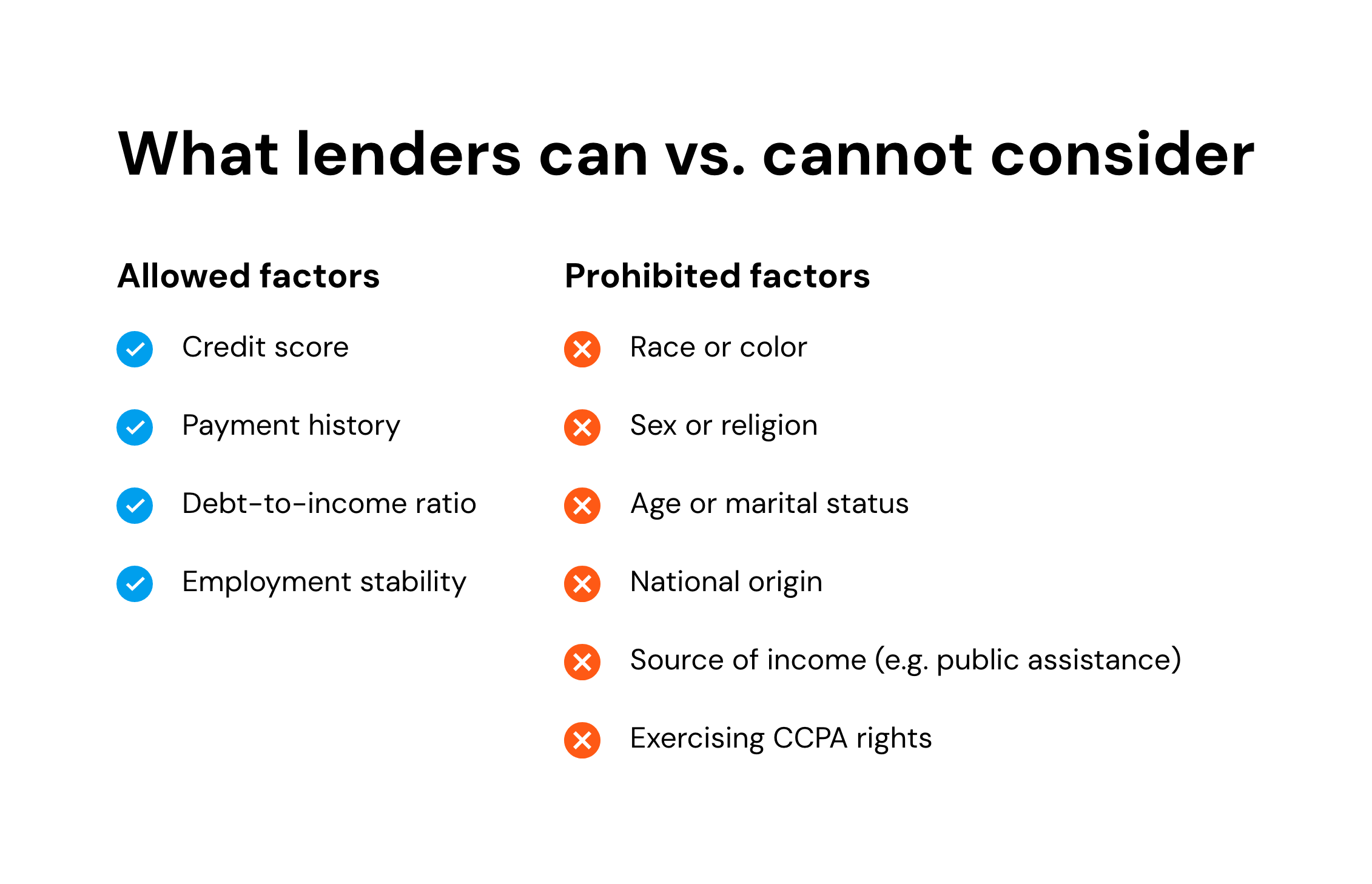
A lender can consider your income, debts, credit history, and ability to repay when you apply for credit. It cannot treat you differently because of a characteristic protected by federal law.
The Equal Credit Opportunity Act prohibits discrimination throughout a credit transaction. It also gives you the right to receive timely notice of a lender’s decision and learn the principal reasons behind certain unfavorable decisions.
What is the Equal Credit Opportunity Act?
The Equal Credit Opportunity Act, or ECOA, is a federal law enacted in 1974. It applies to consumer and business credit, including:
- Mortgages
- Auto loans
- Credit cards
- Personal loans
- Student loans
- Small-business financing
The law applies to more than the final approval decision. It generally covers every stage of a credit transaction, including advertising, applications, underwriting, pricing, servicing, account changes, and collection.
ECOA does not require a lender to approve every application or offer everyone the same terms. It requires lenders to make decisions without discriminating on a prohibited basis.
What discrimination does ECOA prohibit?
Under ECOA, a creditor cannot discriminate against you because of:
- Race
- Color
- Religion
- National origin
- Sex
- Marital status
- Age, provided you are legally able to enter into a contract
- Receipt of income from a public assistance program
- Good-faith exercise of a right under the Consumer Credit Protection Act
Exercising a protected right might include disputing a billing error or asserting certain rights involving consumer credit.
These protections extend beyond outright denial. A lender generally cannot use a protected characteristic to:
- Discourage you from applying
- Require different application information
- Offer a higher interest rate or additional fees
- Approve a smaller amount
- Require a cosigner when a similarly qualified applicant would not need one
- Change, restrict, or terminate an existing account
- Treat you differently during servicing or collection
A denial or unfavorable term is not automatically discrimination. Lenders may consider financial factors related to creditworthiness, such as income, existing debts, payment history, collateral, and the amount requested.
Different treatment can happen before you apply: Pay attention if a lender discourages you from applying, steers you toward a more expensive product, or provides different information than it gives other applicants.
How creditors must evaluate income
Not every source of income is a separate protected category under ECOA. However, a creditor cannot discriminate because some or all of your income comes from a public assistance program.
Public assistance can include programs such as Social Security, Supplemental Security Income, unemployment assistance, Temporary Assistance for Needy Families, and Supplemental Nutrition Assistance Program benefits.
Regulation B also limits how creditors evaluate income. If a creditor considers income, it generally cannot automatically discount or exclude income because it comes from:
- Part-time employment
- Alimony
- Child support
- Separate maintenance payments
- An annuity
- A pension or other retirement benefit
- Public assistance
A creditor may consider the amount of income and whether it is likely to continue. That evaluation should be based on your circumstances rather than assumptions about a group of people.
If you rely on alimony, child support, or separate maintenance payments to qualify, the creditor must consider the income to the extent it is likely to be paid consistently.
You may not need to disclose support income: A creditor generally must tell you that you do not have to disclose alimony, child support, or separate maintenance income if you do not want it considered when evaluating your application.
Your right to information about a credit decision
For many consumer-credit applications, a creditor generally must notify you of its decision within 30 days after receiving a completed application.
A completed application means the creditor has received the information it normally uses to make its decision. Different rules can apply when an application is incomplete, withdrawn, or involves certain forms of business credit.
If the creditor takes adverse action, the written notice generally must include:
- The action taken
- The creditor’s name and address
- An ECOA nondiscrimination notice
- The federal agency responsible for administering compliance for that creditor
- The principal reasons for the decision or instructions for requesting them
If the reasons are not included, the notice must explain your right to request them. You generally have 60 days after receiving the creditor’s notice to ask, and the creditor must provide the reasons within 30 days after receiving your request.
The reasons must be specific. A statement such as “you did not meet our standards” is not enough.
Adverse action can include denying an application, revoking credit, making certain unfavorable changes to an existing account, or refusing a requested credit-limit increase. The definition has exceptions, including some actions involving delinquent accounts.
ECOA and FCRA notices are not the same
ECOA requires the creditor to provide the principal reasons for an unfavorable credit decision. The Fair Credit Reporting Act adds requirements when information from a consumer report contributed to the decision.
If a credit report was used, the notice may also explain:
- Which credit bureau supplied the report
- How to request a free copy of that report
- Your right to dispute inaccurate information
- The credit score used, when applicable
- Key factors that affected that score
Saying that a credit report was used does not replace the ECOA requirement to provide specific reasons for the decision.
Read more >> What Is the Fair Credit Reporting Act?
Warning signs of possible credit discrimination
Discrimination is not always stated openly. According to the Consumer Financial Protection Bureau, potential warning signs may include:
- Being discouraged from applying
- Being offered a more expensive product without a clear financial reason
- Receiving different information in person than by phone or online
- Hearing negative comments about a protected characteristic
- Being denied despite appearing to meet the lender’s advertised requirements
- Being required to provide a cosigner when other similarly qualified applicants are not
- Receiving terms that differ from those offered to similarly qualified applicants
These signs do not prove that a violation occurred. They are reasons to ask questions, compare the lender’s explanation with your application, and document what happened.
What to do if you suspect credit discrimination
Start by saving the application, advertisements, emails, text messages, account documents, and notes from conversations. Record names, dates, and what you were told while the details are still fresh.
Then:
- Review the adverse-action notice. Identify the principal reasons the lender gave for its decision.
- Ask for the reasons if they were not provided. Follow the instructions and deadline in the notice.
- Check the credit report used. If report information contributed to the decision, request your free copy and look for errors.
- Compare the explanation with your records. Note inconsistencies or different treatment that may relate to a protected characteristic.
- Contact the lender. Ask for an explanation and give it an opportunity to correct a mistake.
- File a complaint if needed. You can submit a complaint to the CFPB or report the issue to the regulator identified in the adverse-action notice.
For possible mortgage discrimination, you may also file a complaint with HUD. Depending on the creditor and conduct involved, the FTC, Department of Justice, banking regulators, or state agencies may also have authority.
Read more >> How to Dispute Credit Report Errors
Can you sue for an ECOA violation?
ECOA allows individuals to bring certain legal claims, and available remedies may include actual damages, punitive damages, legal costs, and other relief. The result depends on the facts and the type of case.
Legal deadlines apply, and exceptions can affect when the filing period begins or ends. If you believe discrimination caused you financial harm, speak with a consumer-law attorney or legal aid organization promptly rather than relying on a general deadline.
The Legal Services Corporation can help you locate a legal aid organization in your area.
Why ECOA was created
When Congress enacted ECOA in 1974, discrimination against women applying for credit was common. Lenders sometimes discounted a married woman’s income or required a male cosigner based on assumptions about marriage and childbearing.
The original law prohibited discrimination based on sex and marital status. Congress expanded it in 1976 to cover race, color, religion, national origin, age, public assistance income, and the good-faith exercise of rights under certain consumer-protection laws.
ECOA works alongside other civil rights protections. For example, the Fair Housing Act also prohibits discrimination in mortgage lending based on protected characteristics covered by that law.
Bottom line
The Equal Credit Opportunity Act does not guarantee that a lender will approve you. It requires creditors to evaluate applications and manage credit accounts without discriminating on a prohibited basis.
If a lender denies your application or takes another adverse action, read the notice carefully. Ask for the principal reasons if they are not included, review any credit report used, and document treatment that seems inconsistent.
If inaccurate credit-report information contributed to the decision, dispute it with the credit bureau and the company that supplied it. Kikoff’s dispute tool can help you create a personalized dispute letter.
The Kikoff Credit Account reports on-time payments to all three credit bureaus, with no hard credit check to sign up. Start building a positive credit history with Kikoff.
Frequently Asked Questions
Article Sources
Disclaimer: The information provided in this blog post is meant for informational purposes only and does not constitute financial advice.