.jpg)



If you've ever asked, "What is a reverse mortgage?" and wondered how it could help fund your retirement, you're not alone. Many homeowners reach their senior years with plenty of home equity but a limited monthly income. A reverse mortgage is one way to convert that equity into cash without selling your home.
Our guide unpacks important questions, such as "How does a reverse mortgage work?" so that you can make an informed decision. While this financial tool isn't right for every person or every situation, it is flexible and appealing to older homeowners with lots of equity.
What is a reverse mortgage?
A reverse mortgage refers to several different lending products that allow homeowners to borrow against the equity in their home. The most common type is a home equity conversion mortgage, which requires a borrower to be 62 or older.
Depending on the lender and the terms of your agreement, you may be able to access the equity in one lump sum, at irregular intervals as needed, or in monthly installments.
You don't have to make monthly payments on the loan. However, you are required to continue to pay property taxes and insurance payments for the property. The lender also requires you to keep the home in good condition. The loan will be paid off when you move out permanently, pass away, or sell the home.
Here is a quick breakdown of how a reverse mortgage works:
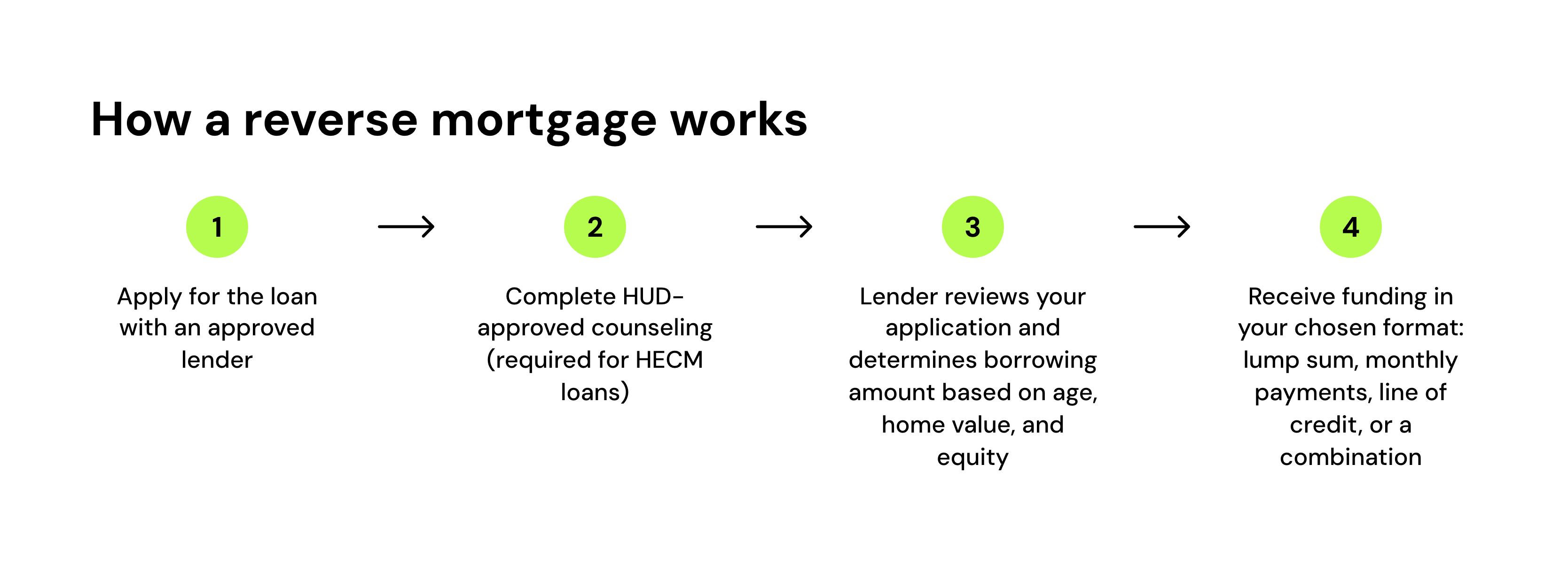
- You apply for the loan
- If you apply for the HECM, you must undergo counseling from an approved agency
- The lender reviews your application and determines how much you can borrow based on the age, value, and available equity of your home
- You receive funding in the chosen format (i.e., lump sum, monthly payments, line of credit, or a combination of formats)
If the lender finds out you are not paying property taxes, maintaining homeowners' insurance, or keeping the home in good condition, the lender can require you to repay the debt.
How to pay off a reverse mortgage
You won't be required to make monthly payments on your reverse mortgage. However, the lender isn't giving away money, either. The amount you owe will accrue interest. The loan will become due when one of three things happens:
- You sell the home
- You pass away
- You permanently move out (i.e., downsize or relocate to an assisted living facility)
If you decide you want out of the reverse mortgage and don't want your heirs to have to deal with the payoff process, you could refinance into a traditional mortgage.
Alternatively, you can sell your home and use the proceeds to repay the lender. If your heirs want to keep the home after you pass away, they can pay off the balance using cash or a traditional mortgage.
HECMs are non-recourse loans, which means that your heirs will never owe more than the home's value at the time of repayment. If they want to keep the home, your heirs will have to pay the loan balance or 95% of the appraised value, whichever is lower. If there is a remaining debt after your heirs pay 95% of the home's value toward the loan, it will be covered by mortgage insurance.
Who qualifies for a reverse mortgage?
To qualify for an HECM or most other reverse mortgages, you must:
- Be 62 or older
- Live in the home as your primary residence
- Own the home outright or have a significant amount of equity
- Complete HUD-approved counseling
Lenders will also verify that you are paying property taxes and insurance. You will also be required to maintain the home, as the lender wants to protect its investment.
Types of reverse mortgages
There are three main types of reverse mortgages, including HECMs, proprietary loans, and single-purpose loans. Some lenders offer proprietary reverse mortgages, which aren't backed by the federal government. They are mainly geared toward homeowners who have higher-value properties.
Single-purpose loans may or may not be available in your area. Some states, local governments, and non-profits offer loans for a specific purpose. Repayment is similar to that of HECMs, but you can only use the funds for a specific reason. Typically, the money must go toward repaying property taxes or making specific home repairs. You will likely have to meet strict income requirements.
Is a reverse mortgage a good idea?
The answer to whether a reverse mortgage is a good idea depends entirely on your financial situation and what your intentions are for the home after you pass away. It is a good fit for some homeowners, but others may prefer to use more flexible options that do not tie up their homes.
Impact of credit score on reverse mortgage
You will need to undergo a credit check as part of your reverse mortgage application process. However, there are no minimum credit score requirements. Lenders are more concerned about:
- Your ability to pay property taxes and insurance
- Existing debts tied to the property, such as liens
- Your overall financial stability
You can allocate some of the funding to pay property taxes, insurance, and maintenance costs. If your credit history is poor, the lender may include specific set-aside requirements in your loan terms. The purpose is to maintain an emergency fund so you can adequately maintain the home.
Reverse mortgages also include terms that allow lenders to make your debt due if you are not holding up your end of the agreement. This could mean having to sell your home prematurely, which can be devastating for many homeowners.
Unlock more options with a higher credit score
Reverse mortgages are a valuable tool for countless older homeowners who need cash flow and financial stability. However, you don't want to limit yourself to only one financial product due to a poor credit score. If you maintain a higher score, you may be eligible to explore other options, such as a home equity line of credit, home loan, or personal loan.
Want to strengthen your credit score before exploring loan options? Kikoff offers free and paid tools to help you achieve your goals. You can create a Kikoff account for free and without a hard credit check. Kikoff also offers verified rent reporting, utility payment reporting, and more. Start building a positive credit history with Kikoff.
Frequently Asked Questions
About the editor

Disclaimer: The information provided in this blog post is meant for informational purposes only and does not constitute financial advice.