


.jpg)
.jpg)



If your credit needs work, getting a home loan may still be possible. Your options will depend on the loan program, the lender’s requirements, your credit history, your income, your existing debts, and the amount of cash you have available.
A lower credit score may limit your choices or increase your borrowing costs, but it does not automatically rule out homeownership. The first step is finding out where you stand and which mortgage programs fit your situation.
How to get a home loan with poor credit
Before contacting lenders, take a clear look at your credit and budget. A mortgage application involves more than meeting a score cutoff.
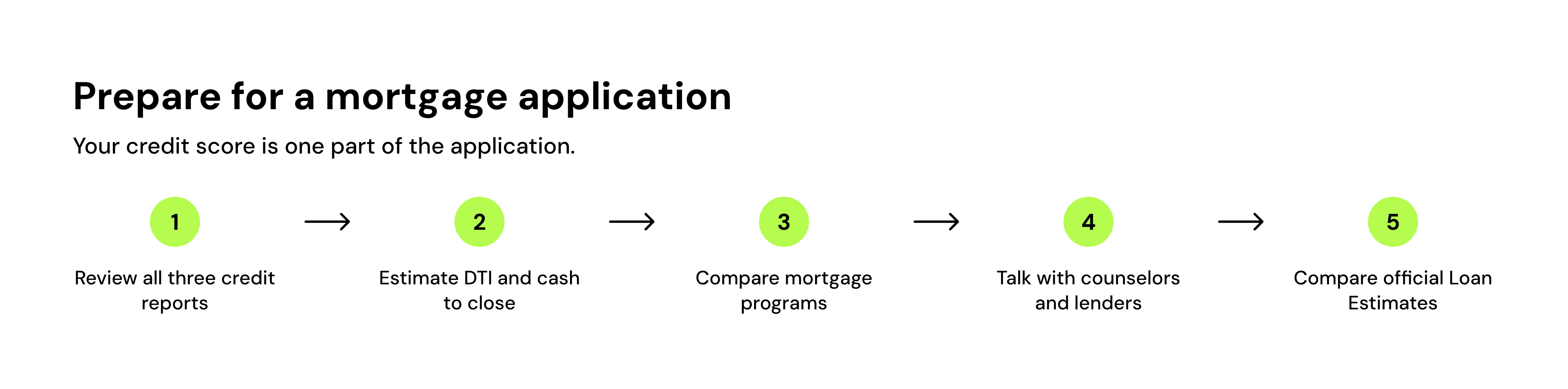
1. Review all three credit reports
Get your credit reports from AnnualCreditReport.com and check each one for:
- Accounts you do not recognize
- Payments incorrectly marked late
- Balances that have not been updated
- Duplicate accounts
- Collection accounts that do not belong to you
If you find an error, dispute it with each credit bureau showing the incorrect information. Start early because an investigation can take time.
The score you see through a credit-monitoring app may not match the score a mortgage lender uses. Credit scores can vary based on the scoring model, the bureau data, the type of loan, and the date the score is calculated.
2. Estimate your debt-to-income ratio
Your debt-to-income ratio, or DTI, compares your monthly debt payments with your gross monthly income. Lenders use it to assess whether you can manage a proposed mortgage payment alongside your existing obligations.
To estimate your DTI, add your required monthly debt payments and divide the total by your gross monthly income.
DTI is an underwriting factor, not a credit-scoring factor. Credit reports do not contain your income, so credit-scoring models cannot calculate your DTI.
3. Calculate how much cash you need
Your down payment is only one upfront expense. You may also need money for:
- Closing costs
- An appraisal and home inspection
- Moving expenses
- Initial repairs
- Emergency savings
- Taxes, homeowners insurance, and association fees
A larger down payment can reduce the amount you borrow, but draining your savings to reach a particular percentage can leave you vulnerable after closing.
4. Compare loan programs and lenders
Mortgage programs have different eligibility rules, fees, and insurance requirements. Lenders may also set standards that are stricter than the underlying program rules.
Ask several lenders which programs they offer and whether they apply their own credit-score minimums. When you are ready to apply, compare official Loan Estimates rather than relying only on advertised rates.
Get independent guidance: A HUD-approved housing counselor can review your budget, explain home loan options, and help you prepare for an application. Some counseling services are free, while others may charge a reasonable fee.
Read more >> How to Read a Credit Report
Minimum credit-score rules by loan type
There is no single credit score required for every mortgage. Program rules, automated underwriting results, lender standards, and the rest of your application can all affect eligibility.
Mortgage requirements vary by program:
- FHA loans: FHA policy permits scores of 580 or higher. Scores from 500 to 579 may qualify with at least 10% down. Individual lenders may require a higher score, and FHA mortgage insurance is required.
- VA loans: The VA does not set a minimum credit score, but participating lenders may set their own requirements. Eligibility rules apply, and a funding fee may apply unless you qualify for an exemption.
- USDA guaranteed loans: The USDA program does not set a minimum credit score. Income and property-location requirements apply, and lenders still evaluate your credit history and ability to manage debt.
- Conventional loans: There is no universal cutoff for every conventional mortgage. Fannie Mae’s Desktop Underwriter does not require a minimum third-party credit score, but lenders and other conventional programs may apply their own requirements.
Meeting a program threshold does not guarantee approval. For example, FHA policy may permit a score as low as 500 with sufficient money down, but a lender can still decline the application based on its own standards or other parts of your financial profile.
Best home loan options for poor credit
The right option depends on more than the lowest advertised credit-score requirement. Compare the total monthly payment, upfront costs, mortgage insurance, rate structure, and cash needed at closing.
FHA loans
FHA loans are issued by private lenders and insured by the Federal Housing Administration. They may accommodate lower credit scores and smaller down payments than many conventional options.
FHA mortgage insurance is required on every FHA loan. It includes an upfront premium and an annual premium paid through monthly payments. Compare FHA and conventional Loan Estimates because the less expensive option can change based on your credit, down payment, and current market conditions.
VA loans
VA-backed loans are available to eligible service members, veterans, and certain surviving spouses. The VA does not set a minimum credit score, although participating lenders may.
These loans may allow eligible borrowers to buy without a down payment. A VA funding fee can apply, but some borrowers are exempt.
USDA loans
USDA guaranteed loans may offer no-down-payment financing for eligible borrowers purchasing qualifying properties. The program does not set a minimum credit score, but lenders still assess your credit history and ability to repay the loan.
Income and property-location restrictions apply. USDA loans also include program fees that should be included when you compare total costs.
Conventional loans
Conventional mortgages are not insured or guaranteed by the federal government. Requirements vary by lender, loan product, and underwriting method.
Fannie Mae removed the fixed minimum third-party credit-score requirement from loans evaluated through Desktop Underwriter in November 2025. That does not mean every applicant or every conventional loan can qualify without a particular score. The automated system evaluates the complete application, and lenders may add their own requirements.
Non-QM loans
A non-qualified mortgage, or non-QM loan, does not meet the federal definition of a Qualified Mortgage. These loans may accommodate circumstances that do not fit standard underwriting, such as certain types of nontraditional income.
Non-QM does not automatically mean predatory or unsafe. However, these loans may have higher rates, fees, or less favorable terms. Review the APR, payment structure, loan term, upfront costs, and any balloon-payment or prepayment provisions carefully.
Read more >> How to Buy a House With Bad Credit
What mortgage lenders look at besides your score
A credit score summarizes some of the information in your credit report, but it does not tell the lender everything it needs to know.
Mortgage underwriting may also consider:
- Credit history: Lenders review late payments, collections, outstanding balances, and how recently problems occurred.
- Debt-to-income ratio: A lower DTI can leave more room in your budget for a mortgage payment, but acceptable limits vary.
- Income: Your lender will determine whether your income is documented, stable, and reasonably likely to continue.
- Down payment: More money down can reduce the loan amount and the lender’s risk.
- Cash reserves: Some lenders or loan programs may want to see savings remaining after closing.
- Property details: The home’s appraised value and condition can affect whether it qualifies for financing.
- Loan purpose and occupancy: Requirements may differ for a primary residence, second home, or investment property.
Approval is not the same as affordability: A lender may approve a payment that leaves little room for childcare, repairs, medical bills, or other expenses. Build your budget around the full housing cost, including taxes, insurance, mortgage insurance, association fees, utilities, and maintenance.
How to improve your chances of approval
If your application is not ready today, you may be able to strengthen it before applying.
Correct credit-report errors
Dispute information that is inaccurate or incomplete. Do not dispute accurate negative information simply because it is hurting your credit. Accurate late payments and other negative items generally cannot be removed on request.
Reduce credit card balances and monthly debt
Lower balances may strengthen your credit profile. Paying off a debt can also reduce your DTI if it eliminates a required monthly payment.
Before using a large portion of your savings to pay down debt, ask a lender how the change could affect your application. Preserving enough cash for closing and emergencies may be just as important.
Build a larger cash cushion
Extra savings can give you more flexibility with the down payment, closing costs, and lender reserve requirements. It can also make the first few months of homeownership less stressful.
Document your income
Gather recent pay statements, tax forms, bank statements, and other records your lender requests. A job change does not automatically disqualify you, and you do not always need to remain with the same employer or in the same field.
What matters is whether the lender can verify your income and reasonably expect it to continue. Self-employed borrowers and people with variable income may need to provide additional documentation.
Consider a co-borrower carefully
A co-borrower with sufficient income and a strong credit history may help an application, but results depend on the loan program and lender.
The other person is not simply lending you their name. A co-borrower or cosigner accepts legal responsibility for the mortgage and may have to repay the entire balance if you do not.
Avoid opening other accounts during the mortgage process
A lender may check your credit when you apply and again before closing. New credit cards, auto loans, or other debts can change your score, DTI, and underwriting result.
Shop for a mortgage within a focused period
Mortgage inquiries receive special rate-shopping treatment under common scoring models. Newer FICO models group eligible mortgage inquiries made within 45 days, while older versions use 14 days. VantageScore 4.0 also uses a 14-day grouping window.
Keeping your applications within 14 days is the more cautious approach when you do not know which model will be used. The inquiries may still appear separately on your reports even when a scoring model counts them as one.
Compare the interest rate, APR, monthly mortgage insurance, upfront loan costs, lender credits, total monthly payment, and cash to close on each Loan Estimate.
Read more >> What Are the Most Common Credit-Building Mistakes?
Bottom line
Getting a home loan with poor credit may be possible, but there is no universal score that guarantees approval. Start by checking your reports, estimating your DTI and cash needs, and comparing the loan programs available to you.
If the numbers do not work yet, waiting can be the better financial decision. Use that time to establish consistent payment history, reduce manageable debts, and build savings rather than accepting a mortgage that strains your budget.
If homeownership is a future goal, Kikoff’s Credit Account reports your on-time payments to all three credit bureaus. It is a free revolving credit line used only in the Kikoff Store, and no hard credit check is required to sign up.
Frequently Asked Questions
Article Sources
Disclaimer: The information provided in this blog post is meant for informational purposes only and does not constitute financial advice.