.jpg)
.jpg)



Mortgage amortization is the process of paying off a home loan through scheduled payments over time. Each payment covers the interest due for that period, and the rest reduces the principal, which is the amount you still owe.
Early in a typical mortgage, more of the principal-and-interest payment goes toward interest because the loan balance is higher. As the balance falls, less interest accrues and more of the payment goes toward principal.
What is mortgage amortization?
An amortizing mortgage uses a payment schedule designed to reduce the loan balance to zero by the end of the term, assuming you make every scheduled payment and the loan terms do not change.
The loan term and amortization are related, but they are not the same:
- Loan term: How long you have to repay the mortgage, such as 15 or 30 years
- Amortization: How each payment is divided between principal and interest as the balance declines
With a typical fixed-rate mortgage, the scheduled principal-and-interest payment remains the same. The split within that payment changes every month.
This does not mean your total payment can never change. Property taxes, homeowners insurance, mortgage insurance, and other escrowed expenses may increase or decrease independently of the loan’s amortization.
Mortgage interest is not a separate fee deliberately charged upfront. More interest is due early because interest is calculated on a larger outstanding balance. As that balance falls, the interest portion falls too.
How does mortgage amortization work?
Each month, the lender or servicer calculates the interest due based on the remaining principal balance and the loan’s interest rate. Your payment covers that interest first, and the remainder reduces principal.
The CFPB explains that with a typical fixed-rate mortgage, the combined principal-and-interest payment stays the same while the allocation changes.
Consider a $300,000, 30-year fixed-rate mortgage at 6.5%. The monthly principal-and-interest payment would be about $1,896. These rounded examples show how its composition changes:
- Payment 1: About $1,625 interest and $271 principal
- Payment 120: About $1,380 interest and $516 principal
- Payment 240: About $910 interest and $986 principal
- Payment 360: About $10 interest and $1,886 principal
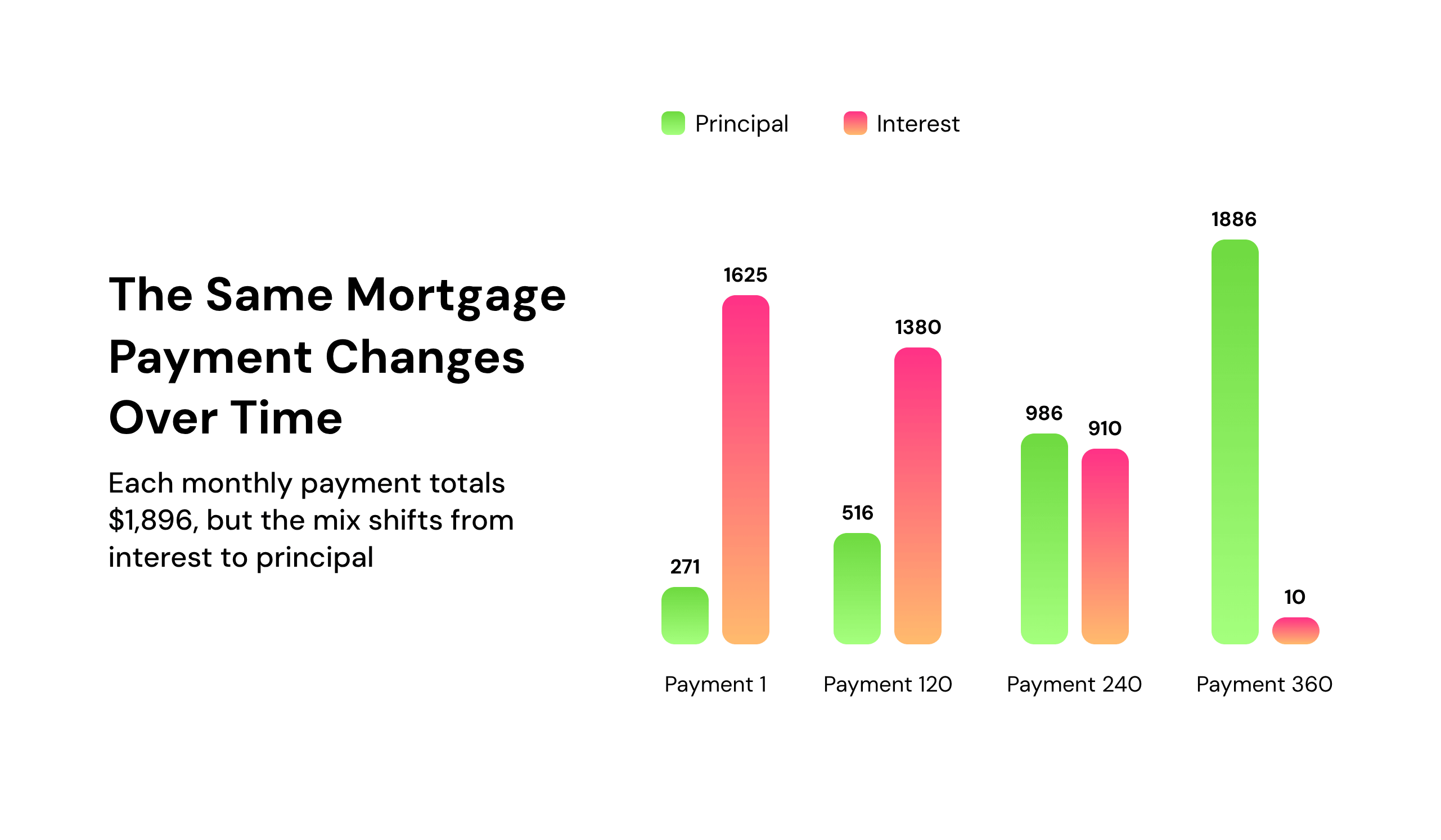
The payment remains about $1,896, but the principal portion grows as the balance falls. This example excludes taxes, insurance, mortgage insurance, homeowners association fees, and other housing expenses.
What is a mortgage amortization schedule?
An amortization schedule shows how the loan is expected to change with each scheduled payment. It commonly includes:
- The payment number or date
- The principal-and-interest payment
- The amount applied to interest
- The amount applied to principal
- The remaining loan balance
- Cumulative principal and interest totals
Your lender or servicer may provide a full schedule, and many mortgage calculators can generate an estimate. Your monthly mortgage statement should show how the servicer applied that month’s payment among principal, interest, and escrow.
Use the schedule as a projection, not a promise that every future total payment will be identical. Extra principal payments, late payments, fees, a loan modification, refinancing, or an adjustable interest rate can change the actual path.
Can extra principal payments change the schedule?
Paying extra toward principal can reduce the balance sooner, which means less interest accrues in future months. Depending on the amount and timing, this may shorten the payoff period and reduce total interest.
Before sending extra money, confirm that your loan permits additional principal payments and tell the servicer to apply the extra amount to principal. Also check whether the loan has a prepayment penalty.
Extra principal usually does not reduce the required monthly payment by itself. The scheduled payment may stay the same while more of it goes toward principal and the loan is paid off earlier. Lowering the required payment may require a formal recast, loan modification, or refinance, depending on the loan and lender.
Read more >> How Soon Can You Refinance Your House?
Fixed-rate vs. adjustable-rate mortgage amortization
Both fixed-rate and adjustable-rate mortgages can amortize, but the payment path differs.
Fixed-rate mortgage: The interest rate stays the same. On a typical fully amortizing loan, the scheduled principal-and-interest payment stays level while the amount going to principal gradually increases.
Adjustable-rate mortgage: The initial rate applies for a set period and may then change at scheduled intervals. When the rate changes, the lender generally recalculates the payment using the remaining balance and term. The new rate is typically based on an index plus the lender’s margin, subject to the loan’s caps.
ARM structures vary. Before choosing one, review when the first adjustment can occur, how often later adjustments happen, the index and margin, the rate caps, and the highest payment you could be required to make. The CFPB recommends checking how high the rate and payment can go and how frequently they can adjust.
How does your credit affect mortgage costs?
Your credit score and the information in your credit reports can affect whether you qualify for a mortgage and the rate you are offered. A higher score generally gives you access to more lenders and more affordable offers, but there is no universal score-to-rate chart that applies to every borrower.
Lenders also consider the loan type, down payment, debt, income, assets, property, and broader market conditions. Compare Loan Estimates from multiple lenders rather than assuming one credit-score band guarantees a particular rate.
The interest rate matters to amortization because it changes how much interest accrues on the remaining balance. With the same loan amount and term, a higher rate means a larger payment and more total interest.
Before applying, review your credit reports and dispute inaccurate information. Avoid opening several new credit accounts while preparing for a mortgage unless they are necessary.
Read more >> How to Get a Home Loan With Bad Credit
Bottom line
Mortgage amortization explains why the same principal-and-interest payment can reduce your balance slowly at first and more quickly later. Reviewing an amortization schedule can help you understand the cost of the loan, compare terms, and estimate how extra principal payments could affect your payoff date.
If you plan to apply for a mortgage, building positive payment history before you shop can strengthen the information lenders review. Kikoff’s Credit Account reports your on-time payments to all three credit bureaus, with no hard credit check to sign up. Kikoff does not determine whether you qualify for a mortgage or what rate a lender offers.
Frequently Asked Questions
Article Sources
Disclaimer: The information provided in this blog post is meant for informational purposes only and does not constitute financial advice.