.jpg)
.jpg)


A subprime auto loan is vehicle financing offered to a borrower whom the lender considers more likely to miss payments or default. A lower credit score may contribute to that assessment, but lenders can also consider your income, existing debts, down payment, credit history, the vehicle, and the amount you want to borrow.
Subprime financing can provide access to a vehicle when other offers are unavailable, but it often comes with a higher annual percentage rate (APR) and a higher total borrowing cost. Before signing, compare multiple offers and make sure the payment works without relying on a future refinance.
What is a subprime auto loan?
An auto loan lets you borrow money to purchase a vehicle and repay the balance, plus interest and any financed charges, over an agreed term. “Subprime” describes a higher-risk category used by lenders and market researchers. It is not a single loan program with one nationwide approval cutoff.
Lenders use risk-based pricing, which means the rate and terms offered may depend on how likely they believe a borrower is to repay. According to the Consumer Financial Protection Bureau (CFPB), lenders may offer different consumers different rates or terms based on their estimated risk of nonpayment.
Because each lender has its own underwriting standards, one lender may decline an application while another approves it. An approval also does not mean the loan is affordable or competitively priced.
What credit score is considered subprime for an auto loan?
There is no universal score that automatically makes every auto loan subprime. The score model, lender, vehicle, loan amount, and rest of the application can all affect the classification and offer.
For its September 2026 auto-lending data, the CFPB groups FICO Score 8 borrowers into these categories:
- Deep subprime: Below 580
- Subprime: 580 to 619
- Near-prime: 620 to 659
- Prime: 660 to 719
- Super-prime: 720 or higher
These bands help the CFPB analyze lending activity. They are not mandatory approval rules for individual lenders, and your lender may use a different scoring model or category.
Important distinction: Your credit score can influence an offer, but it does not determine the decision by itself.
Read more >> What Is the Minimum Credit Score for an Auto Loan?
How do subprime auto loans work?
A subprime auto loan generally follows the same basic structure as another vehicle loan. The lender pays the approved amount toward the vehicle purchase, and you repay the debt in scheduled installments. The contract identifies the amount financed, APR, finance charge, payment amount, number of payments, and other terms.
The important differences are usually in the pricing and conditions of the offer.
Higher APR and total borrowing cost
Borrowers whom lenders classify as higher risk may receive higher rates. A higher APR increases the amount of interest and certain fees reflected in the cost of credit.
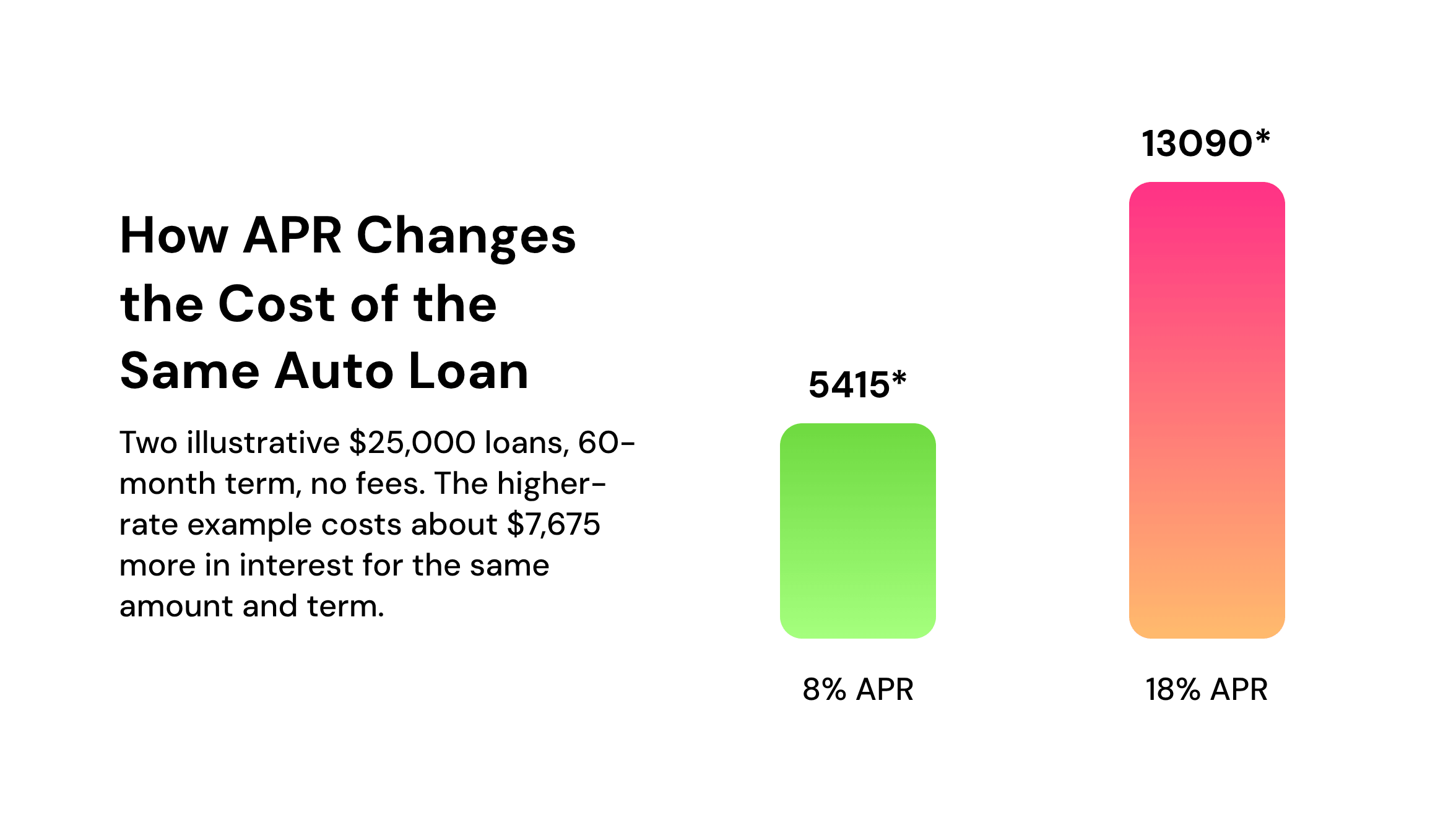
Do not compare offers by monthly payment alone. The CFPB recommends comparing the loan amount, APR and interest rate, term, and monthly payment.
Different down payment requirements
A lender may require a larger down payment, approve a smaller loan, or limit which vehicles qualify. A down payment reduces the amount financed and the loan-to-value ratio. The CFPB notes that a larger down payment may also reduce the rate, although the effect depends on the lender and application.
Do not empty your emergency savings solely to reach a down payment target. Consider what cash you will still need for registration, insurance, fuel, maintenance, and repairs.
Longer or shorter loan terms
There is no standard subprime loan term. A lender may offer several options, and a dealer may emphasize a longer term because it lowers the monthly payment. However, a longer term generally increases total interest and leaves more time for the vehicle to lose value while you still owe a large balance.
Dealer-arranged financing
Dealer financing may be convenient, but the dealer’s contract rate can be higher than the rate quoted to the dealer by a lender. The CFPB explains that dealers may increase the rate to compensate themselves for arranging the financing.
Try to obtain financing offers from a bank, credit union, or other lender before visiting the dealership. A separate offer gives you a benchmark for comparing the dealer’s terms.
What are the risks of a subprime auto loan?
Subprime financing is not automatically harmful, but unfavorable terms can make the vehicle more expensive and the loan harder to manage.
Paying substantially more over time
A higher rate or longer term can add thousands of dollars to the total cost. Always review the finance charge and total of payments in the contract, not just whether the monthly payment fits your immediate budget.
Negative equity
Negative equity means owing more on the loan than the vehicle is worth. Longer terms, small down payments, financed add-ons, and debt rolled in from a trade-in can increase this risk. If you trade the vehicle while you have negative equity, that unpaid amount may be added to the next loan, making the new loan larger and more expensive.
Financed add-ons
Products such as service contracts, GAP coverage, and theft-protection products increase the amount financed when rolled into the loan. The Federal Trade Commission (FTC) advises buyers to ask for each add-on’s price and understand its limits before agreeing to it. You can decline optional add-ons.
Repossession and a remaining balance
If you default, the lender may repossess the vehicle subject to the contract and state law. Repossession does not necessarily erase the debt. If the vehicle is sold for less than the amount you owe plus permitted expenses, you may still owe the deficiency. The FTC explains vehicle repossession and deficiency balances in more detail.
Depending on a future refinance
You may be able to refinance later, but approval and savings depend on your future credit profile, income, vehicle value, remaining balance, rates, and lender requirements. Choose a loan you can afford under its current terms.
How to compare subprime auto loan offers
Use the same vehicle price, down payment, and loan term when comparing offers. Otherwise, a lower payment may simply reflect a longer repayment period or a larger amount paid upfront.
Compare:
- The vehicle’s negotiated purchase price
- Down payment and trade-in credit
- Amount financed
- APR and interest rate
- Finance charge
- Loan term
- Monthly payment
- Total of payments
- Prepayment penalty, if any
- Optional products and their individual prices
- Late fees and default terms
The CFPB recommends getting financing offers before visiting the dealer. When rate shopping requires hard inquiries, grouping your applications within a focused period may reduce the scoring impact. Scoring models treat shopping windows differently, so keeping the search short is safer than assuming every inquiry will be combined.
Read more >> How to Get an Auto Loan With Bad Credit
How to improve your financing options
If you have time before purchasing, these steps may help you present a stronger application or reduce the amount you need to borrow:
- Review your credit reports. Dispute inaccurate information with the credit bureau and the company that furnished it.
- Make every payment on time. Consistent payment history can support your credit profile over time.
- Reduce revolving balances when possible. Lower balances may reduce credit utilization.
- Avoid unnecessary new credit applications. New accounts and inquiries can affect your scores.
- Save for a down payment without draining emergency savings. Borrowing less can reduce the payment and total cost.
- Choose a less expensive vehicle. A smaller loan may be easier to qualify for and repay.
- Get several offers. Compare banks, credit unions, online lenders, and dealer financing on equivalent terms.
A co-signer may help in some cases, but that person becomes legally responsible for the debt. Missed payments can affect both borrowers, so this should be a carefully considered agreement rather than a quick solution.
Bottom line
A subprime auto loan may help you finance a vehicle with a lower score or limited credit history, but the label matters less than the actual contract. Compare the APR, amount financed, term, add-ons, finance charge, and total of payments. If the only way the loan fits your budget is through a very long term or an expected future refinance, consider a less expensive vehicle or more time to prepare.
If adding positive payment history is part of that preparation, Kikoff’s Credit Account reports your on-time payments to all three major credit bureaus, with no hard credit check to sign up. It can help you add positive payment history, but auto-loan approval and terms remain subject to the lender’s requirements.
Frequently Asked Questions
Article Sources
Disclaimer: The information provided in this blog post is meant for informational purposes only and does not constitute financial advice.