.jpg)
.jpg)



If you are considering refinancing your mortgage, closing costs can make an otherwise attractive offer difficult to afford. A no-cost closing refinance can reduce the amount you pay upfront, but it does not eliminate those costs.
Instead, the lender generally provides a credit in exchange for a higher interest rate, or the costs are added to your new loan balance when the loan terms allow it. Either option can preserve cash at closing, but it may increase what you pay over time.
A no-cost structure can be used with a rate-and-term refinance or, in some cases, a cash-out refinance. The term describes how the closing costs are paid, not why you are refinancing.
Refinance closing costs commonly range from 3% to 6% of the loan principal, although the amount depends on the loan, lender, property, and location. On a $300,000 loan, that would be approximately $9,000 to $18,000.
“No cost” may not mean zero cash to close: Prepaid interest, property taxes, homeowners insurance, initial escrow deposits, and payoff adjustments may still affect the amount due at closing.
Read more >> What Is a Cash-Out Refinance?
How a no-cost refinance works
Lenders generally structure a no-cost closing refinance in one of two ways.
Receive a lender credit for a higher rate
The lender may offer a credit that covers some or all of your closing costs in exchange for a higher mortgage rate. The credit reduces what you need to pay upfront, but the higher rate applies to the entire loan balance.
That can make the loan more expensive the longer you keep it. Before accepting a lender credit, compare the higher-rate offer with a lower-rate option that requires more money at closing.
Add the costs to your new loan balance
Some lenders may let you finance the closing costs by adding them to your new principal balance. This depends on the loan program, your available equity, and the lender’s underwriting requirements.
For example, suppose you refinance a $300,000 balance and finance $10,000 in closing costs. Your new balance would begin at approximately $310,000 before accounting for cash out, payoff adjustments, or other amounts.
This option avoids a large upfront expense, but you are borrowing more and may pay interest on the added costs. The larger balance can also affect your loan-to-value ratio and mortgage insurance requirements.
You may be able to make additional principal payments later, but check whether the loan has a prepayment penalty and make sure extra payments are applied to principal.
What refinance closing costs may include
A refinance creates a new mortgage, so many of the costs are similar to those charged when buying a home. Depending on the loan, you may see:
- Loan origination or underwriting fees
- Appraisal fees
- Credit report fees
- Title search and title insurance charges
- Recording fees
- Settlement or attorney fees
- Government and local charges
- Mortgage insurance costs, when applicable
Prepaid interest, property taxes, homeowners insurance, and escrow deposits may also appear in your closing paperwork. These amounts are not always treated as lender fees, so a lender credit may not cover them.
Review the Loan Estimate to see the projected loan costs, lender credits, monthly payment, and cash needed at closing. Before signing, compare it with the Closing Disclosure and ask about any material changes.
Read more >> How Soon Can You Refinance Your House?
How to compare no-cost refinance offers
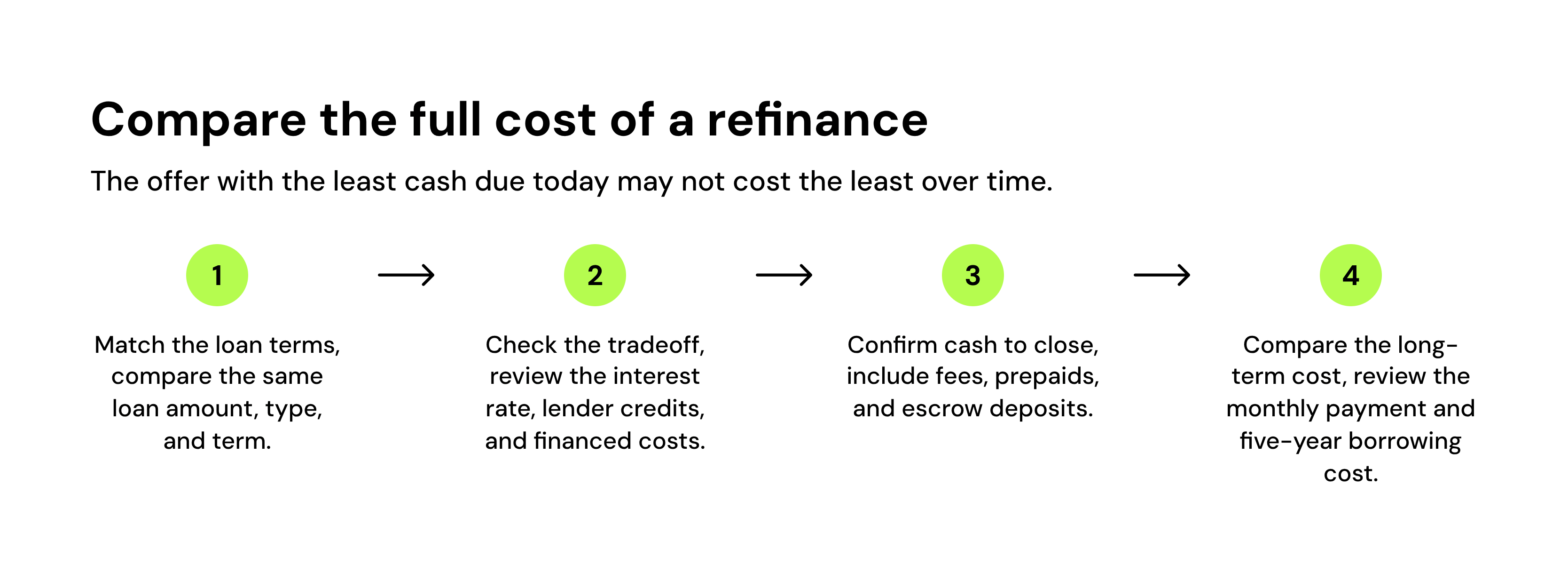
The lowest amount due at closing is not necessarily the least expensive offer. Request Loan Estimates from multiple lenders for the same loan type, amount, and term so you can make a fair comparison.
The Consumer Financial Protection Bureau recommends comparing details such as:
- New loan amount
- Interest rate and whether it can change
- Monthly principal and interest payment
- Mortgage insurance
- Total estimated monthly payment
- Upfront loan costs
- Lender credits
- Cash to close
- Estimated borrowing cost over five years
The annual percentage rate can also help you compare certain borrowing costs, but it should not be the only number you consider. A refinance can lower your monthly payment while increasing total interest if it restarts repayment over a longer term.
If one offer requires upfront closing costs and another uses a higher rate, calculate how long it would take the monthly savings from the lower-rate loan to recover its upfront cost.
For example, if the lower-rate option requires $6,000 more at closing but saves $150 per month compared with the no-cost option, the break-even period would be 40 months:
$6,000 ÷ $150 = 40 months
If you expect to keep the loan longer than that, the lower-rate option may cost less. If you expect to sell or refinance sooner, the no-cost option may be more practical. This is a simplified example, so compare the complete Loan Estimates before deciding.
When a no-cost closing refinance may make sense
A no-cost refinance may be worth considering if:
- Paying closing costs would significantly reduce your emergency savings
- You expect to keep the new loan for a relatively short period
- The new loan still improves your overall financial position
- You understand how the lender will recover the costs
- The new payment fits comfortably within your budget
However, avoiding an upfront expense does not automatically make refinancing a good deal. Consider what you will pay over the period you expect to keep the mortgage.
When you may want to avoid one
A no-cost closing refinance may be less attractive if:
- The higher rate substantially increases your monthly or long-term costs
- Adding fees to the balance leaves you with too little equity
- You expect to keep the loan for many years
- Restarting the loan term increases your total interest expense
- The refinance provides little benefit after all costs are considered
- You still need more cash at closing than you can comfortably afford
Your home secures the new loan: Refinancing into a larger balance or less affordable payment can increase the risk of foreclosure if you later cannot make payments. If you are unsure whether an offer fits your budget, consider speaking with a HUD-approved housing counselor.
Bottom line
A no-cost closing refinance does not make closing costs disappear. It changes how you pay them, usually through a higher interest rate, a larger loan balance, or a combination of the two.
Compare offers using the same loan amount and term, review the cash-to-close figure carefully, and consider how long you expect to keep the mortgage. The best offer is the one that fits both your current cash needs and your longer-term budget.
If refinancing is a future goal, Kikoff’s Credit Account reports your on-time payments to all three credit bureaus, with no hard credit check to sign up. Credit is only one part of mortgage pricing and approval, so also review your income, debts, equity, and overall budget.
Frequently Asked Questions
Article Sources
Disclaimer: The information provided in this blog post is meant for informational purposes only and does not constitute financial advice.