




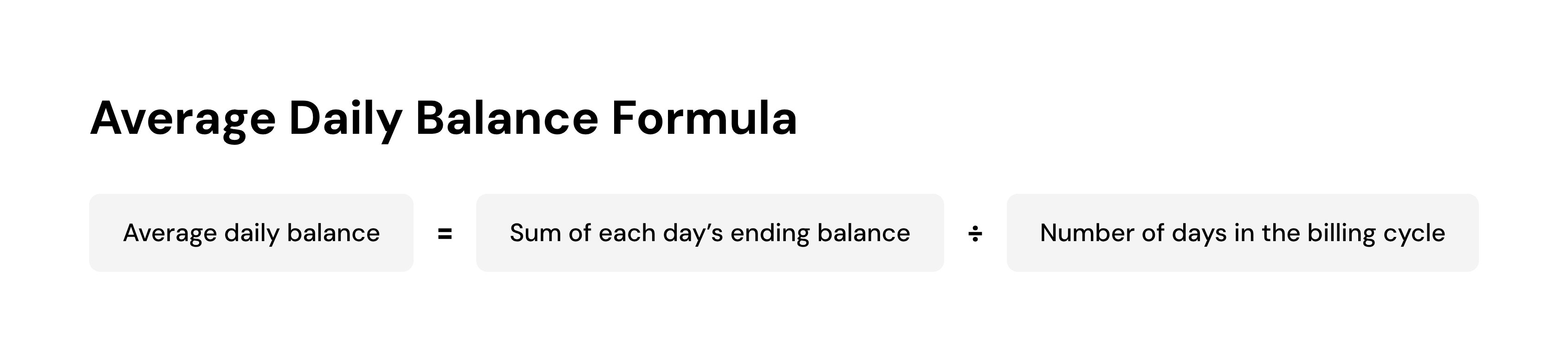
Your average daily balance is what you owed on your credit card, on average, each day of your billing cycle. To find it, add up each day’s ending balance and divide by the number of days in the cycle.
Many card issuers calculate the interest you owe daily based on this average. It means the day you pay affects your interest charge along with the amount you pay. If you pay your full statement balance by the due date each month, you may not owe interest on purchases at all.
What is an average daily balance?
Your average daily balance is the typical amount you owed across one billing cycle, the stretch of days between one statement and the next. It’s usually about a month long.
Each day, your card company records your balance at the end of the day. That number moves up when a purchase, fee, or interest charge posts, and down when a payment or refund posts. Average those daily snapshots together, and you get one number that reflects how much you owed and for how long.
That’s why a $500 balance you carry for the whole month costs more than a $500 balance you pay off a week in.
Read more >> When Is the Best Time to Pay Your Credit Card Bill?
How to calculate average daily balance on a credit card
You’ll need your latest statement or the transaction list in your card’s app. Use the posting date for each transaction, since that’s the day it changes your balance.
Step 1: Find your daily balances
Start with the balance on the first day of the cycle, then move through your transactions in order. Each time your balance changes, write down the new balance and the number of days it stayed at that amount.
You don’t need 30 separate rows. Grouping days with the same balance into stretches gets you the same answer with less work.
Step 2: Add up all daily balances
Multiply each balance by the number of days it lasted, then add those totals together. This gives you the sum of every day’s balance in the cycle.
Step 3: Divide by the number of days in the billing cycle
Divide that sum by the number of days in the cycle. Your statement lists the cycle dates, and cycles can run a few days shorter or longer depending on the month. The result is your average daily balance.
Read more >> How to Avoid Credit Card Interest
How issuers use average daily balance to calculate interest
Once your card company has your average daily balance, the math usually looks like this:
Interest charge = average daily balance × daily periodic rate × days in the billing cycle
The daily periodic rate is your annual percentage rate (APR) broken down into a daily rate. Depending on the card company, it divides your APR by 365 or 360. A 22% APR works out to about 0.06% a day.
That 22% isn’t a random pick. Cards that charge interest average 22.36%, according to the Federal Reserve. The Fed calculates that figure by comparing total interest charges to total average daily balances, so this method shapes the national number too.
A few details can change how the formula applies to you:
- Different balances can have different rates. Purchases, cash advances, and balance transfers often carry separate APRs. Your statement has to show each category and how much of your balance falls into it.
- A grace period can take interest off the table. A grace period is the time between the end of your billing cycle and your due date. Card companies aren’t required to offer one, but most cards do for purchases. Pay your full statement balance by the due date, and you typically won’t pay interest on those purchases.
- Cash advances usually start charging right away. Grace periods generally cover purchases only, so interest on a cash advance often begins the day you take it.
Read more >> How to Manage and Pay Off Credit Card Debt
What if your math doesn’t match your statement? Small differences are normal. Many card companies add each day’s interest to the next day’s balance, which raises the total by a few cents. Your card may also use 360 days instead of 365, or calculate a separate average for each balance type. Your card agreement names the method your card uses. You can also call the number on the back of your card and ask.
Putting the formula to work
Say you start a 30-day billing cycle carrying an $800 balance on a card with a 22% APR.
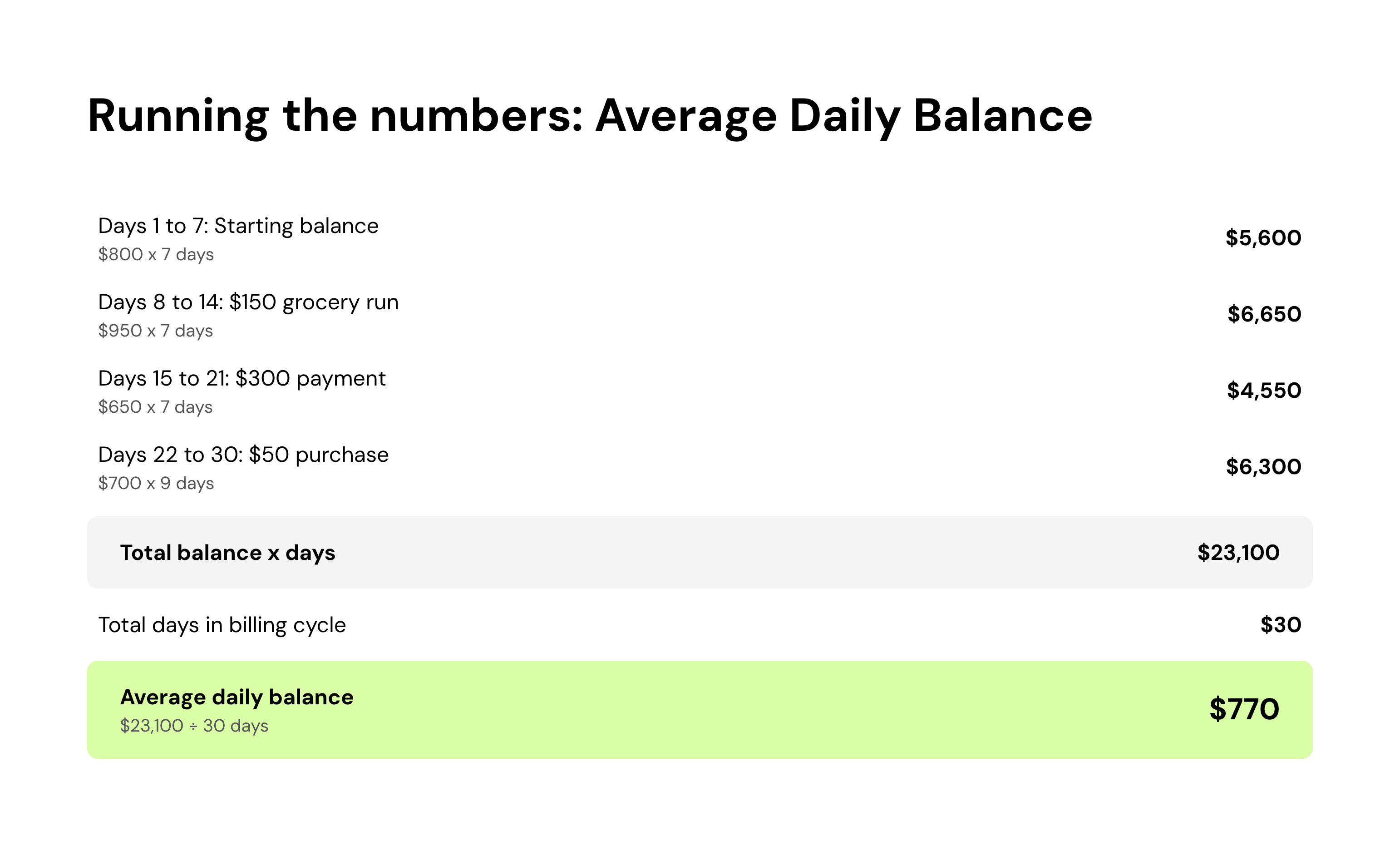
Divide $23,100 by 30 days, and your average daily balance is $770.
Now plug it into the interest formula:
$770 × (0.22 ÷ 365) × 30 = about $13.92 in interest for the month
Timing changes the result
Make that same $300 payment on day 2 instead of day 15, and your daily balances add up to $19,200. Your average daily balance drops to $640, and your interest falls to about $11.57.
That’s $2.35 saved in one month with the same payment and the same purchases. If you carry a balance month after month, those savings repeat.
Read more >> What Is a Good APR for a Credit Card?
How to lower your average daily balance
Your average daily balance responds to two things: how much you owe and how long you owe it. These steps work on both.
- Pay as early as you can. A payment lowers your balance from the day it posts. If paying the full amount at once is tough, split it: Send part when your paycheck lands and the rest before the due date. Paying early doesn’t count against you, as long as the minimum is paid by the due date.
- Pay more than the minimum when you can. When you pay more than the minimum, your card company generally must apply the extra to your highest-rate balance first, according to the CFPB. That helps the extra dollars cut the most interest.
- Hold off on new charges while you’re paying down a balance. Once you lose your grace period, new purchases usually start adding interest on the day you make them.
- Work back toward paying in full. Paying your full statement balance by the due date is how you keep your grace period. Miss it once, and you may lose the grace period for that month and the month after, so it can take a cycle or two to get it back.
Read more >> How to Negotiate Credit Card Debt With Your Creditor
If the balance keeps growing
When interest is outpacing what you can pay, paying more isn’t always the answer. A nonprofit credit counselor can look at your full financial situation and work out a debt management plan that lowers the rate. The National Foundation for Credit Counseling can connect you with free or low-cost debt counseling at 800-388-2227.
Bottom line
Your average daily balance is each day’s balance added up and divided by the days in your billing cycle. When you pay and how much you pay both shape it, and it’s the number your interest charge is built on.
The formula has one more number in it: your APR. Paying earlier lowers your balance this month, but the rate you’re offered on your next card depends partly on your credit history when you apply.
Kikoff’s Credit Account reports your on-time payments to all three credit bureaus, helping you build the credit history lenders look at when they set your rate. There’s no credit check to sign up, and plans start at $5 a month.
Frequently Asked Questions
Article Sources
Disclaimer: The information provided in this blog post is meant for informational purposes only and does not constitute financial advice.