.jpg)
.jpg)



If you’re retired and your credit needs some work, you might be unsure of how to build it. You might also wonder whether it is worth the effort.
It can be. Credit may still affect your options when you apply for a loan, rent a home, or shop for insurance in some states. Here is how to build credit during retirement without taking on more debt than you can afford.
How to build credit for retirees: an overview
Whether your credit needs major work or you simply want to keep it healthy, these strategies could help.
Keep credit accounts active
A card issuer may close an account you haven’t used, but there is no standard six- or twelve-month timeline. The issuer’s policy determines when an inactive account may be closed.
Closing a card reduces your available credit. If you carry balances on other cards, that could increase your credit utilization and affect your score. However, a closed account with positive payment history may remain on your credit reports, so closing it does not necessarily shorten your credit history right away.
If a card has no annual fee and keeping it open doesn’t tempt you to overspend, consider using it occasionally for a small purchase you can pay off. Continue checking the statements for unexpected charges.
Closing the card may still make sense if it charges an annual fee or makes it harder to control your spending. The Consumer Financial Protection Bureau explains the factors to consider before closing a credit card.
Monitor your credit
Start by reviewing your credit reports from Equifax, Experian, and TransUnion at AnnualCreditReport.com. Checking your own reports does not hurt your credit.
A credit report contains information about your accounts and payment history, but it usually does not include a credit score, according to USA.gov. If you want to track a score, check whether your bank, credit card issuer, or credit monitoring service provides one.
Review all three reports for unfamiliar accounts, incorrect balances, and payments reported late by mistake. If you find an error, the Consumer Financial Protection Bureau recommends disputing it with both the credit reporting company and the business that supplied the information.
If the problem appears to involve identity theft, report it at IdentityTheft.gov.
Watch for imposter scams: A caller may claim that your retirement savings are in danger and tell you to move the money to “protect” it. Do not transfer money in response to an unexpected call or message. Hang up and contact the company or agency using a phone number you find yourself. The Federal Trade Commission has more guidance on scams targeting older adults.
Use a credit-builder app
Credit-building products can add payment history to your credit reports, but their costs and terms vary. Before signing up, check the required payments, fees, bureau reporting, and what happens if you miss a payment.
Kikoff’s Credit Account is a free revolving line of credit used for purchases in the Kikoff Store. It charges no interest and reports your on-time payments to all three credit bureaus. There’s no hard credit check to sign up.
How credit works during retirement
Retirement itself does not affect your FICO Scores. Your age, income, occupation, and employment history are not included in the calculation, according to FICO.
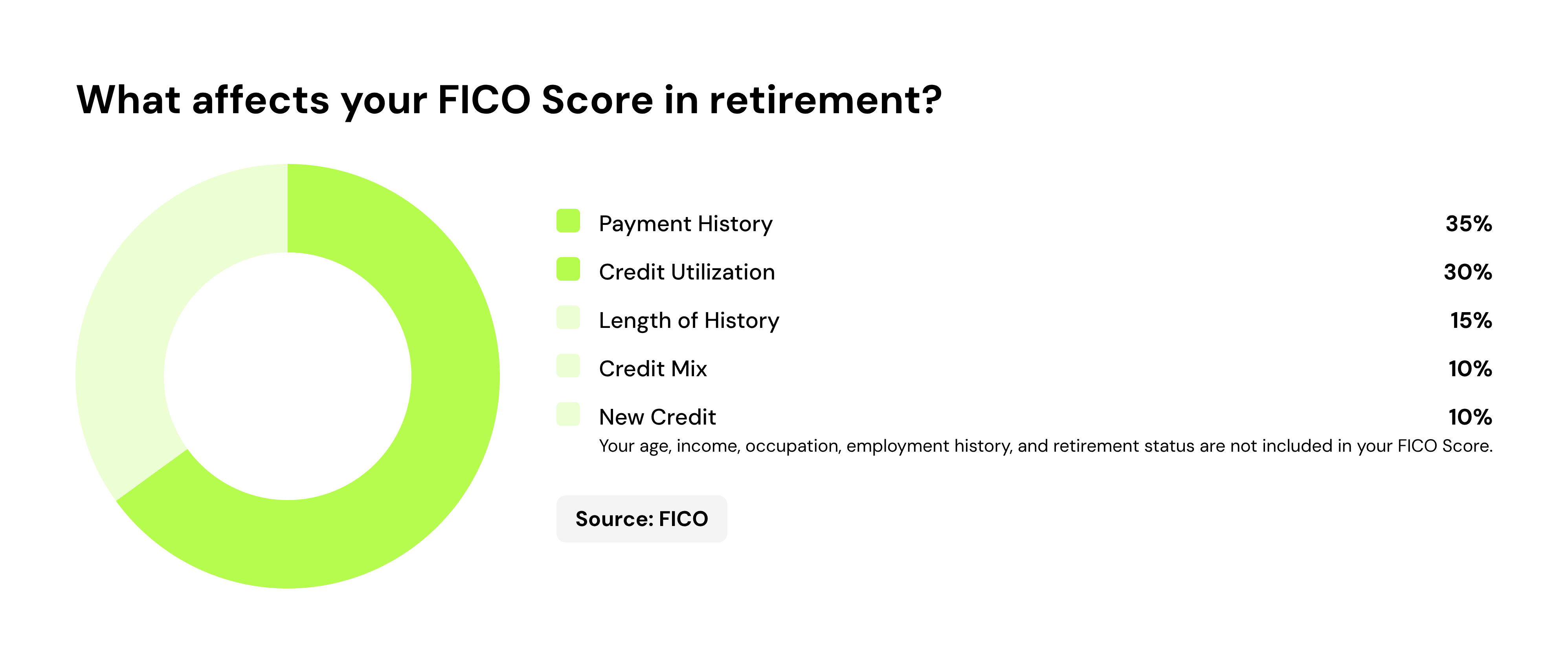
Retirement can still change the financial habits that affect your credit. For example:
- A lower income could make it harder to keep balances manageable
- Missed payments could appear on your credit reports
- An account closure could increase your credit utilization by reducing your available credit
- Fraud or identity theft could add accounts or balances you do not recognize
Lenders may consider your retirement income, existing debts, and ability to repay when you apply for new credit. That is separate from how your FICO Scores are calculated.
Credit can still matter in retirement if you apply for a loan, rent a new home, or shop for insurance in a state where credit-based insurance scoring is allowed.
Is it worth building credit as a retiree?
Even after you leave the workforce, maintaining healthy credit can give you more financial flexibility.
Potentially lower insurance premiums
In states where the practice is allowed, home and auto insurers may use a credit-based insurance score when setting premiums. This is different from the credit score a lender uses, and state laws limit or prohibit its use in some places.
Credit information is generally only one of several factors that may affect what you pay. The National Association of Insurance Commissioners explains how credit-based insurance scores work. Check with your state insurance department to learn what insurers are allowed to consider where you live.
More borrowing options
Strong credit may make it easier to qualify for a loan or credit card if you need to borrow. Approval and terms can also depend on your income, debts, and the lender’s requirements.
Credit is not a replacement for emergency savings, and borrowing can make a financial setback more expensive. Compare the interest rate, fees, monthly payment, and total repayment cost before using credit to cover an emergency.
Housing flexibility
Like many retirees, you might decide to sell your current home and downsize. If you’re renting, you might want to move somewhere quieter or closer to family.
Credit can affect your options in either situation. Mortgage lenders may consider your credit along with your income, debts, and other financial information. Landlords may review your credit reports where permitted by state and local law.
Healthy credit does not guarantee approval, but it may prevent your credit history from becoming another obstacle during a move.
Common mistakes to avoid
If you want your credit-building experience to go as smoothly as possible, watch for these common mistakes.
Freely cosigning loans
A lender may ask you to cosign for a child, grandchild, or other relative. Think carefully before agreeing. A cosigner is legally responsible for the debt. Depending on state law, the lender may be able to collect from you first.
Late or missed payments may also affect your credit. Before cosigning, ask yourself whether you could afford the full payment or remaining balance on your retirement income. Consider reviewing the agreement with a financial advisor or attorney.
Before you cosign: Helping someone qualify also means accepting responsibility for the debt. Do not sign unless you understand the payment, term, total cost, and what happens if the borrower cannot pay.
Ignoring your credit reports
If you don’t regularly check your credit reports, you may not catch errors or signs of identity theft. Review reports from all three credit bureaus because the information may not be identical across them.
Carrying high balances
Responsible credit card use can help you build credit, but high balances can work against you. There is no single 30% cutoff that makes or breaks your credit. In general, lower utilization is better.
Missing payments
Payment history is the largest category used to calculate FICO Scores. A reported late payment may remain for up to seven years, but not every missed due date is immediately reported.
The effect of a reported late payment depends on factors such as how late it is, how recently it happened, and the rest of your credit profile. If you think you may miss a payment, contact the creditor before the due date and ask whether assistance is available.
Read more >> How to lower your credit utilization
Bottom line
Retirement does not directly affect your FICO Scores, but your payment history, balances, and account activity still matter. Keep payments current, use credit cards carefully, review all three credit reports, and think seriously before cosigning for someone else.
Credit can still affect your options after you leave the workforce, including borrowing, renting, and insurance pricing where credit-based insurance scores are allowed.
Kikoff’s Credit Account reports your on-time payments to all three credit bureaus, with no hard credit check to sign up. Every month you pay on time adds to the payment history in your credit profile. Get started today.
Frequently Asked Questions
Article Sources
Disclaimer: The information provided in this blog post is meant for informational purposes only and does not constitute financial advice.