

.jpg)



Your card can cover rent and groceries, but your auto lender almost certainly won’t take it. Auto lenders generally don’t accept credit cards for monthly payments. There are workarounds, and every one of them costs extra. If you’re short this month, calling your lender costs nothing and may get you more time.
Can you use a card to pay your car loan?
Not directly. Most banks, credit unions, and auto finance companies won’t take a card through their payment portal. They want payment from a checking account or by debit card.
You can still use your available credit, though, through one of three workarounds.
Read more >> How Many Payments Can You Miss Before the Car Is Repossessed?
Ways to make a car payment with a credit card
Third-party payment services
Some payment services will charge your credit card and then send the money to your lender as a check or bank transfer. This can work even when your lender’s portal won’t take a card. You’ll pay a fee, usually a percentage of the payment. Check what it is before you pay.
Balance transfer checks
A balance transfer check works like a personal check, but it draws from your credit card’s line of credit instead of your bank account. Your lender cashes it, and the amount goes onto your card balance.
Expect a fee of 3% to 5% of the check amount. If the check doesn’t come with a promotional rate, your issuer may treat it as a cash advance, with interest from day one at a higher rate. Not many issuers offer these checks, so ask before you count on one.
Cash advance
You can withdraw cash against your card at an ATM or a bank. Some issuers also let you send a cash advance straight to a linked checking account. Then you pay your lender as usual.
Cash advances typically cost 3% to 5% of the amount or $10, whichever is higher. On a $400 car payment, that’s $12 to $20 before interest. The rate is usually higher than your purchase rate, and interest starts right away with no grace period. Most cards also set a cash advance limit lower than your overall credit limit.
Read more >> The Importance of On-Time Payments in Building Credit
When it makes sense to pay with a credit card
Putting a car payment on a card is usually a one-time bridge. It can make sense when:
- You’re short this month, and your lender can’t help. Keeping the loan current can be worth a fee. Call your lender first.
- You’re working toward a signup bonus. Compare the fee you’ll pay to the value of the bonus. A percentage-based fee often costs more than the points you’d earn on the payment itself.
- You have a 0% promotional offer on balance transfers. This is the one case where you can avoid interest for a while. You’ll still pay the transfer fee, and the regular rate applies to whatever’s left when the promotion ends.
Risks of using your card for a car loan payment
- Fees add up. Every workaround charges one, and a cash advance charges interest from day one.
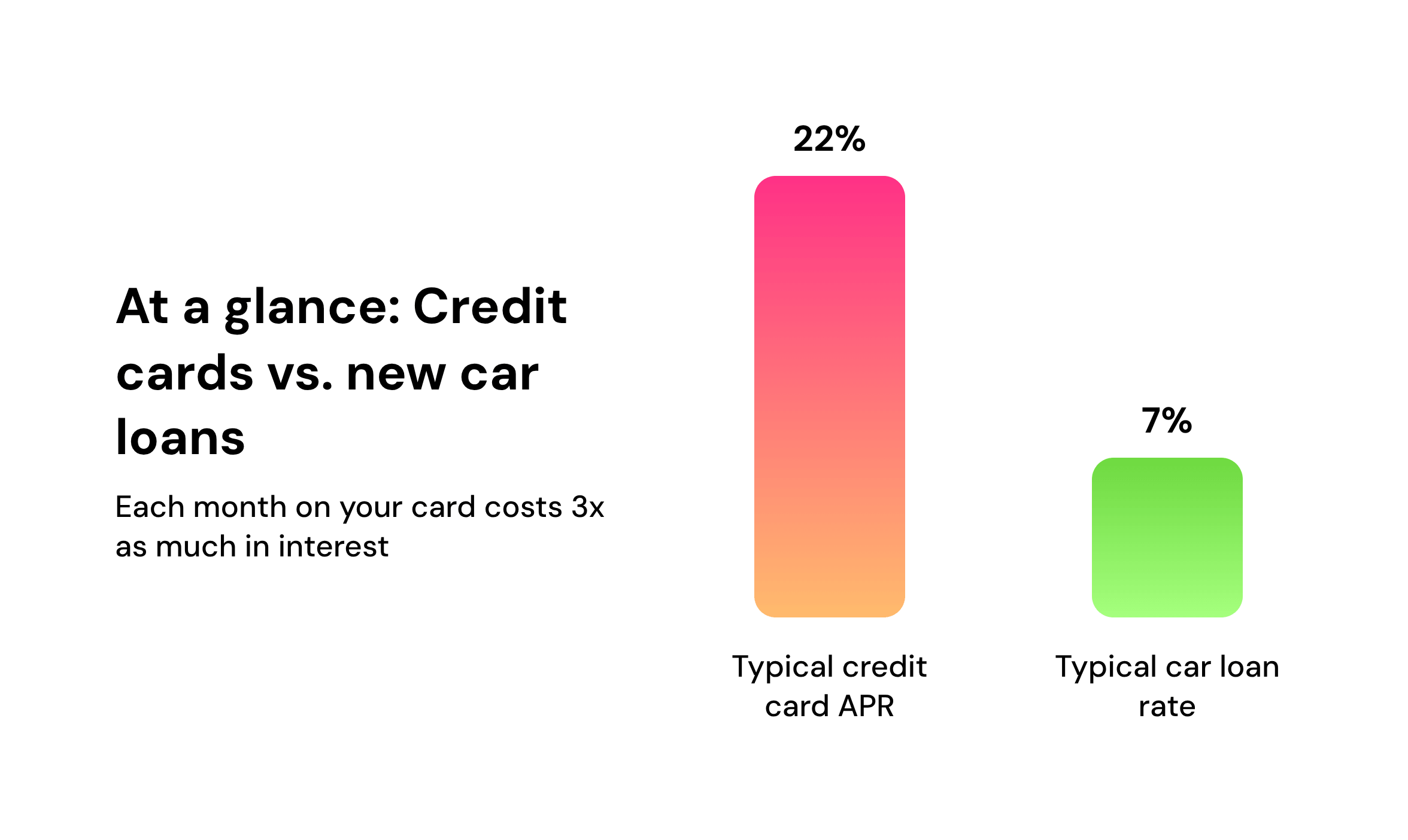
- You’re moving debt to a higher rate. Credit card accounts that pay interest average about 22%, compared with about 7% for a 60-month new car loan at commercial banks, according to the Federal Reserve. Each month you put on the card can cost you about three times as much in interest.
- Your utilization rises while the balance sits unpaid. Your credit utilization is how much of your available credit you’re using. A higher balance can lower your score while it’s on your statement, and the effect goes away once you pay it down.
If you’ve covered more than one payment this way, it can help to sort out whether the shortfall is temporary or ongoing. A temporary shortfall is a cashflow problem. If it’s ongoing, the car payment itself may need to change, and your lender is the place to start.
What happens if you miss the payment
A payment that’s a few days late usually brings a late fee. It isn’t reported to the credit bureaus until it’s at least 30 days late.
Repossession works differently. There’s no legal waiting period. Default is set by your loan contract, and in some cases a lender can repossess without warning or a court order after you’ve missed one payment. Many lenders wait longer, but it’s up to your contract.
Already missed a payment? There’s no federal waiting period before repossession. In many states a lender can take the car once you’re in default, often without notice and without going to court. Your contract decides when default starts, which can be one missed payment.
That’s worth knowing before you put a payment on a card to buy time. A nonprofit credit counselor can look at your situation for free, and a licensed attorney can tell you what applies in your state. Call the National Foundation for Credit Counseling at 800-388-2227 for free or low-cost counseling.
Alternatives to using a credit card
- Call your lender before the due date. Use the number on your statement or in your lender’s app. You lenders may offer affordable payment plans, a new due date, or a pause on payments through forbearance. Asking costs nothing.
- Look at refinancing for future months. It won’t cover this month’s payment. If your credit has improved since you bought the car, though, a new loan could lower the payment going forward. Compare the total cost, not just the monthly amount, since a longer term can mean paying more interest overall.
- Set aside a small buffer, if you can. Once you’re caught up, even part of one payment gives you room the next time a month comes up short.
Bottom line
You can get a car payment onto a credit card, but only through a workaround that adds fees, and the balance then carries a rate about three times your auto loan’s. Call your lender first to explain your situation and ask about options.
The rates you’re offered on both loans and cards depend on your credit. A Kikoff Credit Account adds on-time payments to your record at all three bureaus with no credit check. Plans start at $5 a month.
Frequently Asked Questions
Article Sources
Disclaimer: The information provided in this blog post is meant for informational purposes only and does not constitute financial advice.