.jpg)




You can get an auto loan with bad credit, but approval and good terms aren't guaranteed. A lower credit score can mean a higher APR, a smaller loan, or a bigger down payment.
The goal isn't just getting approved. It's a car and a loan you can afford once you count the down payment, interest, taxes, fees, insurance, fuel, maintenance, and repairs.
Can you get an auto loan with poor credit?
There's no industry minimum score for an auto loan. Each lender sets its own standards, considering your credit history, income, existing debts, down payment, loan amount, and the vehicle being financed.
A low credit score narrows your choices, but it doesn't mean accepting the first offer. Banks, credit unions, online lenders, finance companies, and dealerships each can look at the same application differently.
Read more >> What's the Minimum Credit Score for an Auto Loan?
How to get an auto loan with bad credit
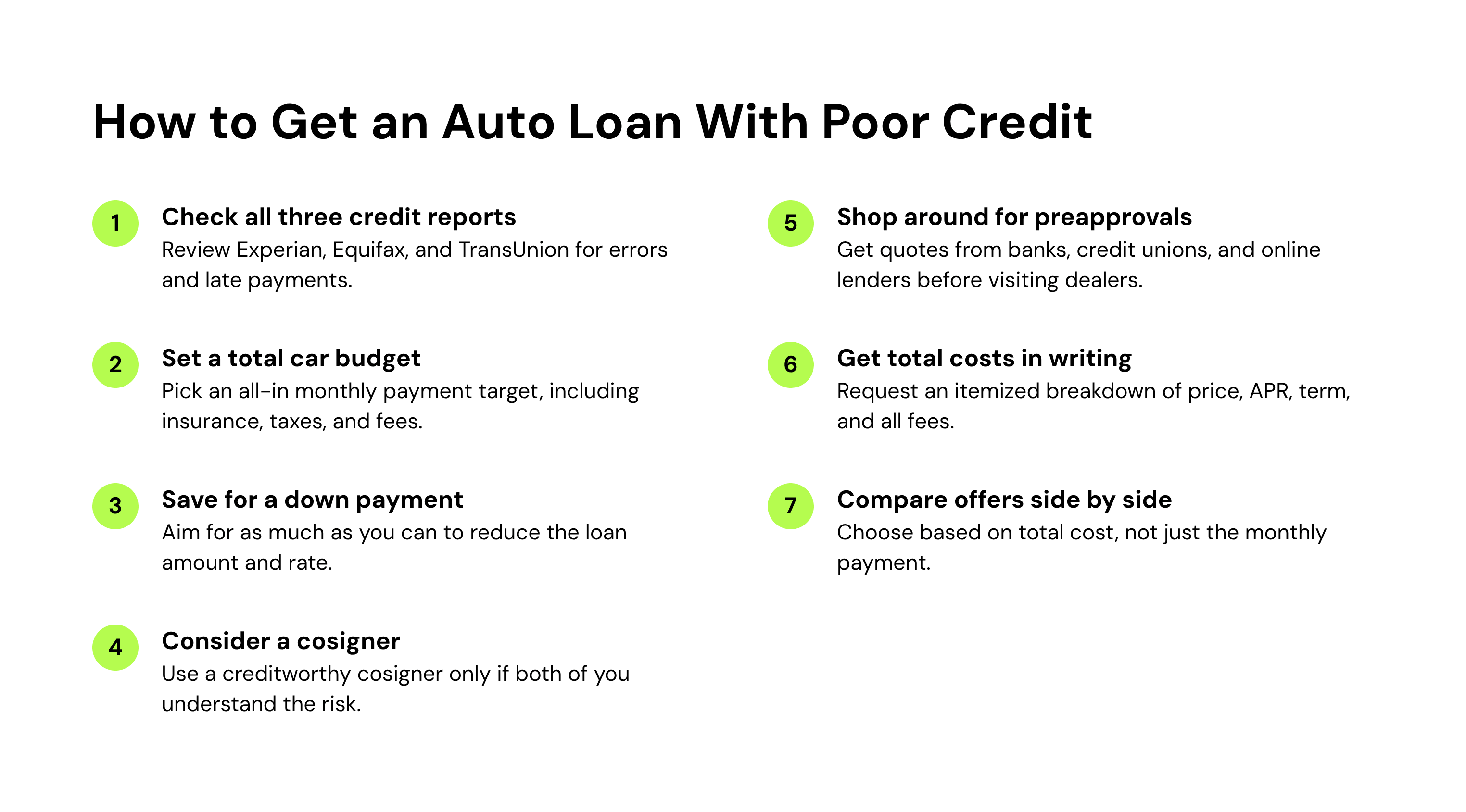
1. Review your credit reports for errors
Before setting foot on a dealership lot, get your weekly credit reports from Equifax, Experian, and TransUnion at AnnualCreditReport.com, the official site authorized by federal law to provide them for free.
Look them over carefully for anything that's factually wrong, like accounts you don't recognize, payments incorrectly marked late, paid-off balances still showing as open, or information that's not yours.
Dispute anything that's inaccurate with both the bureau and the creditor that reported it. Disputing is free, but if you'd rather not draft the letters yourself, Kikoff's AI Credit Disputes helps you prepare them, and Premium and Ultimate plans can mail them for you.
One thing worth remembering: your credit report is not your credit score. Your reports don't include a score at all. Instead, they hold the information behind your score, like open accounts, past balances, and past addresses. Not all auto lenders use the same scoring models, and so a score showing in your banking app can be different from the one a dealer uses when you apply.
2. Set a complete vehicle budget
When you've set your sights on a specific car, the dealer will start with a monthly payment. But a payment you can technically make isn't necessarily the one you can afford.
Add up every fee and upfront cost, and consider everyday costs, not just the loan:
- Insurance. Get several quotes before you buy. In most states, your credit affects the premium, so poor credit could mean paying more here too.
- Taxes, title, registration, and dealer fees. These hit at signing and can run into the thousands.
- Down payment. A bigger upfront payment lowers the amount you need to borrow, and the interest you'll pay over the life of the loan.
- Maintenance and repairs. Budget for repairs on a used car, even if it seems fine.
- Fuel or charging, parking, and tolls. Everyday costs can eat into your budget.
A longer term lowers the payment and raises the total interest. It also keeps you underwater on the loan longer, owing more than the car is worth, which matters if you need to sell it or it's totaled in an accident.
Run the numbers >> Use Kikoff's auto loan calculator to see how your down payment and loan term change what you pay.
3. Save for a down payment
A larger down payment not only lowers what you borrow, but it also makes the loan less risky for the lender. With poor credit, money down is among the few ways to offset a low score, and some lenders will approve an application they might otherwise decline.
It can protect you too: Cars lose value fast, and a low down payment can leave you "underwater" on your loan within months, leaving you owing more than the car is worth.
But don't use all of your savings. Keep cash on hand for registration, the first insurance payment, and other costs that come up in the first few months. If a repair goes on your credit card instead, you've traded a lower car payment for a higher-interest balance.
4. Consider a cosigner
A cosigner backs the loan with their own credit and income, which might turn a declined application into an approval. The lender reviews their credit file alongside yours, including debts, their payment history, and other financial obligations.
Be clear about what you're asking. Missed payments show up on their credit as well as yours, and they owe the full balance if the loan defaults. The lender can also use the same collection methods against them that it could use against you, and it doesn't have to try collecting from you first.
Before signing, walk through the payment, the term, and total costs together, and agree on what happens if you can't keep up with payments one month. After signing, give them access to the loan portal or statements from the start.
5. Shop around for preapprovals
Get preapprovals from several lenders before you walk into a dealership. A bank, a credit union, and an online lender will often quote the same borrower differently. Credit unions consistently offer lower rates on auto loans, according to the NCUA.
If you keep your rate shopping within a tight window of 14 days (or up to 45 days with newer FICO versions), the credit inquiries count as one for scoring.
You're not obligated to act on any preapprovals, but having them gives you a rate the dealer needs to beat.
6. Get the out-the-door pricing in writing
Before you visit the lot, ask each dealer to send you the total price of the car in writing, including taxes and fees. The FTC recommends getting this "out the door" pricing before you talk financing.
With that number fixed, you can compare dealers on the same terms and spot add-ons that slip into the deal. It also keeps the chat on the total cost instead of the monthly payment.
7. Compare financing offers side by side
Once the price is fixed, compare each offer at the same price and the same down payment, focusing on four main numbers:
- APR. The annual cost of the loan, including interest and some lender charges. It's the best single number for comparing lenders.
- Finance charge. This is what the loan costs you in dollars.
- Total of payments. The amount financed plus the finance charge, or what you'll pay over the life of the loan, not counting your down payment.
- Any prepayment penalty. It decides whether paying early saves you anything.
The next most important numbers are the amount you're financing, the term, the monthly payment, and any add-ons. The monthly payment is the number dealers are likely to lead with. But it's the least useful for comparing offers, because stretching the term can lower the payments.
Extended warranties, gap insurance, paint protection, and other optional products can get added at signing, and each one increases the amount you're financing. You can ask the dealer to remove what you don't want.
If the dealer beats your best preapproval, take it. If not, you already have financing.
Read more >> How to Pay Less Interest on a Car Loan
What is a subprime auto loan?
A subprime auto loan is financing for a borrower the lender considers riskier, usually because of a lower credit score or past credit problems. There's no single number to stay above, and lenders price the same score differently.
Subprime loans carry higher APRs than loans to borrowers with stronger credit. That doesn't make them the wrong choice. After all, a car you need for work is worth financing at a higher rate if the total cost fits your budget. It does make comparison offers more important: Two lenders can both call you subprime and quote rates that are wide apart.
Read more >> What Is a Subprime Auto Loan?
What is "buy here, pay here" financing?
A buy here, pay here dealership finances the car itself rather than arranging a loan through a bank, credit union, or finance company. These dealers market to people with limited or damaged credit, but their rates tend to run higher than what other lenders charge.
Credit reporting is worth understanding. The CFPB notes these dealers often report only negative information, like late payments, and not those made on time. So two years of paying on time may not help your credit, while one late payment can hurt it.
Get all of this in writing before you sign:
- The APR, term, payment, and total cost
- When payments are due
- Every fee and add-on
- Whether on-time payments are reported, and to which bureaus
- How late payments and repossession are handled and whether the lender can disable the car remotely
- Whether there's a prepayment penalty
Look specifically at how the contract defines default. In many states, a lender can repossess the car after as soon as you miss payments, often without notice and without a court order.
Read more >> Pros and Cons of Buy Here, Pay Here Dealerships
How to improve your credit before applying
If you don't need a car immediately, a few months strengthening your credit can change what you're offered.
Focus on the two biggest ways to make a difference:
- Catch up on any past-due accounts. A late payment stays on your report, but bringing the account current stops it from reaching 90 days late or being charged off.
- Pay down revolving balances. A lower balance can show up on your report within a cycle or two.
Then work on the rest:
- Make every payment, every month, by its due date
- Dispute anything inaccurate on your credit reports
- Skip credit applications you don't need
- Keep saving for the down payment and the costs that come with it
Be realistic about the timeline. Credit moves over months, not weeks, and no single step guarantees a particular rate. A better score gets you better offers, so comparison shop when you're in a position to buy.
If catching up isn't possible right now, a nonprofit credit counselor can help you decide which accounts to focus on first. The National Foundation for Credit Counseling connects people to free or low-cost counselors at 800-388-2227.
Bottom line
Getting an auto loan with poor credit is possible, but approval doesn't guarantee a good deal. Know your car budget, compare lenders, and read every fee and add-on before signing anything. The APR you're offered applies to the whole term, so better credit before you apply can lower what the car costs you.
If the car can wait, Kikoff’s Credit Account reports on-time payments to Equifax, Experian, and TransUnion before you apply. There's no credit check to sign up, and plans start at $5 a month.
Frequently Asked Questions
Article Sources
Disclaimer: The information provided in this blog post is meant for informational purposes only and does not constitute financial advice.