.jpg)
.jpg)



Refinancing a car loan replaces your current loan with a new one. It may help you lower your APR, reduce your monthly payment, remove a cosigner, or change the repayment term, but a lower payment does not always mean a lower total cost.
The right comparison is not simply your current payment versus a new payment. Compare the remaining cost of your existing loan with the APR, term, fees, and total repayment cost of each refinancing offer.
How does refinancing a car loan work?
When you refinance, the new lender pays off your existing auto loan and creates a new loan secured by the same vehicle. You then make payments under the new loan’s terms.
A refinance does not reduce the principal you already owe unless you pay part of the balance yourself. It changes how that balance is financed.
The new loan could have:
- A lower or higher APR
- A shorter or longer term
- A different monthly payment
- New fees or state title and lien charges
- Different rules for late payments, automatic payments, and early payoff
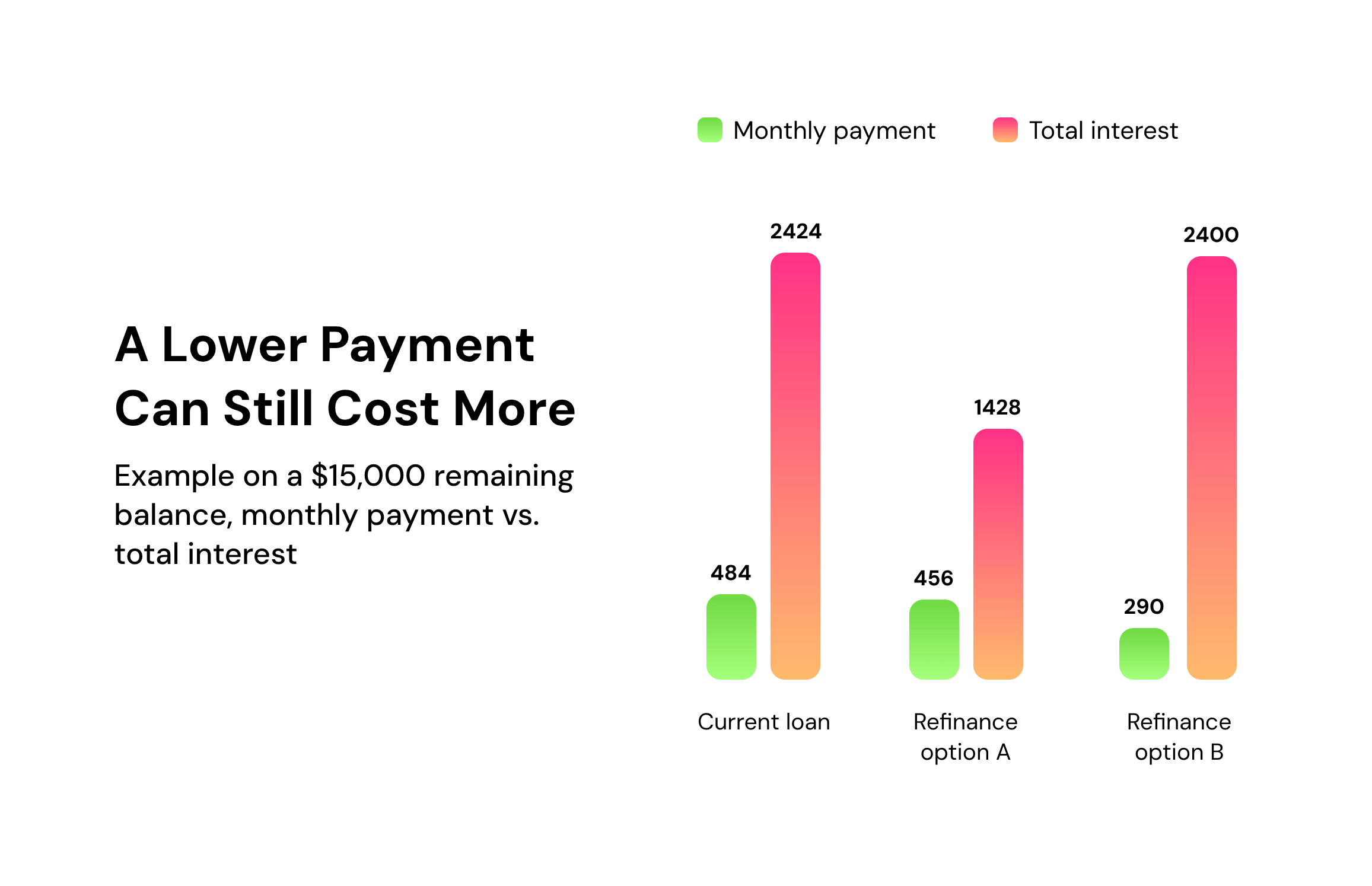
Your goal depends on your situation. You may want the lowest total borrowing cost, a more manageable payment, a shorter payoff schedule, or the removal of a cosigner. One offer may not accomplish all of these goals at once.
A longer term can reduce your monthly payment while increasing the total interest you pay. Always compare the full remaining cost, not just the payment.
How to refinance a car loan
1. Review your current loan
Start with your current contract and a payoff quote from your lender or servicer. Record:
- The payoff amount
- The APR
- The monthly payment
- The number of payments remaining
- Any prepayment penalty
- Any late fees or past-due amount
- The estimated remaining interest if you keep the loan
The payoff amount may differ from the balance on your latest statement because of accrued interest, fees, or the date through which the quote is valid.
Check your contract before refinancing. The CFPB explains that auto-loan prepayment penalties depend on the contract and state law. A penalty could reduce or eliminate the financial benefit of replacing the loan.
2. Check your credit reports
Review your credit reports for inaccurate information before applying. You can request free reports from Equifax, Experian, and TransUnion through AnnualCreditReport.com.
Dispute information only when it is inaccurate or incomplete. Correcting an error may change the information lenders evaluate, but it does not ensure a particular score, approval decision, or interest rate.
There is no specific score improvement required before refinancing. Lenders may also consider your income, debts, requested loan amount and term, the vehicle, and how the payoff balance compares with the vehicle’s value. The CFPB describes the factors auto lenders commonly consider.
3. Check the vehicle and loan eligibility requirements
Refinance lenders set their own rules. Before applying, ask about requirements involving:
- Vehicle age and mileage
- Minimum or maximum loan balance
- Vehicle make, model, title status, and condition
- The vehicle’s value compared with the payoff amount
- How recently the original loan was opened
- Where the vehicle is registered
- Whether the current lender is eligible for payoff
If you owe more than the vehicle is worth, you have negative equity. Some lenders will not refinance an upside-down loan, while others may require you to pay down part of the balance first.
4. Compare offers from several lenders
Check banks, credit unions, online lenders, and your current lender or servicer. Ask each lender whether checking a rate or requesting prequalification requires a soft inquiry or a hard inquiry. Do not assume that every prequalification process uses a soft inquiry.
When comparing offers, look at:
- APR
- Interest rate
- Amount financed
- Loan term
- Monthly payment
- Origination, title, lien, and other fees
- Prepayment penalties
- Total of payments
- Whether optional products are included
The CFPB recommends comparing the amount financed, APR, interest rate, term, and monthly payment. Compare each offer with the remaining cost of your existing loan, not with the loan’s original amount or original total interest.
Try to complete applications within a focused period. Depending on the scoring model, auto-loan inquiries made within a shopping window are generally treated as one inquiry. The CFPB recommends limiting auto-loan shopping to 14 to 45 days.
5. Apply for the offer that fits your goal
A lender may request:
- Government-issued identification
- Proof of income and residence
- Vehicle registration and insurance
- The vehicle identification number
- Current mileage
- Current loan and payoff information
- Permission to review your credit
Prequalification is not final approval. The lender may offer different terms after verifying your credit, income, vehicle, and payoff information. Review the final disclosures before signing and make sure the APR, term, amount financed, fees, payment, and total cost match what you expected.
6. Confirm that the old loan is paid off
The new lender will commonly send the payoff directly to your existing lender or servicer. Continue monitoring the old account until the payoff posts and the balance reaches zero.
Do not cancel automatic payments on the old loan until you confirm how the payoff is being handled and whether another scheduled payment is due. Ask how any overpayment will be refunded and confirm that the title or lien record is updated.
Then verify the first due date and payment instructions for the new loan.
Read more >> What Is the Minimum Credit Score for an Auto Loan?
When does refinancing a car loan make sense?
Refinancing may be worth considering in the following situations.
You qualify for a meaningfully lower APR
A lower APR can reduce interest costs, especially when you still have a substantial balance and several years remaining. Compare the dollar cost of the remaining payments under both loans after including refinance-related fees.
Your credit profile or finances have changed
Stronger credit, higher income, lower debts, or a smaller loan balance may help you qualify for different terms. There is no score increase that automatically produces a better offer, so compare actual lender disclosures.
Market rates have declined
A lender may offer a lower rate when current market conditions are more favorable than when you obtained the original loan. Your personal rate will still depend on the lender’s underwriting and your application.
You need to remove a cosigner
First ask whether your current lender offers cosigner release and what requirements apply. If release is unavailable, refinancing in your name alone may remove the cosigner because the original loan is paid off.
You must qualify for the new loan without relying on the cosigner’s credit or income. Removing someone from the vehicle title does not, by itself, remove that person from the loan.
You need a lower required payment
Extending the term may reduce the monthly payment and provide short-term budget relief. However, it can also increase total interest and keep the vehicle encumbered by the loan longer.
If payment relief is the goal, compare the refinance with hardship options from your current servicer before deciding.
When might refinancing not be worth it?
Refinancing may provide little benefit when:
- The new APR is not meaningfully lower.
- Fees or a prepayment penalty offset the interest savings.
- You are close to paying off the existing loan.
- A longer term lowers the payment but raises the total remaining cost.
- The vehicle does not meet lender age, mileage, value, or title requirements.
- You owe more than the vehicle is worth and cannot cover the difference a lender requires.
- You expect to sell or trade the vehicle soon.
- The final offer is less favorable than the preliminary quote.
Do not refinance solely because the advertised monthly payment is smaller. A fair comparison uses the same payoff balance and accounts for every remaining payment and fee.
Read more >> How to Get an Auto Loan With Bad Credit
How does refinancing a car loan affect your credit?
Applying for refinancing may result in a hard inquiry. Opening the new loan also adds a new account, while the original loan is reported as paid and closed. These changes can affect credit scores, but the direction and size of the effect depend on the scoring model and the rest of your credit profile.
There is no reliable rule that a refinance will reduce a score by fewer than five points. Keeping your applications within a focused auto-loan shopping window may reduce the effect of multiple inquiries.
After refinancing, make every payment by the due date. Late or missed payments can negatively affect your credit, while on-time payments add positive payment history if the lender reports them.
What if you are already struggling with the payment?
Contact your lender or servicer as soon as you think you may miss a payment. Depending on the company and your circumstances, possible options may include changing the due date, arranging a payment plan, receiving a temporary extension, or refinancing.
Ask how any accommodation will affect interest, the loan term, fees, and credit reporting. Get the agreement in writing before relying on it. The CFPB warns that extensions and longer terms can lower immediate payments while increasing the interest paid over time.
Read more >> Does Car Loan Forbearance Hurt Your Credit Score?
Bottom line
Refinancing a car loan can make sense when the new loan improves the outcome that matters to you without creating a larger long-term cost. Compare the payoff amount, APR, term, payment, fees, and total of payments with what remains on your current loan.
Do not rely on a score threshold, a preliminary quote, or a smaller monthly payment alone. Confirm the final terms, understand how the old loan will be paid, and keep monitoring both accounts until the payoff is complete.
Your credit history can influence the terms an auto lender offers, but building credit does not ensure refinancing approval or a lower rate. If adding positive payment history is part of your longer-term plan, Kikoff offers credit-building plans that report account activity to Equifax, Experian, and TransUnion. Signing up does not require a credit check, but approval and identity verification requirements apply, and late or missed payments can negatively affect your credit.
Frequently Asked Questions
Article Sources
Disclaimer: The information provided in this blog post is meant for informational purposes only and does not constitute financial advice.