



If you’re one of the millions of people in the United States with student loan debt, reducing your interest charges can make your monthly payments more manageable, and free up space in your budget. Alternatives for lowering your student loan interest rate vary based on the type of loans you have, your credit history and your financial health. If you’re looking for payment relief, here are some options to consider.
Ways to lower your student loan interest rate
Even a small reduction in your rate can make it easier to repay what you owe. These strategies can help ease your financial burden while you work to pay off your student loans.
Refinance your student loans
Refinancing private student loans when you can get a lower rate generally makes sense if you don’t extend your loan term, but refinancing a federal student loan may not. Because you must refinance federal student loans with a private lender, you’ll need to weigh the potential cost-savings of a lower interest rate against the risk of giving up certain benefits, such as income-based repayment plans, student loan forgiveness and hardship assistance.
Before applying to refinance, consider prequalifying with several different lenders to see the estimated rate and loan terms you’re likely to qualify for. Prequalification typically uses a soft credit inquiry that won’t affect your credit scores, making it helpful for comparing loan offers. But it doesn’t guarantee you’ll be approved if you choose to apply.
Sign up for autopay
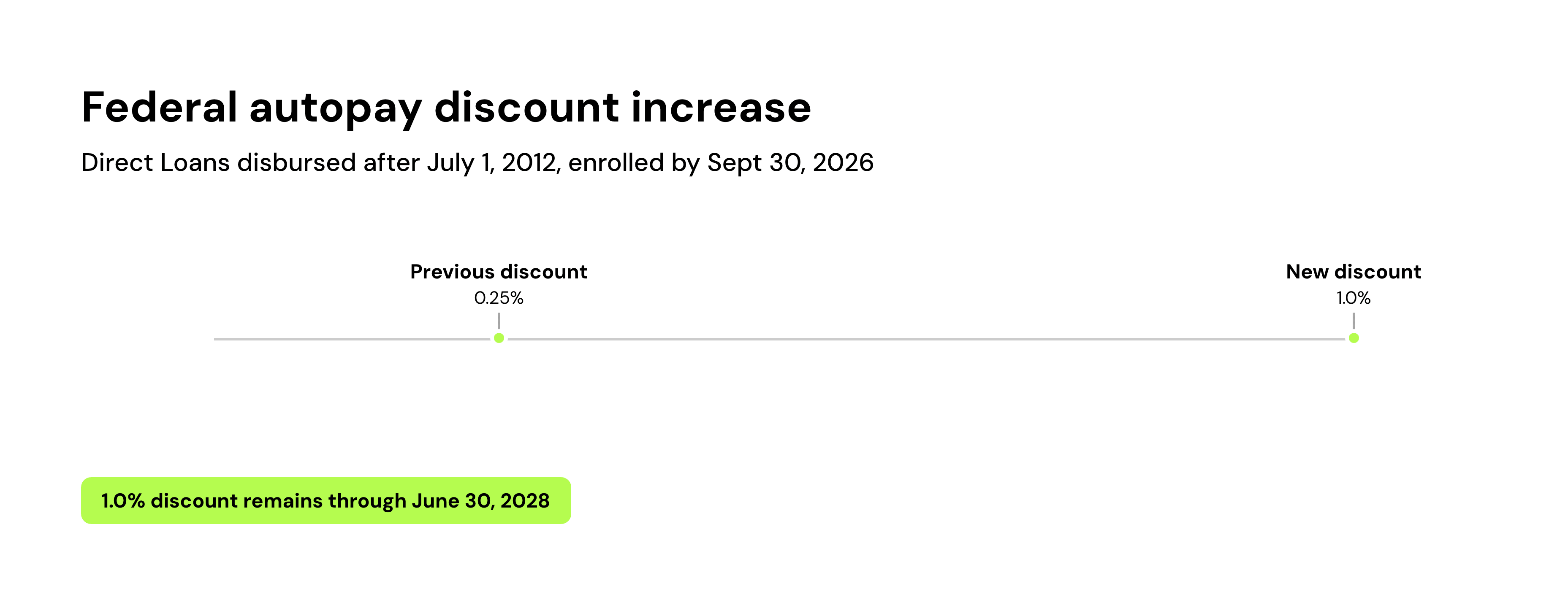
Federal and private student loan lenders often offer an interest rate discount when you sign up for automatic payments. The federal government recently increased the autopay discount on Direct Loans disbursed after July 1, 2012 from 0.25% to 1.0% for borrowers who are enrolled in autopay by September 30, 2026. The 1.0% discount is scheduled to remain in effect through June 30, 2028.
If you have a private student loan, check with your lender about potential autopay discount opportunities.
Apply for an interest rate reduction from your servicer
Interest rate reductions aren’t available on federal student loans, but if you have a private student loan, you may be able to negotiate a lower rate. Rate reductions are rare, and you typically need to be experiencing significant financial hardship to qualify for one. Even then, your lender may not offer you a lower interest rate.
Improve your credit before refinancing

Lenders use credit scores to help determine whether you qualify for a loan and the interest you’ll receive if your application is approved. Taking steps to improve your credit before you apply to refinance may help you get a lower rate. Here are some tips for building a positive credit history.
- Make on-time payments consistently. Your payment history is the most important factor in credit score calculations. If you have accounts that are past due, get them current as soon as possible, and make all your payments on time going forward.
- Pay down existing debt. Decreasing the total amount you owe typically increases your chances of being approved for a loan.
- Dispute credit reporting errors. If you have inaccurate information on your credit report, your scores could be negatively affected by things you didn’t do. Resolve errors before applying to refinance so your credit history is accurate when lenders review it. Kikoff disputes credit reporting errors for free.
Consider federal loan consolidation
Combining your federal student loans into a single loan simplifies your monthly payments. If you have variable rate loans, it also allows you to convert your variable rate to a fixed rate for predictable monthly payments. The interest rate on your new loan is the weighted average of the loans you’re consolidating.
Look into employer student loan benefits
Under federal law, employers may contribute up to $5,250 in tax-free educational benefits per employee each year. Employees may use the money for various education-related expenses including student loan repayment. If you qualify for educational benefits through your employer, you may apply the funds to the principal and interest charges on your student loans.
The bottom line
If you’re a student loan borrower facing high interest rates, there are several ways you may be able to find relief. Your available options depend on the type of loan you have, your credit profile and your current employer. You may even be able to take advantage of multiple relief options if you’re eligible.
If you’re planning to refinance, establishing a positive payment history now may improve your chances of being approved and qualifying for a lower rate.
Kikoff’s free credit account reports your on-time payments to the three major credit bureaus and can help you build credit before you apply.
Frequently Asked Questions
About the editor

Article Sources
Disclaimer: The information provided in this blog post is meant for informational purposes only and does not constitute financial advice.