.jpg)




Most loans that don’t require a bank account cost far more than ones that do. Payday and car title loans can carry APRs of 300% to 400%, and many have to be repaid in a few weeks. Before you take one, it’s worth knowing the cheaper options, including how to open an account if you’ve been turned down before.
Lenders that don’t require a bank account usually make subprime loans, meaning loans aimed at borrowers who don’t qualify for traditional credit. They make up for that risk with high fees and interest rates. If you need money now, read the full terms before you sign. In particular, look at whether the loan can be “rolled over” into a new one, and what each rollover costs.
Types of loans you can get without a bank account
Payday loans
Payday loans are short-term loans that are usually due in two to four weeks, often on your next payday. Many payday lenders require a bank account, but some will load the money onto a prepaid card instead.
These loans are among the most expensive ways to borrow. A typical two-week payday loan charging $15 for every $100 borrowed comes out to an APR of almost 400%, according to the CFPB. In states that allow higher fees, it runs well past that.
If you can’t repay the full amount on the due date, some states let the lender roll the loan over. You pay just the fee, and the loan and its costs start again.
Title loans
A title loan uses your car title as collateral. You generally need to own the car outright. If you don’t repay, the lender can take the car.
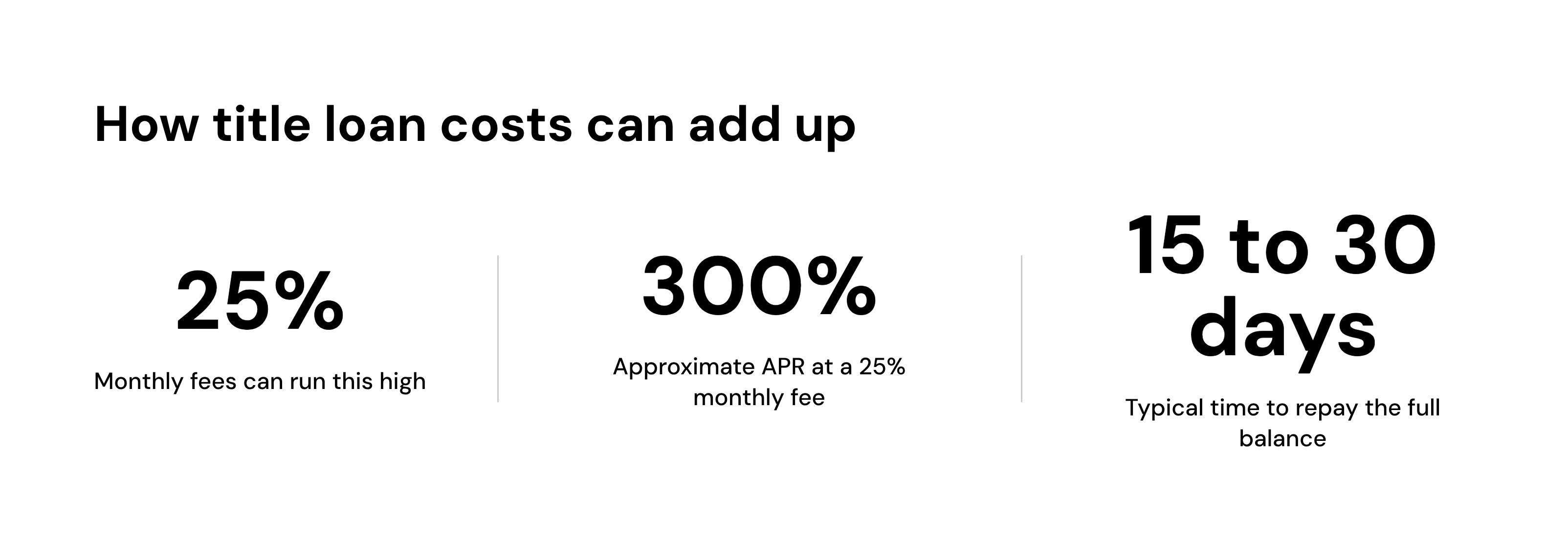
Secured loans usually cost less than unsecured ones because the lender has collateral. Title loans are the exception. Monthly fees as high as 25% work out to an APR of about 300%, and you’ll usually have 15 to 30 days to repay the whole thing at once. Most borrowers can’t. In a 2016 study, the CFPB found that more than 4 in 5 title loans were renewed the day they were due, and about 1 in 5 borrowers had their vehicles seized.
If you default on the loan, the lender can repossess and sell your car. Depending on your state, the lender may not have to give you the difference between the sale price and what you owed.
Pawnshop loans
A pawn loan is a small loan backed by something you own, like jewelry or electronics. The pawnshop appraises the item and lends you a portion of its value.
Pawn loan terms are set by state law and typically run a few months. If you don’t repay, the shop keeps the item and sells it. Pawn loans are typically non-recourse, meaning the lender’s only remedy is keeping what you pawned. You lose the item, but you owe nothing more and nothing goes to collections.
In-app borrowing
Some fintech apps offer small advances or loans and send the money to your balance in the app. Read the requirements first: many of these apps require a linked bank account. Also check the costs, which can include a monthly subscription, a fee for instant transfers, or a requested “tip.”
Payday alternative loans from credit unions
Federal credit unions can offer payday alternative loans (PALs) of up to $2,000, repaid over one to 12 months, and some PALs are available as soon as you join. Interest is capped at 28% APR. Joining a credit union also gets you an account, which the next section covers.
Installment loans from storefront lenders
Some storefront lenders will lend based on proof of income and let you repay in cash installments. Depending on your state’s rules, rates can still be very high. Before you borrow, look up the lender’s license with your state’s financial regulator or on NMLS Consumer Access.
Read more >> How to Get an Emergency Loan With Bad Credit
If you’re weighing a loan against bills you can’t cover, a nonprofit credit counselor can go through the numbers with you for free or at low cost and point you to other options. The National Foundation for Credit Counseling can connect you at 800-388-2227. Or dial 211 for local rent, utility, and food assistance.
How to open a bank account if you’ve been denied before
Most bank account denials come from a checking account report, most often from ChexSystems. It works like a credit report for your banking history.
A bank can turn you down for:
- An unpaid overdraft balance at another bank
- An account a bank closed involuntarily
- A history of bounced checks
- Suspected fraud
Start by seeing what’s on your report. ChexSystems gives you a free report at least once every 12 months, and you can get another free copy if a bank denies you based on it. If something is wrong, dispute it. Reporting companies must investigate disputes of inaccurate information. Most negative information can’t be reported after seven years, and some checking account reporting companies ignore anything older than five. If the record is accurate, paying off an old balance may help a bank approve you.
Bank On certified accounts
Bank On certified accounts are low-cost accounts that meet national standards, with no overdraft fees, a monthly fee of $10 or less, and $25 or less to open. Banks offering them can deny new customers only for past fraud, not for an old overdraft or bounced check. Find a Bank On account in your state.
Second-chance checking accounts
Some banks and credit unions offer second-chance accounts for people who’ve been denied because of their banking history. They may come with a monthly fee or limits, and in some cases you can switch to a regular account after a few months to a year.
Smaller banks and credit unions
Each bank or credit union sets its own approval rules, and some are more flexible than others. Smaller institutions may be willing to hear your explanation.
Prepaid debit cards
While you look for an account, a prepaid debit card lets you get paid, make purchases, and withdraw cash at ATMs. Compare fees before you pick one. Some charge monthly, reload, or ATM fees that add up.
Read more >> Do You Need a Credit Score to Open a Bank Account?
Once you have an account, your rent can start counting. Paying rent from a bank account creates a record. But a record isn’t the same as a credit history. Most landlords don’t report to the bureaus, so years of on-time rent leave your credit file unchanged.
Kikoff Rent Reporting sends on-time rent paid from a linked bank account to Equifax and TransUnion, which turns the biggest payment most renters make into credit history.
Bottom line
You can borrow without a bank account, but the options cost far more than a credit union loan, and a bank account is often within reach even after a denial.
Opening an account, even a Bank On or second-chance account, is the step that opens up everything else, including building credit. Once you have one, a Kikoff Credit Account reports your on-time payments to Equifax, Experian, and TransUnion, with no credit check to sign up. Plans start at $5 a month.
Frequently Asked Questions
Article Sources
Disclaimer: The information provided in this blog post is meant for informational purposes only and does not constitute financial advice.