.jpg)
.jpg)


A lender can consider your credit history, income, debts, and ability to repay when reviewing an application. It cannot treat you differently because of protected characteristics such as race, religion, sex, marital status, or receipt of public assistance.
That protection comes from the Equal Credit Opportunity Act and Regulation B. But what is Regulation B, and what should you expect when applying for credit?
What is Regulation B?
Regulation B is the federal rule that implements the Equal Credit Opportunity Act, commonly called ECOA. Congress enacted ECOA in 1974 to prohibit discrimination in credit transactions.
The two are closely related, but they are not the same:
- ECOA is the federal law that establishes the right to equal treatment when seeking or using credit.
- Regulation B contains the detailed rules creditors must follow to comply with that law.
Regulation B applies to more than the initial application. It covers application procedures, creditworthiness standards, approval and denial decisions, account servicing, collections, refinancing, and changes to existing accounts.
It also applies to consumer and business credit, including credit cards, mortgages, auto loans, personal loans, and business financing.
Read more >> What Is the Equal Credit Opportunity Act?
What discrimination does Regulation B prohibit?
A creditor may not discriminate against an applicant based on:
- Race
- Color
- Religion
- National origin
- Sex
- Marital status
- Age, provided the applicant can legally enter a contract
- Receipt of income from a public assistance program
- Good-faith exercise of a right under the Consumer Credit Protection Act
These protections apply to every aspect of a credit transaction, not only whether an application is approved. A lender also cannot use a protected characteristic to set less favorable terms, lower a credit limit, close an account, or treat a borrower differently during servicing or collection.
State and local laws may protect additional characteristics.
Regulation B changed in 2026: The current rule states that ECOA does not recognize disparate-impact liability. In practical terms, a difference in lending outcomes alone does not establish an ECOA violation. Creditors still may not intentionally discriminate based on a protected characteristic.
How does Regulation B protect public-assistance income?
The protected category is not every possible source of income. It specifically includes income derived from public assistance programs.
A lender cannot reject an applicant simply because some or all of their income comes from Social Security, Supplemental Security Income, or another qualifying public assistance program.
However, the lender may evaluate the amount and probable continuation of income when assessing the applicant’s ability to repay. It must evaluate the applicant’s actual circumstances rather than automatically discounting the income because of its source.
Regulation B also prevents creditors from automatically excluding income from part-time work, retirement benefits, annuities, alimony, child support, or separate maintenance when that income is relevant to the application. Creditors may still evaluate whether the income is likely to continue.
What notices must creditors provide?
Regulation B establishes deadlines and disclosure requirements after you apply for credit.
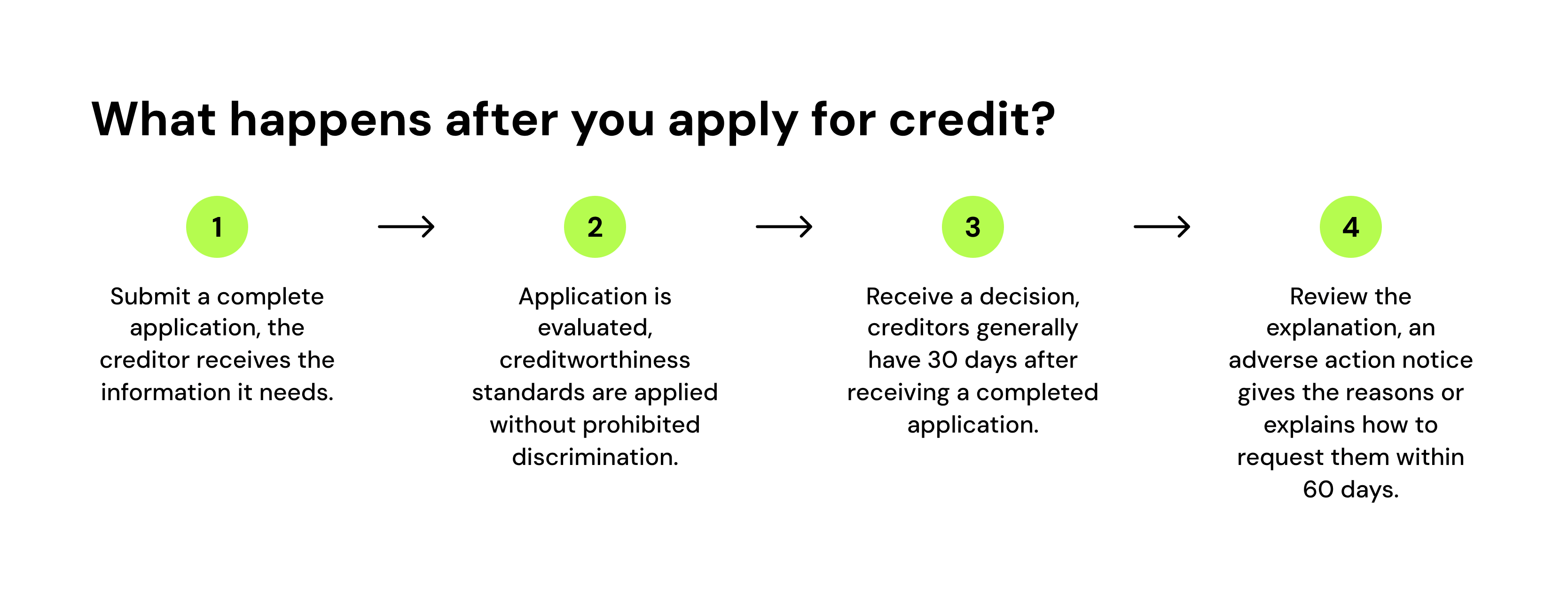
Once a creditor has a completed application, it generally must notify you of its decision within 30 days. An approval notice may be written, oral, or implied by providing the credit you requested.
If the application is incomplete, the creditor may:
- Notify you that it is incomplete
- Identify the information it still needs
- Give you a reasonable deadline to respond
- Deny the incomplete application and provide the required notice
A creditor may also make a counteroffer. For example, it might offer a $5,000 loan after you applied for $10,000. If you do not accept or use the counteroffer, the creditor generally must provide an adverse action notice within 90 days unless it already gave you a compliant combined counteroffer and adverse action notice.
What is an adverse action notice?
Adverse action can include denying an application, revoking credit, or refusing to provide substantially the amount or terms requested.
The notice must either give you the principal reasons for the decision or explain how to request them. If the notice tells you to request the reasons, you generally have 60 days to do so.
The explanation must be specific. Saying that you failed to meet the lender’s internal standards or did not receive a qualifying score is not enough. A reason such as delinquent credit obligations, insufficient income for the amount requested, or limited credit history is more useful because it identifies what affected the decision.
If the decision relied on your credit report, additional FCRA requirements apply. The notice should identify the credit bureau that supplied the report and explain your right to request a free copy within 60 days.
Read the notice before applying again: A denial does not necessarily mean discrimination occurred. The stated reasons can help you determine whether the decision was based on creditworthiness, an error in your report, or potentially unlawful treatment.
Read more >> What Is the Fair Credit Reporting Act?
What records must creditors retain?
Recordkeeping helps regulators and applicants determine how a creditor reached its decision.
For consumer credit, Regulation B generally requires creditors to retain application records for 25 months after notifying the applicant. Relevant records may include:
- The application
- Information used to evaluate it
- The notice of action taken
- The stated reasons for adverse action
- Written allegations that the creditor violated ECOA or Regulation B
The general retention period for business credit is 12 months, although different requirements apply to certain business applications. Records may need to be kept longer when an investigation, enforcement proceeding, or lawsuit is pending.
Does Regulation B provide mortgage appraisal rights?
When you apply for credit secured by a first lien on a home, the creditor generally must provide copies of appraisals and other written valuations developed for the application.
The creditor generally must provide each copy promptly after it is completed or at least three business days before closing or account opening, whichever comes first. These rights may apply even if the application is denied, withdrawn, or never reaches closing.
Reviewing the valuation can help you understand how the property was assessed and identify factual errors that may have affected the decision.
What can lenders legally consider?
Regulation B does not guarantee that an application will be approved or that every applicant will receive the same rate.
Creditors may generally consider legitimate measures of creditworthiness, including:
- Credit history
- Existing debts
- Income and its probable continuation
- Ability to repay
- Collateral
- The amount and type of credit requested
The creditor must apply its standards without intentionally discriminating on a prohibited basis.
A denial based on high balances, recent missed payments, insufficient income, or limited credit history may be lawful when the creditor applies the same standards consistently. A creditor cannot use those explanations as a cover for prohibited discrimination.
What should you do if you suspect credit discrimination?
Start by saving your application, advertisements, emails, account statements, and adverse action notice. Write down what representatives told you, including names and dates.
Then:
- Review the stated reasons. If the notice says you may request them, do so within 60 days.
- Check your credit reports. If the creditor relied on inaccurate information, dispute it with the credit bureau and the company that supplied it.
- Contact the creditor. Ask it to explain the decision or correct an error.
- Use the regulator listed on your notice. Regulation B notices identify the federal agency responsible for that creditor.
- Submit a complaint. You may report suspected discrimination to the CFPB or FTC. Your state attorney general may also be able to help.
Consider speaking with a consumer-law attorney or legal aid organization if you believe a protected characteristic affected your application, pricing, or account treatment.
A private ECOA lawsuit generally must be filed within five years of the violation. Depending on the case, available remedies may include actual damages, equitable relief, and punitive damages of up to $10,000 against a nongovernmental creditor. Costs and reasonable attorney’s fees may be available in a successful case. These outcomes are not automatic, so seek legal guidance promptly if you are considering a claim.
Bottom line
Regulation B requires creditors to evaluate applications without intentional discrimination and to explain adverse decisions. It does not require a lender to approve an application or overlook legitimate concerns about creditworthiness.
If a lender cites limited credit history or other information on your credit report, focus on the specific reason before applying again. Correct any reporting errors and work on the factors you can control.
Kikoff offers plans that report your on-time payments to all three major credit bureaus, with no hard credit check to sign up. Building credit does not guarantee approval, but a stronger payment history may give future lenders more information to evaluate.
Frequently Asked Questions
Article Sources
Disclaimer: The information provided in this blog post is meant for informational purposes only and does not constitute financial advice.